 Request information

Dr. Miriam Jimenez on How Language, Human Rights, and AI Shape the Future of Diplomacy
Faculty Spotlight: Dr. Miriam Jimenez
The rise of artificial intelligence is transforming the way scams are written, making fraudulent messages more convincing and more difficult to spot. In a recent interview with KJRH 2 News Oklahoma, Dr. Miriam Jiménez, Associate Dean of International Relations and Diplomacy at Schiller International University, discussed how AI is changing the language of deception and the linguistic patterns that can still reveal a scam.
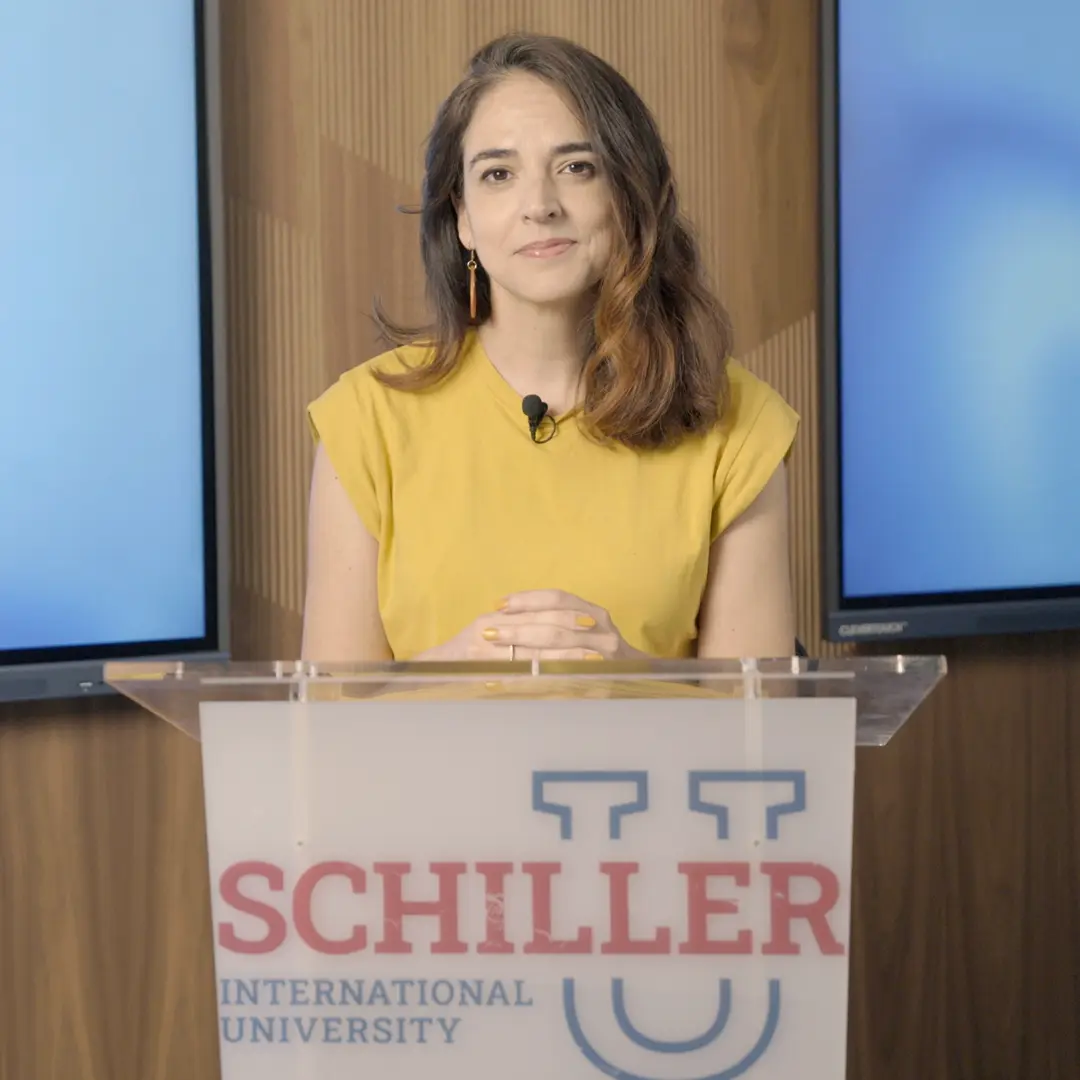 With a background spanning linguistics, communication, philosophy, and education, Dr. Jiménez brings a multidisciplinary perspective to the relationship between language and technology. Her research explores how AI can support forensic linguistics while emphasizing the importance of human expertise and critical analysis when interpreting patterns in digital communication. As she explains, a message can be grammatically flawless and professionally written while still being designed to deceive.
Her work also connects closely with her teaching and academic interests in International Relations, diplomacy, human rights, and intercultural communication. For future diplomats and international relations professionals, she sees language not simply as a communication tool, but as a fundamental part of understanding context, negotiating across differences, and building relationships.
Key Takeaways
- AI is changing how language-based deception works: AI can make fraudulent messages more polished, making context, urgency, suspicious links, and unusual requests important warning signs.
- AI should support, not replace, human linguistic expertise: AI can identify patterns across large volumes of digital communication, but those patterns still require human linguistic analysis and interpretation.
- Language and communication are fundamental to diplomacy: Effective diplomacy requires understanding context, tone, cultural expectations, implicit meanings, and different perspectives—not just knowing languages.
- Intercultural dialogue helps build effective international cooperation: Listening, empathy, cultural awareness, and understanding different perspectives are essential for constructive cooperation across cultural boundaries.
- Future professionals need critical thinking and adaptability: Students preparing for international relations careers need disciplinary knowledge alongside communication skills, critical thinking, intercultural competence, and the ability to work with complexity and uncertainty.
In this Faculty Spotlight, Dr. Miram Jiménez Bernal reflects on the growing role of AI in communication, why critical thinking is becoming increasingly important, and how language and intercultural understanding can help students navigate an increasingly complex and interconnected world.
Language, Artificial Intelligence, and Critical Thinking
In your recent interview on AI-generated scams, you explained that malicious actors often rely on recurring linguistic patterns and narratives to build trust. What are some of the warning signs people should look out for when interacting online?
One of the most important things to remember is that a message can now be grammatically perfect, professionally written, and still be fraudulent. AI has made some of the traditional warning signs much less reliable. What we should pay attention to instead is the communicative context. Messages that create artificial urgency or pressure, unexpected requests for money or sensitive information, unusual payment methods, suspicious links or domains, and sudden changes in communication channels should all raise our suspicion. Another important warning sign is language that is polished but somehow contextually odd or lacks the specificity we would expect in a genuine interaction. Ultimately, the safest approach is to slow down and verify unexpected requests through an independent communication channel, especially when money or personal information is involved.
Your latest research explores how AI can support forensic linguistics. What role do you see artificial intelligence playing in the way we analyze language and online communication in the future?
I see AI as a very powerful tool for forensic linguistics, particularly when we are dealing with large amounts of digital communication. AI can help us identify patterns in vocabulary, syntax, discourse organization, and other linguistic features that would be extremely difficult to detect manually across large datasets. At the same time, we need to be careful about how we interpret those patterns. AI-generated language does not necessarily have a stable individual “fingerprint,” and the traditional concept of linguistic fingerprinting has always been more complex than it may appear. AI should therefore support human linguistic expertise rather than replace it. Its greatest value may be in helping researchers and practitioners identify patterns and formulate questions that can then be evaluated through rigorous linguistic analysis.
Many people associate AI with technology rather than language. Why is linguistics becoming increasingly important in understanding AI-generated content, misinformation, and digital communication?
Because so much of what AI does is ultimately about communication. Large language models learn from enormous quantities of human-generated language, which means that understanding how language works is essential to understanding both their capabilities and their limitations. AI can reproduce not only grammar and vocabulary, but also stylistic, social, and pragmatic patterns. This is precisely why AI-generated messages can feel so natural and persuasive. Linguistics allows us to look beyond whether a text is grammatically correct and ask more important questions: How is meaning being constructed? What assumptions are being activated? What emotional response is being encouraged? How is trust being created? In the context of misinformation and fraud, these questions are particularly important because persuasion often depends less on individual words than on the overall narrative and communicative strategy.
As AI-generated content becomes more common, how can individuals develop the critical thinking skills needed to assess information responsibly?
The first step is to become comfortable with questioning information rather than simply accepting it because it looks or sounds credible. We need to develop the habit of asking who is communicating, why they are communicating, what they want us to do, and whether the context makes sense. We should also distinguish between the quality of the language and the credibility of the information: a well-written message is not necessarily a trustworthy one. Most importantly, we need to resist artificial urgency. Taking a moment to verify information through independent sources can make an enormous difference. In an environment where AI can produce highly convincing content, critical thinking is not about becoming an expert at detecting AI. It is about becoming more careful, contextual, and reflective consumers of information.
International Relations, Diplomacy, and Human Rights
As Associate Dean of International Relations and Diplomacy, why do you believe understanding language and communication is essential for future diplomats and international relations professionals?
International relations is, to a very large extent, about communication. Diplomats negotiate, mediate, persuade, interpret positions, manage disagreements, and build relationships across linguistic and cultural boundaries. All of these processes depend on language, but effective communication involves much more than knowing vocabulary or speaking another language. It requires understanding context, tone, cultural expectations, implicit meanings, and the perspectives of others. A diplomat may have an excellent knowledge of international law or political science, but if they cannot communicate effectively or understand how their words may be interpreted by others, their knowledge will have limited impact. For me, linguistic and intercultural competence are therefore not complementary skills in diplomacy; they are fundamental ones.
Alongside your work on language and technology, you have also researched human rights and vulnerable populations. What role do narratives and public discourse play in shaping how societies understand these issues, and how can they influence international cooperation and diplomacy?
The way we talk about people and social problems has consequences. Narratives can make certain groups visible or invisible, construct people as victims or as agents, and influence whether societies perceive an issue as a shared responsibility or as somebody else's problem. This is particularly important when we talk about vulnerable populations and human rights. Public discourse can reinforce stereotypes and divisions, but it can also create empathy, recognition, and solidarity. At the international level, the narratives we construct around conflicts, migration, inequality, or human rights violations can influence political priorities and even shape the possibilities for cooperation. This is why critical analysis of discourse is so important: before we can change policies, we often need to question the narratives through which we understand the problem itself.
Intercultural dialogue is a recurring theme in your work. Why do you believe it remains one of the foundations of effective diplomacy and international cooperation?
Because cooperation does not mean that we all have to think in the same way. In fact, meaningful cooperation begins when we recognize difference and learn how to work constructively across it. Intercultural dialogue creates spaces where people can question their own assumptions, understand other perspectives, and identify common ground without erasing differences. This is particularly important in diplomacy, where misunderstandings can have consequences far beyond an individual conversation. Effective dialogue requires listening, empathy, cultural awareness, and also the ability to tolerate uncertainty. In an increasingly interconnected world, learning how to communicate across differences is not simply desirable; it is essential.
You have written about topics ranging from human rights and armed conflict to global citizenship and intercultural education. Which global challenges do you believe require the greatest international cooperation today?
I would highlight several interconnected challenges rather than a single one. Human rights, armed conflict, climate change, technological transformation, misinformation, inequality, and the responsible development of artificial intelligence cannot be effectively addressed by countries acting independently. What makes these challenges particularly difficult is precisely their interconnected nature. Technology affects human rights; conflict affects migration; climate change can intensify inequality and instability; and misinformation can undermine democratic institutions and international cooperation. We therefore need professionals who can move beyond disciplinary and national boundaries and understand these connections. International cooperation is not only about finding agreements between governments; it is also about developing shared knowledge, common responsibilities, and the capacity to respond collectively to problems that do not stop at borders.
Challenge-Based Learning and the Future of Education
Your research and teaching place a strong emphasis on connecting theory with practice. How would you describe your teaching philosophy, and how do you help students engage with real-world challenges in the classroom?
I believe that education is most meaningful when students can understand why what they are learning matters. My teaching philosophy is therefore strongly connected to the relationship between theory and practice. I want students not only to acquire concepts, but also to use them to analyze situations, question assumptions, solve problems, and make informed decisions. This means bringing real-world examples and cases into the classroom, implementing simulations and creating opportunities for students to take an active role in their own learning. My goal is not simply for students to remember information at the end of a course, but to develop the ability to use knowledge critically and responsibly when they encounter new situations.
A recurring theme in your work is challenge-based learning. What attracted you to this methodology, and why do you believe it is so effective for today's students?
What attracted me to challenge-based learning is precisely its ability to connect academic knowledge with meaningful problems. Students today are preparing for professional and social environments that are complex, uncertain, and constantly changing. They therefore need more than the ability to reproduce information. They need to know how to analyze a problem, work collaboratively, consider different perspectives, and develop possible solutions. Challenge-based learning creates that opportunity because students become active participants in the learning process. It also makes learning more meaningful: when students understand the relevance of what they are doing and can see how knowledge can be applied to a real challenge, they are more likely to engage deeply with it.
With a Ph.D. in Philosophy and Language Sciences and a background spanning linguistics, communication, and education, how has your research shaped the way you think about teaching and learning in higher education?
My research has taught me that learning is never simply about transmitting information. Language, communication, context, and the way knowledge is constructed all influence how people understand and interpret the world. That perspective has made me increasingly interested in helping students become critical thinkers rather than passive recipients of information. It has also reinforced my belief in interdisciplinary approaches. Many of the problems students will encounter in their professional lives do not belong neatly to a single discipline, so education should give them the tools to make connections between different forms of knowledge. For me, teaching and research are therefore closely connected: research constantly challenges us to ask better questions, and teaching gives us the opportunity to help students develop the ability to ask those questions themselves.
You have published extensively on educational innovation, inclusive learning environments, and digital transformation. Looking ahead, what do you believe will be the most important qualities of higher education in preparing students for an increasingly interconnected world?
I think higher education needs to become increasingly human-centered while also becoming more digitally aware. Students will need strong disciplinary knowledge, but they will also need adaptability, critical thinking, communication skills, intercultural competence, ethical awareness, and the ability to learn continuously. Digital transformation and AI are changing the way knowledge is produced and accessed, but this makes education more important, not less important. Universities should help students understand not only how to use new technologies, but also when to question them, how to use them responsibly, and what their social and ethical consequences may be. Ultimately, I believe the university of the future should prepare students not simply for a particular job, but to participate responsibly in a complex and interconnected society.
In the end, diplomacy and international relations are about people: how we communicate with one another, how we understand differences, and how we find ways to cooperate despite them. That human dimension will remain essential, even as technology continues to transform the field.
Looking Ahead
The challenges facing today's international relations professionals are increasingly complex, from technological disruption and misinformation to human rights and international cooperation. What advice would you give students preparing for these realities?
My main advice would be to remain curious and never stop learning. The international environment they will enter is changing too quickly for any degree to provide all the answers they will need throughout their careers. They should therefore develop a strong disciplinary foundation, but also learn to connect different perspectives and disciplines.
I would also encourage students to cultivate critical thinking and communication skills. Learn to question information, listen carefully, understand perspectives that are different from your own, and communicate complex ideas clearly. And, perhaps most importantly, do not be afraid of complexity. The challenges facing international relations today rarely have simple solutions. Being able to work with uncertainty, engage respectfully with different perspectives, and continue asking meaningful questions will be among the most valuable skills they can develop.
Discover Our Campuses