 Request information

Schiller Heidelberg Students Explore the Real-World Impact of Digitalization and AI
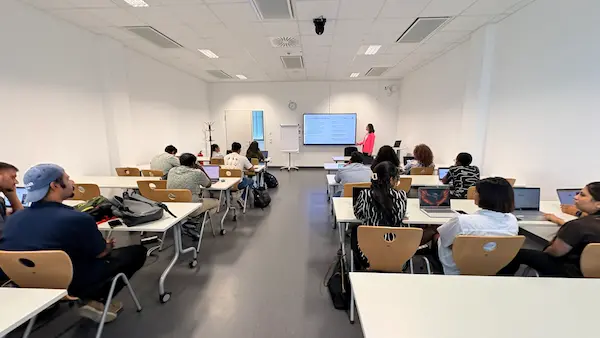
Recently, more than 30 Schiller International University Heidelberg students from our MBA Business Administration, MBA in International Business and MA in International Relations had the opportunity to explore the realities of working in digitalization and artificial intelligence with guest speaker Kerstin Lambert, Digitalization Manager at EPPLE GmbH in Heidelberg.
The session, organized by Heidelberg professors Dr. Manuela Toteva and Dr. Natalya Burkle, connected the principles of research and analysis with real-world professional practice, giving students insight into how businesses evaluate technologies, identify requirements, manage digital projects, and navigate the opportunities and challenges created by AI.
Key Takeaways
- More than 30 graduate students participated in the session.
- Kerstin Lambert shared insights from her professional experience in digitalization, AI, knowledge management, project management, and IT.
- Students explored the journey from an idea to implementation, including research, evaluation, testing, risk checks, communication, and stakeholder engagement.
- The session highlighted the importance of human expertise, particularly in decision-making, critical thinking, ethics, compliance, and accountability when working with AI.
- Active discussion and practical examples helped connect research methods with the challenges and opportunities professionals encounter in the workplace.
From Business to Technology
 Kerstin Lambert's career provided students with a perspective on how a background in business can lead into digitalization and technology. Having studied International Business herself, she described a professional path that moved from business into knowledge management, communities of practice, digitalization, AI, and IT support.
Today, as Digitalization Manager at EPPLE GmbH in Heidelberg, she works at the intersection of people, processes, and technology. Her presentation emphasized that digitalization and AI are not simply technology topics, but also involve business, communication, and change.
Lambert introduced students to the different responsibilities involved in her role, including researching new technologies, technical writing and documentation, training and coaching, problem solving, project and stakeholder management, asset management, and IT security.
From Curiosity to Digital Solutions
One of the central themes of the session was how organizations can approach new technologies in a structured way. Lambert explained how curiosity can be the starting point for exploring technologies such as Microsoft Copilot, ChatGPT, Claude, industry-specific AI solutions, and automation tools, but that enthusiasm alone is not enough.
Students explored the questions that need to be considered when evaluating a potential solution: Can it solve a real problem? Is it secure and legal? Is it worth the cost? Will people use it? Does it create business value?
The presentation also introduced a practical model for moving from a new idea to implementation. Rather than viewing rollout as the main part of digitalization, Lambert highlighted the work that comes beforehand: researching possible solutions, testing their technical fit, running controlled pilots, assessing risks, preparing communication, and gaining support from the people who will ultimately use them.
This process provided a direct connection to research and analysis, showing students how gathering information, evaluating alternatives, and testing assumptions can contribute to practical business decisions.
Documentation, People, and Problem Solving
The session also explored aspects of digitalization that extend beyond technology itself. Lambert highlighted the importance of documentation in making knowledge accessible and processes scalable, covering areas such as policies, procedures, governance rules, knowledge articles, user guides, and process maps.
She also discussed the role of teaching and knowledge sharing, including presentations, workshops, AI training, coaching, and security awareness. Different formats can help people learn according to their needs and build confidence in using new technologies.
Problem solving and stakeholder management were another important part of the discussion. Lambert's presentation showed how digitalization professionals work across departments, end users, management, IT service providers, and software vendors. Seeing the whole picture requires understanding different needs and ensuring that business and technology remain aligned.
Keeping Humans in the Loop
A key takeaway from the session was that AI does not eliminate the need for human expertise. Lambert explored how AI can support tasks such as searching, summarizing information, drafting documents, creating presentations, and preparing meeting notes, while people remain responsible for applying judgment, business knowledge, critical thinking, interacting with others, and taking responsibility for decisions.
The presentation also addressed ethics and accountability in AI and project management. Students considered the distinction between what is legal and what is ethical, as well as the continuing responsibility of people and organizations when AI systems are used.
The session concluded with a broader reflection on the role of digitalization professionals. Among the lessons highlighted were the importance of people, good processes, documentation, curiosity, human expertise, and management support. As Lambert's presentation summarized: AI, documentation, process improvement, and problem solving are tools that ultimately help people work better.
As Dr. Toteva reflected on the session:
Kerstin showed our students that AI is not an isolated technology topic, but part of a broader digital transformation process. Her session clearly demonstrated how research, requirements analysis, testing, stakeholder engagement, and continuous learning turn business challenges into practical digital solutions.
Connecting Research with Professional Practice
For students studying Methods of Research and Analysis, the session offered an opportunity to see how analytical thinking and structured research can be applied beyond an academic setting.
Through Kerstin Lambert's practical perspective, students were able to explore how professionals investigate new technologies, analyze requirements, evaluate solutions, manage risks, communicate with stakeholders, and continuously learn as technology evolves.
The session reflects Schiller's commitment to bringing real-world perspectives into the classroom and creating opportunities for students to connect their academic learning with the professional challenges they may encounter in their future careers.
The session also aligns with Schiller's focus this year on SDG 5: Gender Equality. Through Kerstin Lambert's involvement in the Rhein-Neckar professional network for women in IT, which promotes knowledge exchange, networking, and professional discussion around technology and careers, the session also highlights the importance of creating opportunities for women to connect and develop within the technology sector.