 Request information

Experiential Learning in Madrid: Politics at Puerta del Sol
A visit to Madrid’s protest camp helps students examine how citizen movements and civil society organizations interact with democratic institutions.
For students at Schiller International University, learning about politics, history and international affairs does not have to stop at the classroom door.
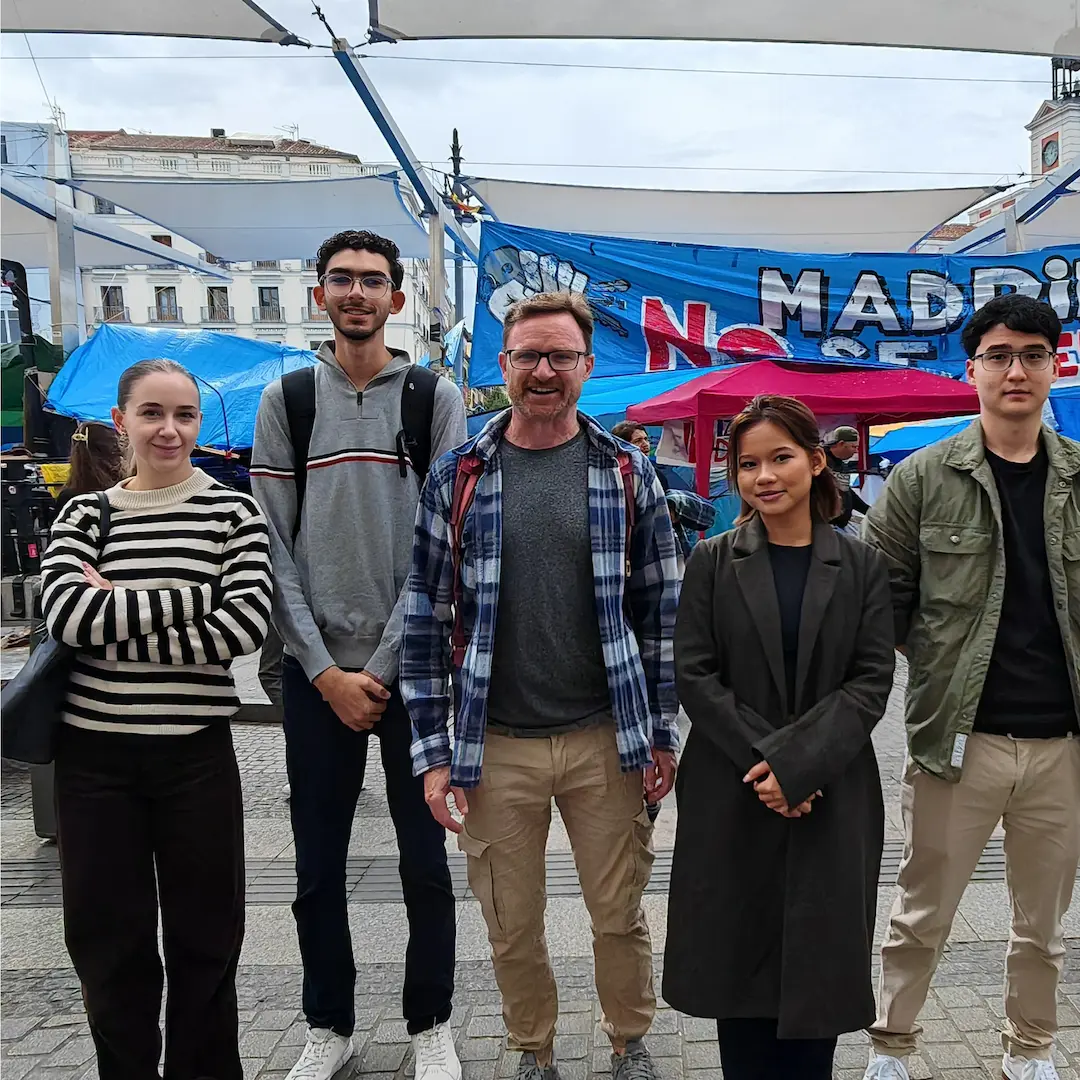
Students from BS International Business, BS International Hospitality and Tourism Management, and BA International Relations and Diplomacy at Schiller's Madrid campus recently took their learning into the heart of the city with a visit to the protest camp at Puerta del Sol. The visit offered them an opportunity to observe a contemporary example of civic mobilization and consider how citizen movements, civil society organizations and mass protest interact with democratic institutions.
The participating students came from two European History classes, primarily composed of first-year students, as well as Writing for Foreign Affairs and U.S. Political System classes.
By bringing together students from different programs and courses, the visit provided several academic perspectives from which to examine the same contemporary event.
Key Takeaways
- Learning Beyond the Classroom: Students explored civic mobilization firsthand at Madrid’s Puerta del Sol.
- Connecting Theory and Practice: The visit linked concepts from history, politics and foreign affairs with a contemporary case study.
- Exploring Civic Participation: Students observed how volunteers and civil society organizations contribute to collective action.
- Developing a Global Perspective: Discussions encouraged students to compare different political systems and understandings of protest.
- Turning Observation into Analysis: Written reflections will help students connect their experience with academic concepts and develop critical thinking skills.
Understanding Civic Action Through Experience
 One of the central learning objectives was to explore a fundamental question: How does mass direct-action protest interact with a democratic system of government?
Rather than approaching that question exclusively through academic readings and classroom discussions, students were able to observe elements of civic organization firsthand.
At the camp, they saw volunteers coordinating different activities and services, including food provision, cleaning and the creation of political art. They also observed the physical organization of the space, including temporary rain coverings and areas identified with street and neighborhood names.
Civil society organizations were also present, including Greenpeace and Sindicato de Inquilinas.
For Professor Alan, taking students to Puerta del Sol was an opportunity to transform concepts discussed in class into an experiential case study.
"We theoretically teach students about inequality and the conflict between capitalism and socialism, but this was an experiential learning opportunity. There were so many NGOs volunteering at the camp. I knew it was urgent they get to see history in the making."
Connecting Contemporary Madrid with History and Politics
The experience also created connections across the subjects represented by the participating classes.
For European History students, the visit provided an opportunity to reflect on themes explored through the French Revolution, including protest, direct action and inequality, while considering the important differences between historical and contemporary circumstances.
Students in the U.S. Political System and Writing for Foreign Affairs courses could examine the experience through different lenses, including democratic participation, political communication and the way social and political movements enter public debate.
Discussions also addressed how mass protests may be treated differently across political systems. Drawing on the international backgrounds represented in the classroom, students considered different experiences and understandings of protest, including comparisons between democratic and more authoritarian contexts.
Students also reflected on the politicization of protest and broader debates around inequality and the sustainability of economic systems.
Engaging with the Social and Civic Reality of a Host City
For an international student, understanding a country involves more than studying its institutions from a textbook.
Experiences such as the Puerta del Sol visit give students an opportunity to engage with the social, political and civic realities of the city in which they are studying and to observe how debates discussed academically can manifest themselves in public life.
The journey itself became part of that learning experience. Professor Alan accompanied the first-year students from the Madrid campus to Puerta del Sol, stopping near the Spanish Congress along the way before continuing to the camp.
Once there, students documented what they were seeing and discussed how the camp operated, who participated and what its organization could reveal about collective civic action.
From Experience to Critical Reflection
The visit does not end at Puerta del Sol.
Students will complete a written reflection on the experience, helping them move from observation to analysis and connect what they witnessed with concepts, readings and discussions from their courses.
Professor Alan also plans to use the experience as a case study across all four classes, continuing an approach of incorporating contemporary Spanish political cases into students' academic learning.
This approach reflects the same connection between academic concepts and real-world experience highlighted in other Schiller learning initiatives. In a recent Heidelberg experiential learning activity, for example, students connected research and analytical methods with the realities of digitalization and AI in professional practice.
Whether examining technology in Heidelberg or civic participation in Madrid, these experiences help students move from learning about a subject to observing, questioning and critically analyzing it in context.
For Schiller's international students, the city around them can therefore become an extension of the classroom, providing opportunities to better understand the societies in which they live and study while developing the critical perspective needed to engage with an interconnected world.