 Request information

American-Style Bachelor's Programs in Europe: What Parents Should Know
The university your child chooses will influence more than the next four years. It can shape how they learn, how they think, and how prepared they are for the opportunities that follow. Cost, reputation, location, career opportunities, and campus experience all influence that decision. Yet one question often receives less attention than it deserves: how will your child learn once they arrive at university?
That question has become increasingly important because employers are looking for more than subject knowledge alone. According to the Association of American Colleges & Universities (AAC&U):
- 95% of employers believe graduates should be able to apply what they learn in real-world situations
- 94% of employers value teamwork and oral communication
- 93% of employers consider critical thinking an essential workplace skill
Those findings suggest that academic success is only one part of what prepares students for life after graduation.
This is one reason why more parents are exploring bachelor programs in Europe that offer a different educational experience. Among them, American bachelor's programs in Europe have become an attractive option because they combine academic flexibility, practical learning, English-language instruction, and an international university environment within Europe.
If you are comparing universities for your child, understanding how these programs work is just as important as comparing tuition fees or rankings.
Key Takeaways
- Teaching methods influence learning outcomes. A landmark PNAS meta-analysis of 225 studies found that students taught through active-learning methods scored 6% higher on examinations and were 1.5 times less likely to fail than students taught primarily through lectures.
- Employers increasingly value transferable skills. According to AAC&U, 95% of employers expect graduates to apply learning in real-world situations, while 94% prioritize teamwork and communication.
- American bachelor's programs in Europe combine academic study with discussion, presentations, collaborative projects, and continuous assessment.
- Looking beyond rankings can help parents evaluate the overall learning experience, career preparation, and long-term value of a degree.
- Choosing the right university means understanding both what students will study and how they will learn.
Start by Understanding the Learning Experience
Every bachelor's degree has a curriculum. What often differs is the way that curriculum is delivered.
Some universities rely heavily on lectures and final examinations. Others expect students to contribute during class discussions, analyze case studies, complete projects, and receive feedback throughout the semester. Students still graduate with academic knowledge, but the journey to get there can look very different.
That difference is supported by research.
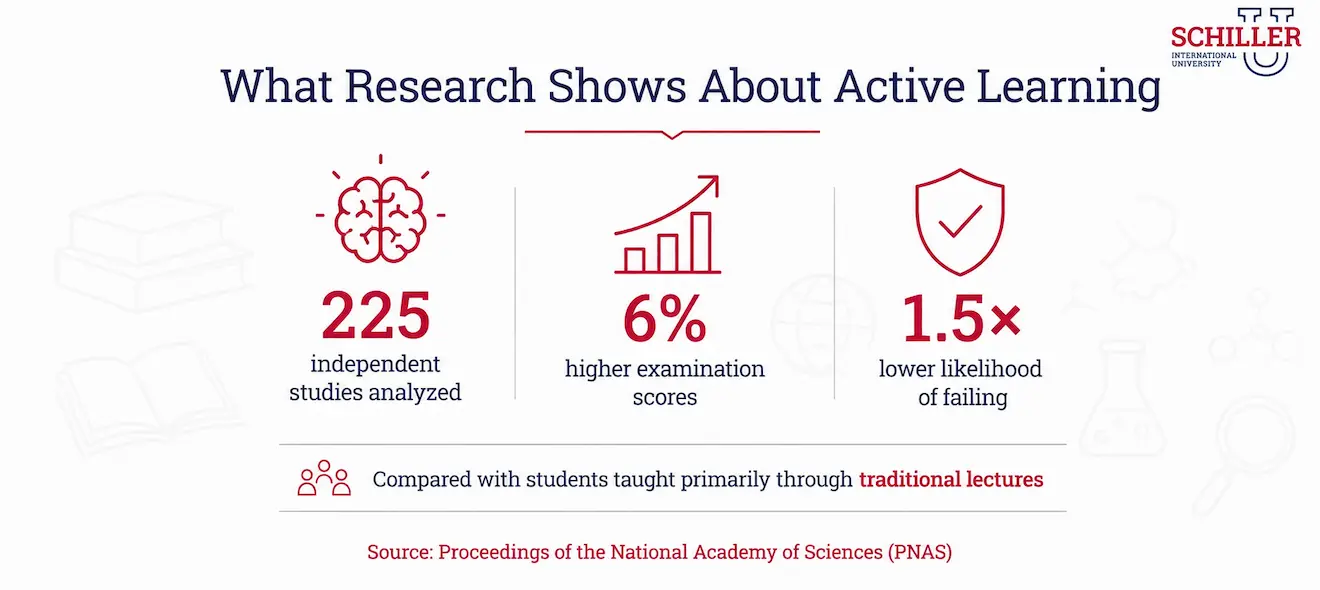
This helps explain why many American bachelor's programs in Europe place greater emphasis on participation, presentations, collaborative work, and continuous assessment. The goal is not to replace academic rigor but to help students engage more actively with what they are learning.
If you would like to explore this educational philosophy in more detail, Schiller's guide to American-Style Education from a European Perspective explains how this approach differs from more traditional university models.
Compare Educational Models
Two universities may offer the same bachelor's degree on paper, yet the experience of earning that degree can be very different.
The difference often lies not in what students study but in how they learn. Some universities encourage discussion, collaboration, and practical applications throughout the semester. Others place greater emphasis on lectures and end-of-term examinations. Neither approach is inherently better, but understanding the learning experience can help families decide which environment best matches their child's strengths and aspirations.
Looking beyond rankings and program titles often provides a clearer picture of university life. Teaching methods, assessment styles, curriculum flexibility, and opportunities for practical learning all shape how students develop academically and professionally over the course of their degree.
|
What to Compare |
Why It Matters |
|
Teaching style |
Classroom discussions, case studies, and projects encourage students to engage actively with their learning. |
|
Assessment |
Continuous assessment provides regular feedback instead of relying almost entirely on final examinations. |
|
Curriculum structure |
Greater flexibility allows students to explore different subjects before focusing on a specific area. |
|
Practical learning |
Real-world projects help students connect academic concepts with professional situations. |
|
Learning environment |
International classrooms expose students to different cultures, perspectives, and ways of thinking. |
Rather than comparing universities solely by reputation, these factors offer a more complete understanding of the educational experience students will have every day.
Why Curriculum Flexibility Matters
Very few students begin university knowing exactly what career they will pursue.
Interests develop, industries evolve, and new opportunities emerge throughout a student's undergraduate years. A curriculum that offers some flexibility allows students to explore different disciplines before narrowing their academic focus, helping them make more informed decisions about their future.
That philosophy has long been associated with American-style education, where students are encouraged to develop both subject expertise and broader transferable skills during their degree.
Parents comparing different higher education systems may also find Schiller's article on How is Academia Different in America vs. Europe? useful for understanding how curriculum design, classroom expectations, and assessment methods differ across educational models.
Think About the Skills Employers Value
Parents naturally ask what opportunities a degree might create after graduation.
The answer depends on more than the subject a student chooses. Employers increasingly expect graduates to communicate effectively, collaborate with others, and apply their knowledge in practical situations.
AAC&U's employer research reflects that expectation. Eighty-one percent of employers rate oral communication as very important when hiring graduates, 80% value teamwork, and 79% prioritize critical thinking. These are qualities that students develop through repeated practice, feedback, and collaboration over the course of their studies.
When evaluating American bachelor's programs in Europe, it is worth considering how the university helps students build these capabilities alongside academic knowledge. They are becoming an important part of graduate employability across industries.
Why Study at an American University in Europe?
Choosing an educational model is one decision. Choosing where to experience it is another.
An American university in Europe allows students to study within an American-style academic system while living in a European environment. Classes are typically taught in English, but learning extends well beyond the classroom. Students interact with peers from different countries, work on group projects with diverse perspectives, and experience cultures that prepare them for increasingly international workplaces.
For parents, this combination offers something distinctive. Students benefit from an education designed around active participation while developing the confidence to communicate and collaborate across cultures, an experience that is difficult to replicate in a more locally focused university setting.
What Parents Should Compare Before Deciding
Choosing a university often means comparing rankings, tuition fees, and locations. Those factors are important, but they rarely tell the whole story.
The university experience is shaped just as much by the support students receive, the opportunities available outside the classroom, and the environment in which they learn. Looking at these practical considerations, alongside academic reputation, helps families evaluate the long-term value of a degree rather than its immediate appeal.
|
What to Compare |
Why It Matters |
|
Accreditation |
Confirms that the institution meets recognized academic quality standards. |
|
Career support |
Career services, employer engagement, and internships help students prepare for employment before graduation. |
|
International opportunities |
Campus mobility and multicultural classrooms broaden students' academic and professional perspectives. |
|
Teaching approach |
Interactive learning encourages students to participate, communicate, and apply their knowledge throughout the degree. |
|
Student support |
Academic advising, wellbeing services, and mentoring contribute to a stronger university experience. |
These questions often reveal far more about a university than marketing materials or league tables alone. They help parents understand how an institution supports students throughout their academic journey and prepares them for life after graduation.
Parents who have already decided that an American-style education aligns with their child's goals may also find Schiller's guide on Why an American Bachelor in Europe Could Be the Perfect Choice for Your Child useful when comparing different institutions.
Is an American Degree Earned in Europe Recognized?
This is one of the most common questions parents ask, and understandably so.
Recognition depends on several factors, including the university's accreditation and the country where graduates intend to work or continue their studies. That is why institutional accreditation should always form part of the decision-making process.
American universities typically demonstrate academic quality through recognized institutional accrediting bodies. Organizations such as the Middle States Commission on Higher Education (MSCHE) evaluate institutions against established academic standards, while the Council for Higher Education Accreditation (CHEA) recognizes accrediting organizations that meet national quality expectations in the United States.
Parents interested in understanding how American degrees are viewed internationally can also read Schiller's article on Are American College Degrees Valued in Europe?, which explains accreditation and recognition in greater detail.
Why Families Choose Schiller International University
For families exploring international universities in Europe, the educational philosophy often becomes just as important as the destination itself.
Schiller International University brings together the principles of American-style education with the experience of studying in Europe. Programs are taught in English within multicultural classrooms where students learn alongside peers from different countries, encouraging collaboration, communication, and the exchange of diverse perspectives throughout their studies.
The learning experience extends beyond the classroom. Practical projects, interactive teaching methods, and career-focused learning help students apply academic concepts in meaningful ways while preparing for increasingly international workplaces.
Another distinctive aspect of Schiller's approach is the opportunity to study across its European campuses. Experiencing different academic and cultural environments within one university system allows students to broaden their perspective while remaining part of the same academic community.
Families comparing undergraduate options can explore Schiller's bachelor's programs to learn more about available pathways and how each program combines academic study with practical, career-focused learning. Those interested in the university's broader educational philosophy can also read about Schiller's mission and vision, which reflects its long-standing commitment to international education, critical thinking, and responsible global citizenship.
Choosing the Right Educational Model for Your Child
University decisions often begin with rankings, tuition fees, or location. They usually end up somewhere else.
Parents eventually ask whether the university will challenge their child, help them grow in confidence, and prepare them for opportunities beyond graduation. Those questions place the educational experience at the center of the decision.
For many families, that is exactly where American bachelor's programs in Europe stand apart. They combine academic study with practical learning, encourage students to think independently, and provide an international environment that reflects the way many industries operate today.
The right university is not simply the one with the strongest reputation. It is the one whose learning model best matches the student who will spend the next several years there.
If you're exploring an international undergraduate education, discover Schiller International University's bachelor's programs and learn how an American-style education in Europe can support your child's academic and professional ambitions.
FAQs
Q1: What is an American-style bachelor's program in Europe?
An American-style bachelor's program combines the flexibility and teaching philosophy of the US higher education system with the experience of studying in Europe. Students typically benefit from interactive learning, continuous assessment, and English-language instruction within an international environment.
Q2: Is an American degree earned in Europe recognized worldwide?
Recognition depends on the university's accreditation and the country where graduates plan to work or continue their education. Parents should always verify institutional accreditation and any professional licensing requirements relevant to their child's future.
Q3: Why choose an American university in Europe instead of a traditional European university?
Many families appreciate the combination of flexible learning, English-taught bachelor's programs, multicultural classrooms, and career-focused education while studying in Europe.
Q4: Are American-style bachelor's programs in Europe taught in English?
Yes. Most American-style bachelor's programs are delivered in English, allowing students to study in an international academic environment while strengthening their communication skills.
Q4: What career opportunities are available after graduating from an American university in Europe?
Career opportunities vary by degree and industry. Graduates may pursue roles in multinational companies, international organizations, entrepreneurship, or postgraduate study, supported by the transferable skills developed throughout their education.
Discover Our Campuses