 Request information

Walls Crumbling: What the Fall of the Berlin Wall Still Teaches Us Today
Thirty-seven years after the fall of the Berlin Wall, its history continues to raise questions that go far beyond the physical barrier that once divided Berlin: about freedom, political change, the division of societies, and how major historical transformations actually happen.
During Walls Crumbling: 37 Years Since the Fall of the Berlin Wall, Cristian Ivanes, Professor of International Relations and Diplomacy at Schiller International University, explored these questions with students, combining historical context with individual stories and his own experience of living through the political transformations of 1989 in communist Romania.
Key Takeaways
- The Berlin Wall did more than divide a city. It separated families, restricted movement, and shaped everyday life for almost three decades.
- Its fall was not an isolated event, but part of a much broader period of political and social transformation across Eastern Europe.
- The events of 1989 were not experienced in the same way everywhere. Looking at East Germany and Romania offered different perspectives on political transformation.
- Exploring history through personal experiences and different perspectives helps us better understand its lasting impact today.
Understanding the Wall beyond the Event Itself
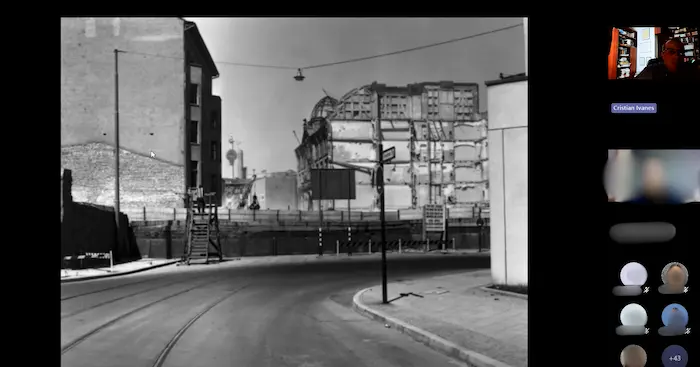 The presentation looked beyond what happened on November 9, 1989, considering what the Berlin Wall had represented during almost three decades of division.
The Wall separated families and communities, restricted freedom of movement, and became one of the clearest physical expressions of the political and ideological divisions of the Cold War. Through photographs and individual stories, including accounts of people attempting to escape through tunnels and modified vehicles, students explored what those restrictions meant in everyday life.
The discussion then widened to the political environment surrounding the Wall: the relationship between East and West, Soviet influence in Eastern Europe, growing demands for reform and freedom, mass demonstrations, migration through neighboring countries, and the pressures facing governments across the region by the end of the 1980s.
One of Cristian Ivanes’ reflections captured the political dimension behind those demands:
If you live decently, then you want something more than that. And this something more is, at a political level, democracy, freedom, the right to vote, even to vote them out of office.
Questions from students took the conversation further, touching on political power and protest, freedom of movement, the roles of the Soviet Union and Western powers, and why change unfolded differently across Eastern European countries.
Rather than treating the fall of the Wall as an isolated historical moment, the session placed it within the broader political, social, and international dynamics that surrounded it.
A Perspective Shaped by Expertise and Experience
As Professor of International Relations and Diplomacy, Cristian Ivanes approached the Berlin Wall not simply as a historical event, but as part of a wider conversation about political systems, international relations, individual freedoms, and the forces that lead societies through periods of profound change.
His interest in the subject also has a deeply personal dimension. Ivanes was 17 and living in communist Romania when the Berlin Wall fell. During the session, he recalled seeing images from Berlin on Western television and turning to Radio Free Europe to understand what was happening. A month later, Romania would experience its own political transformation, under very different circumstances.
This combination of academic expertise and lived experience gave students two ways of approaching 1989: examining the political forces behind the events while also considering how those changes were experienced by the people living through them.
It also provided a natural point of comparison between countries. Although East Germany and Romania were both undergoing major political change in 1989, their transitions developed differently. This opened a wider discussion about the role of political leadership, institutions, public protest, and the international context in shaping periods of transformation.
Learning from the Past to Understand the Present
For an international community, and particularly for our International Relations Bachelor and Masters students, looking at history from more than one perspective is particularly relevant. The same period can be experienced very differently across countries and communities, depending on political systems, geography, institutions, and individual circumstances.
The comparison between East Germany and Romania was one example. The questions raised by students added others, taking the conversation beyond the German experience and into the wider political environment of the Cold War and the transformations taking place across Eastern Europe.
This is also where a faculty-led presentation can extend beyond a particular course. A discussion about the Berlin Wall becomes a way of examining broader questions about freedom, borders, political systems, international relations, and how societies respond to change.
As Cristian Ivanes reflected at the conclusion of the session:
“The wall is long gone. Its trace remains.”
Those traces are part of why understanding the past remains relevant: they give us context to make sense of the present and allow us to consider, with greater perspective, the choices and changes that shape the future.