 Request information

Schiller Student Meriem Bouzedif Presents Her Research at the Gulf Research Meeting 2026 in Cambridge
Schiller Student Spotlight: Meriem Bouzedif
Being invited to present her work at an international academic meeting is a significant milestone for any student. For Meriem Bouzedif, it was an opportunity to take part in a wider conversation on some of the most pressing political, financial, and social challenges facing the Middle East.
Key Takeaways
- Presented research at the Gulf Research Meeting (GRM) 2026 at the University of Cambridge.
- Examined the role of Gulf private capital and diaspora funding in rebuilding Syria and Lebanon.
- Developed the Capital Readiness Framework to examine barriers to productive investment.
- Gained valuable insights through interdisciplinary discussions with international researchers.
- Strengthened her future research interests in International Relations, political economy, conflict, and development.
Meriem, an MA in International Relations and Diplomacy Online student at Schiller’s Distance Learning campus, recently attended the Gulf Research Meeting (GRM) 2026 at the University of Cambridge. Bringing together researchers and experts from different countries and academic disciplines, the meeting provided a space for exchanging perspectives and exploring complex issues affecting the Gulf and the wider region.
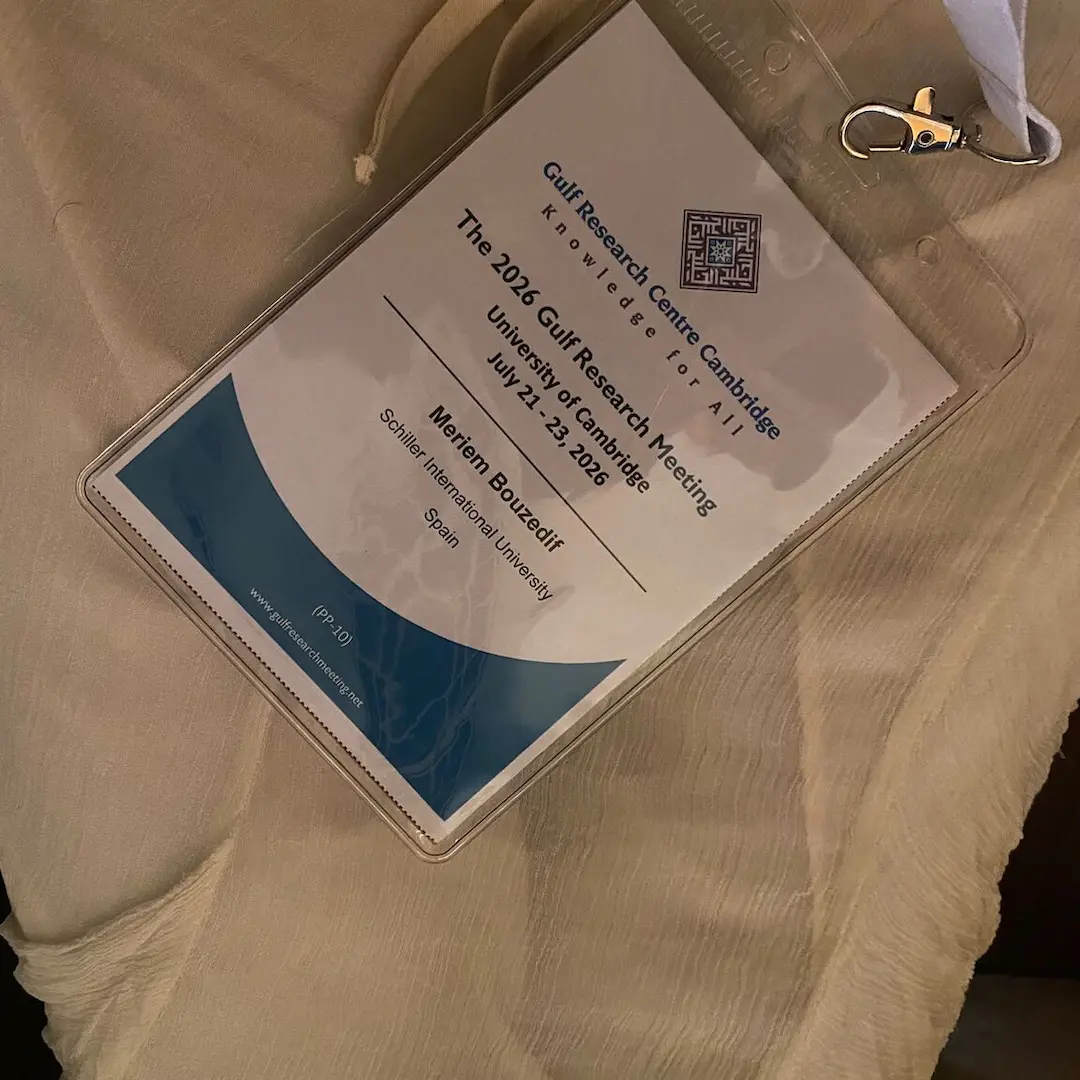 As part of Workshop 10, Mobilizing Diasporas and Gulf Private Investors for the Reconstruction of Syria and Lebanon, Meriem had the opportunity to present her research and engage directly with academics working across fields including finance, governance, reconstruction, sanctions, diaspora studies, and regional affairs. She describes the experience as both challenging and enlightening, particularly the opportunity to see how the same reconstruction challenges can be approached from very different disciplinary perspectives.
Beyond the presentation itself, GRM gave Meriem the chance to question her own assumptions, receive feedback on her work, and build connections with researchers whose interests overlap with her own. The experience also strengthened her interest in pursuing research in International Relations, political economy, conflict, development, and the Middle East and North Africa, with a focus on producing work that can contribute to broader policy discussions.
We spoke with Meriem about her experience at the Gulf Research Meeting, the conversations and perspectives that stood out to her, and how taking part in an international academic forum is influencing her future research ambitions.
Can you briefly explain the research paper you presented at the Gulf Research Meeting? What was the main question your research aimed to answer?
I presented my paper, titled “Private Gulf Capital and Diaspora Liquidity in the Post-War Reconstruction of Syria and Lebanon: A Comparative Political Economy of Sanctions, Banking Collapse, and Capital Readiness.” The paper asks why large amounts of private capital, diaspora money, and investment potential in the region do not automatically translate into reconstruction finance. It presents the Capital Readiness Framework, which examines an economy’s ability to attract, protect, and sequence capital in the context of political and financial fracture. Syria and Lebanon illustrate two different bottlenecks: Syria is externally constrained by sanctions, whereas Lebanon has suffered from banking collapse and lost financial credibility from within.
What motivated you to choose this research topic, and why do you think it is relevant today?
I chose this topic because reconstruction conversations tend to pay more attention to the number of dollars that need to be spent than to whether they can be spent safely and productively. The Gulf and Levantine diasporas have valuable financial and human resources, but these must be connected with viable institutions, trusted intermediaries, and investment vehicles. The topic is particularly relevant today because post-conflict recovery is occurring in a more complex geopolitical and financial environment where donor-led approaches alone are not enough.
What was the most interesting or unexpected finding from your research? Did anything challenge your initial expectations?
The most surprising finding was that the two cases have different causes of capital blockage but the same result: capital is available in theory, but does not become productive investment. My first thought was that the financial resources available in both contexts would be a primary difference. But the analysis revealed that factors such as trust, legal access, asset protection, and sequencing are more significant. This led me to view reconstruction as a capital-readiness problem instead of a funding problem.
Having your paper accepted at the Gulf Research Meeting is a significant achievement. What did it mean to you to present your research in such an international academic environment?
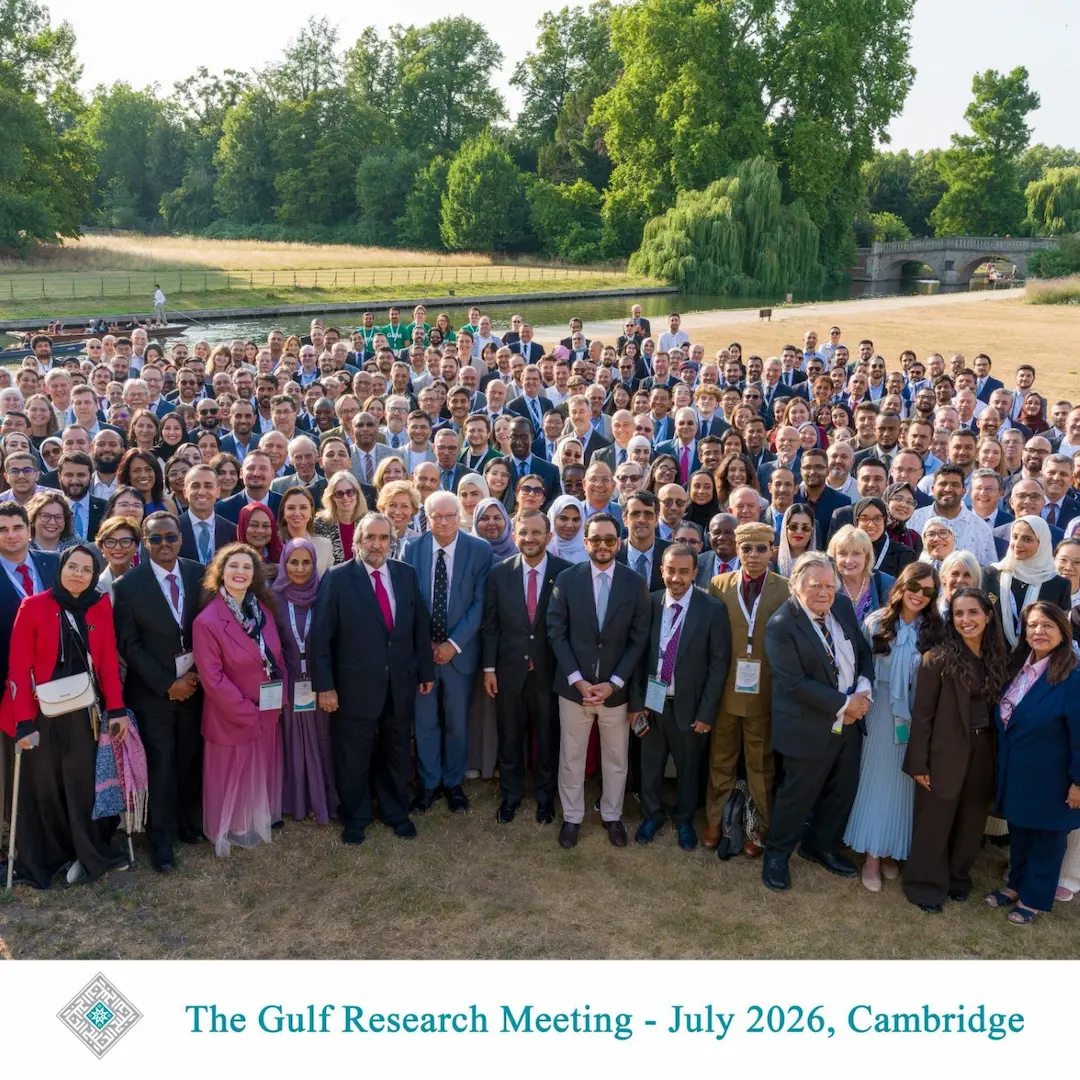 Being invited to present at the Gulf Research Meeting at the University of Cambridge was a significant academic honor. It allowed me to situate my work in a serious international discussion and receive critical feedback from scholars and experts working on the Gulf, the Levant, reconstruction, finance, political economy, conflict, and regional affairs. Engaging with researchers from different academic and professional backgrounds was challenging and enlightening. It increased my confidence that an interdisciplinary approach can contribute to broader discussions about post-war recovery, regional investment, and reconstruction.
I was also very proud to represent Schiller International University at such a high-level academic forum. The university’s continued support was crucial in making this opportunity possible and helped me bring the research I have pursued throughout my academic career into a broader international research and policy arena.
Beyond presenting your research, what was it like to engage with researchers from different countries and disciplines at Cambridge? Were there any conversations or connections that particularly stood out to you?
The greatest contribution of GRM was the chance to discuss related reconstruction issues with researchers from entirely different geographical and disciplinary backgrounds. What was striking to me was that the same reconstruction challenge can be viewed very differently from the perspectives of finance, governance, energy, diaspora studies, sanctions, and social policy.
The workshop format was also helpful because the discussion went beyond the presentations. I was able to question assumptions, look at things from another point of view, and extend my framework by considering where I could take it. I was particularly drawn to the linkages between financial credibility and sectoral reconstruction, as well as how these linkages could be realized through the involvement of diaspora and Gulf actors in securing practical investment avenues.
This experience reminded me that strong research is an iterative process that develops through communication. Being exposed to researchers with different backgrounds made me consider my assumptions and methodology in greater depth, examine the implications of my work, and develop relationships with researchers whose work overlaps with my own.
Looking back, what has this experience taught you, and how do you think it will shape your future research or career?
This experience taught me that a strong research argument should be clear and open to challenge. GRM highlighted the need to communicate complex ideas clearly and accurately, to be prepared to explain and justify an argument, and to remain open to criticism and other points of view. It also taught me that academic research is not a standalone activity, but part of a larger discussion.
In the future, I would like to expand the Capital Readiness Framework by conducting investor interviews, collecting project-level evidence, and developing more systematic indicators to measure aspects such as trust, asset security, convertibility, and deployment capacity. More generally, the experience strengthened my interest in research as part of my long-term career plans, especially in International Relations, political economy, conflict, the Middle East and North Africa, and development.
I wish to continue publishing, attending international academic conferences, and developing research that combines academic rigor with practical policy questions.
Why do you believe academic research is important in the field of International Relations? In what ways can research help address today's global challenges?
Academic research is especially relevant in International Relations because many of today’s global issues cannot be considered from a single perspective. Institutions, markets, and transnational networks are crucial in shaping the deep interconnections between conflict, migration, financial instability, development, climate change, and geopolitical competition.
Research helps us move beyond broad assumptions and explore these problems systematically. It can identify patterns, question conventional wisdom, and provide evidence that can inform effective policy decisions.
In my view, the importance of research lies particularly in its capacity to link learning with policy relevance. Research should not be reserved for universities. When made accessible and communicated well, it can help policymakers, institutions, and other stakeholders understand complex issues and consider different options.
My experience at GRM strengthened this belief. Conversations with other researchers in fields ranging from finance, governance, and development to energy, sanctions, diaspora, and regional studies showed me how research can be enriched by exposure to other views and disciplines.
It also reinforced my desire to pursue a future research trajectory in International Relations, political economy, conflict, development, and the Middle East and North Africa, with the long-term objective of producing research that is both academically rigorous and policy-relevant.