 Request information

Seven Awards in Three Weeks: Schiller Madrid Debate Club Excels Across Four MUN Conferences
What began last academic year as a student-led initiative at Schiller International University’s Madrid Campus has quickly developed into an active interdisciplinary community representing the university in national and international competitions.
Over the past three weeks, members of the Madrid Debate Club have participated in four Model United Nations conferences: IE MUN, St. Louis Crisis MUN, UCJC MUN and Cambridge MUN. Across the competitions, Schiller students completed 22 participations and roles, including both delegates and crisis backroom participants, and received seven individual awards and recognitions.
The latest results continue a strong trajectory for the Club. During the previous academic year, Schiller students earned the Best Delegation Award at Universidad Europea Model United Nations 2026. A four-person team later travelled to Münster, Germany, where all four students were named Outstanding Delegates and the team finished second in the overall delegation rankings despite being the smallest delegation at the conference.
Key Takeaways
- Four Conferences in Three Weeks: Madrid Debate Club members participated in IE MUN, St. Louis Crisis MUN, UCJC MUN and Cambridge MUN.
- Seven Individual Distinctions: Students earned three Best Delegate Awards, two Outstanding Delegate Awards and two Verbal Mentions.
- Twenty-Two Participations and Roles: Schiller was represented by delegates and crisis writers across different conference formats.
- An Interdisciplinary Student Community: The Debate Club includes students from different academic years and degree programs, bringing several perspectives into the same debates.
- Learning Through International Competition: Students strengthened their public speaking, research, negotiation, leadership and diplomatic decision-making skills.
Four Conferences and Different Forms of Diplomacy
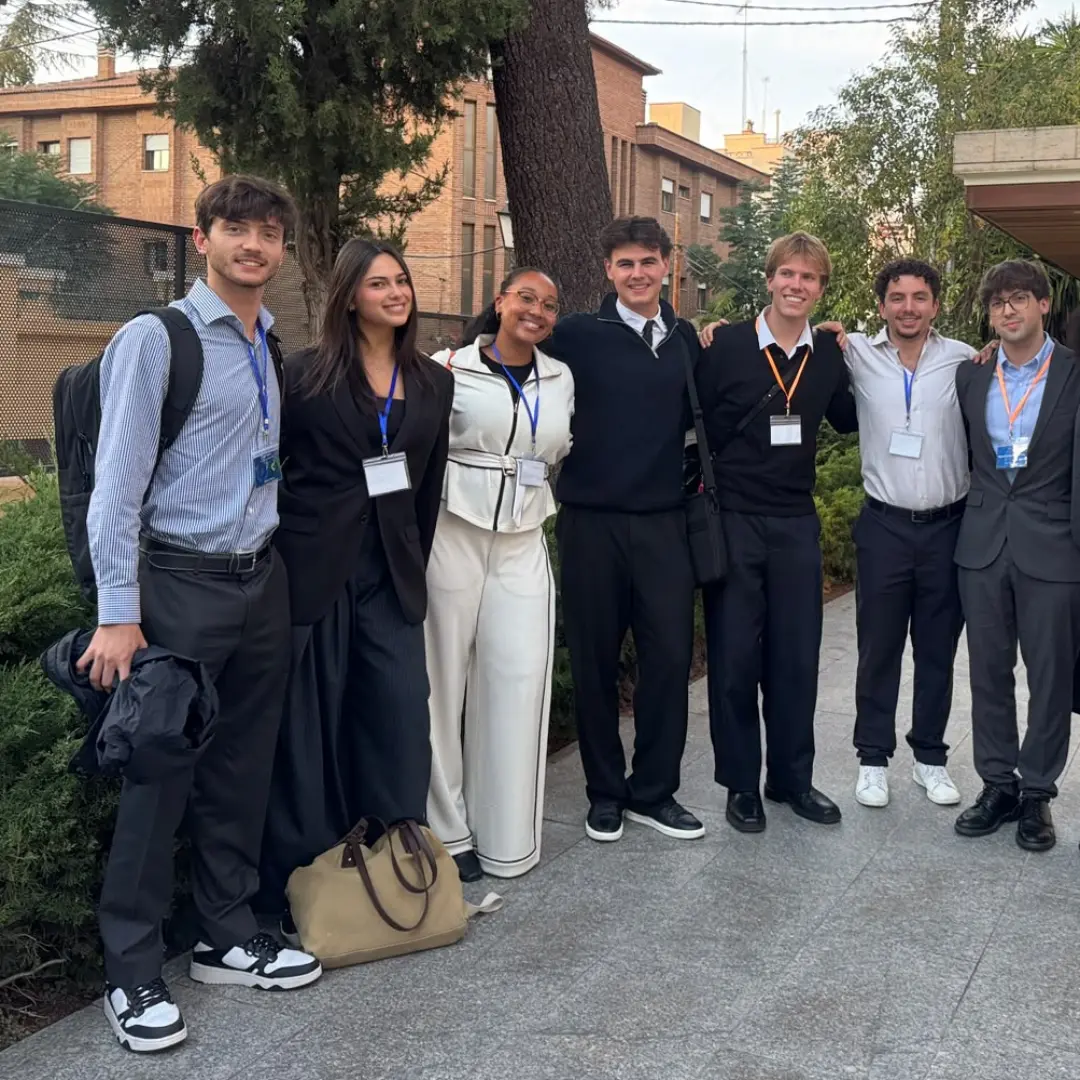 Each conference placed students in a different simulation environment, requiring them to research their assigned roles, understand complex international issues and communicate positions that did not necessarily reflect their own personal views.
At IE MUN, seven Schiller delegates participated in an extensive international conference in Madrid. The 2026 event welcomed more than 500 delegates from over 40 countries across 16 committees, combining several days of debate, negotiation and diplomacy.
At St. Louis Crisis MUN, five delegates were joined by two students working in the backroom as crisis writers. Crisis committees differ from traditional MUN formats because the simulation evolves continuously. Delegates must respond to new developments, while backroom participants process directives and help create updates that influence how events unfold. This format places particular emphasis on adaptability, strategic thinking and decision-making under pressure.
Four delegates also participated in UCJC MUN, the Madrid International Model United Nations hosted by Universidad Camilo José Cela. The conference brings together university delegations to defend positions, build alliances and draft resolutions while developing skills in public speaking, critical thinking, negotiation, leadership and teamwork.
A further four students represented Schiller at Cambridge MUN, adding another international experience to the Club’s growing competition record.
Recognizing Seven Outstanding Performances
The students’ preparation and performance resulted in seven awards across the four conferences.
At St. Louis Crisis MUN, Pilar Heredia Márquez and Adrian Khabibulin Slyvka were both named Best Delegate.
At IE MUN, Marcos Felipe Argibay received the Outstanding Delegate distinction.
At UCJC MUN, Manuel González earned a Verbal Mention.
The Club concluded this period with three further distinctions at Cambridge MUN: Vera Kadrije Ibraim was named Outstanding Delegate, Joshua Knafo received a Verbal Mention and Manuel González earned the Best Delegate Award.
These results recognize individual performance, but succeeding in MUN also depends on collaboration. Delegates must negotiate with other participants, build coalitions and work towards resolutions that can gain sufficient support within their committees.
Debating Historical and Contemporary Global Challenges
Throughout the conferences, Schiller students engaged with a wide range of international affairs, diplomacy and global security issues.
The topics included:
- Military coups in West Africa within the African Union
- Conflict and security challenges within the OSCE in light of Moldova’s European Union accession process
- NATO’s response to a missile crisis involving Polish airspace
- Accountability for the destruction of cultural heritage during armed conflict within UNESCO
- The Suez Crisis
- Other historical and contemporary international challenges
The breadth of these topics required students to move between different regions, institutions and historical contexts. Participants had to research national interests, understand the authority and limitations of their assigned committees and respond persuasively to the positions advanced by other delegates.
An Interdisciplinary Club for Students Across Schiller
Although Model United Nations is closely connected to international relations and global governance, the Madrid Debate Club is not limited to one academic program.
Its membership brings together students from different years and degree programs, reflecting the range of disciplines available at Schiller. This allows participants to draw on perspectives from international relations, business, sustainability, finance, technology and other fields when examining complex international challenges.
This interdisciplinary composition matters because global issues rarely belong to one discipline. A security crisis may also involve economic interests, environmental pressures, emerging technologies, cultural heritage or questions of sustainable development.
Building on a Strong First Year
Founded during the 2025-2026 academic year, the Madrid Debate Club has rapidly expanded its experience and competition record.
Its first year included an outstanding performance at Universidad Europea Model United Nations 2026, where the Schiller delegation received the Best Delegation Award, Manuel González was named Best Delegate in the DISEC Committee and Muras Baiyshev received an Honourable Mention in the Security Council.
The Club later achieved international recognition in Germany. Despite travelling with only four delegates, the Schiller team finished second overall at Münster University International Model United Nations, and every team member received an Outstanding Delegate Award.
The latest seven awards demonstrate that these earlier results were not isolated achievements. They form part of an increasingly consistent record built through environments while representing Schiller across several institutions and countries.
Their achievements show what can happen when students from different programs bring their knowledge together, challenge themselves through international competition and transform a shared interest into an active learning community.