
 Request information

Pepephone Founder Pedro Serrahima Discusses His Pioneering Business Strategy at Schiller
As part of Professor José Pinto's Business Ethics course, students at Schiller International University's Madrid campus had the opportunity to learn from one of Spain's most respected business leaders: Pedro Serrahima, founder of Pepephone and a pioneer in customer-centric business strategy.
Few entrepreneurs have demonstrated as clearly as Pedro Serrahima that ethical decision-making can be a source of competitive advantage. As founder of Pepephone, one of Spain's most admired telecommunications companies, Serrahima built a business that challenged industry norms by putting trust and transparency at the center of every customer relationship.
Key Takeaways
- Pedro Serrahima, founder of Pepephone, shared how trust, transparency, and customer respect became the foundation of one of Spain's most successful telecommunications companies.
- Students explored how ethical decision-making can serve as a powerful competitive advantage rather than a limitation on business growth.
- The session demonstrated how values such as authenticity, fairness, and long-term thinking can drive customer loyalty and sustainable success.
- Through real-world examples, students gained insight into the practical application of business ethics beyond compliance and regulation.
Why Pepephone Became a Business Case Study
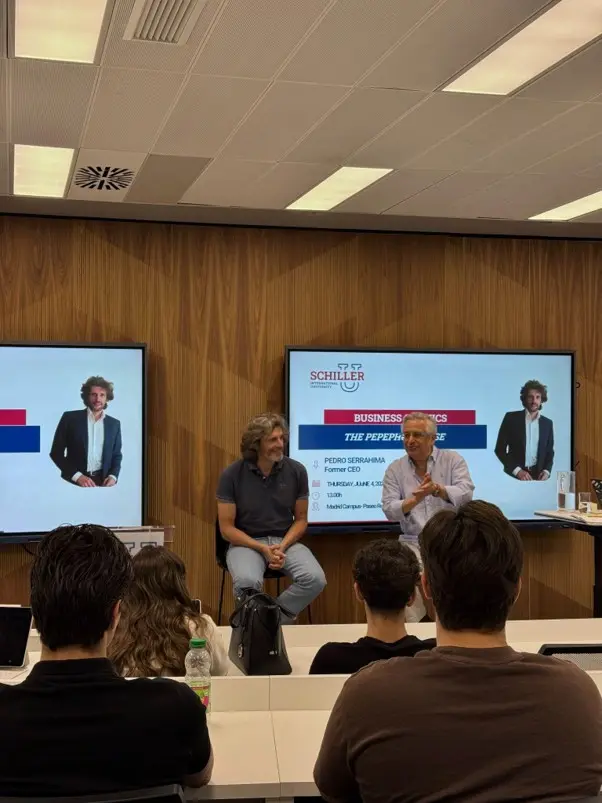 Founded in 2007, Pepephone entered Spain's highly competitive telecommunications market with a radically different philosophy. At a time when many operators relied on long-term contracts, hidden fees, and complex pricing structures, Pepephone chose a simpler path: treating customers fairly and communicating with complete transparency.
The results were remarkable. By the end of 2015, Pepephone had grown to more than 460,000 mobile customers and over 35,000 broadband customers while generating €64 million in annual revenue—all with a team of just 22 employees. The company's efficiency, profitability, and exceptionally loyal customer base led to its acquisition by MásMóvil in 2016 for €158 million.
Yet Pedro Serrahima argues that the company's success was never primarily about telecommunications. It was about trust. Pepephone became a business case study because it demonstrated that transparency, fairness, and customer respect could be powerful drivers of growth in one of the most competitive industries in Spain.
Today, Pepephone continues to be referenced in business schools and leadership discussions as an example of how trust, transparency, and consistency can create sustainable competitive advantage.
Building a Business on Trust
During the session, Serrahima challenged some of the most common assumptions about business success. His central message was both simple and powerful:
"The most important thing in a company is not the product. It is the relationship the company establishes with its customers."
In an era where companies compete relentlessly through innovation, technology, and pricing strategies, Serrahima argued that trust remains the ultimate competitive advantage.
Pepephone became successful not because it offered a radically different product, but because it treated customers differently.
According to Serrahima, businesses often overcomplicate their offerings in pursuit of growth. Yet some of the most disruptive decisions a company can make involve restraint rather than action.
"Sometimes, the most disruptive thing you can do is nothing," he explained. Instead of constantly creating new promotions, hidden conditions, or complex pricing structures, Pepephone focused on honesty, transparency, and consistency. The company's philosophy was straightforward: treat customers fairly, communicate openly, and prioritize long-term relationships over short-term gains.
For Serrahima, authenticity is not merely a personal virtue but a business principle. Companies build credibility when they communicate like humans, acknowledge mistakes, and remain true to their values, even when faced with commercial pressures.
Ethics Beyond Compliance
For Schiller students, the session provided a practical demonstration of how business ethics extends far beyond regulations and compliance frameworks.
At Pepephone, ethical principles were embedded into everyday decisions:
- Being transparent when mistakes occurred.
- Eliminating hidden fees and confusing contracts.
- Respecting customers' freedom to leave.
- Making decisions based on what was right for the customer, not just what maximized revenue.
The result was a brand that earned extraordinary levels of customer loyalty and advocacy.
Lessons for Future Global Leaders
One of the most memorable moments of the session came when Serrahima reflected on his entrepreneurial journey.
Asked about a lesson he had learned along the way, his answer was immediate:
"I should have done what I did earlier."
The statement highlighted an important reality for aspiring business leaders: acting according to your values should never be postponed. The sooner organizations align their operations with principles such as transparency, fairness, and authenticity, the stronger their foundations become.
For students preparing to lead organizations in an increasingly complex and interconnected world, Serrahima's message was clear:
- Trust is more valuable than short-term profits.
- Authenticity creates stronger customer relationships.
- Ethical leadership is a strategic advantage, not a limitation.
- Simplicity and honesty often outperform complexity and manipulation.
- Long-term relationships matter more than short-term transactions.
Ethics as a Competitive Advantage
Pedro Serrahima's visit reinforced one of the core principles taught at Schiller International University: successful leadership requires both business acumen and ethical judgment.
His story demonstrates that ethics is not an obstacle to growth. On the contrary, it can be the very foundation of sustainable success.
For our students, the takeaway was unmistakable: products can be copied, technologies evolve, and markets change. Trust, however, is far more difficult to replicate.
As Pepephone's experience shows, businesses that earn trust create value that lasts. In any industry, market, or country, the strongest brands are ultimately built not on what they sell, but on the relationships they cultivate.