 Request information

From Product to Lifestyle Brand: Monster Energy Shares Lessons in Marketing, Adaptability and Failure at Schiller Madrid
What transforms a product into a globally recognizable brand? For Monster Energy, the answer involves more than what is inside the can. It also depends on lifestyle, community, cultural relevance, and the ability to evolve without losing sight of what makes the brand distinctive.
Students at Schiller International University’s Madrid Campus recently explored these ideas during a visit from Andrés Costa, Regional Marketing Director at Monster Energy, and Juan Abajo, Senior Business Development Director for Spain and Portugal.
The speakers introduced students to the company’s origins, the challenges it encountered during its early development, and the decisions that helped it adapt its product, commercial approach, and marketing strategy. A previous public talk featuring both speakers similarly focused on the company’s product and brand history, its unsuccessful initial launch, its strategic refocus, and challenges involving distribution.
Rather than presenting success as a simple or linear process, the session highlighted the importance of recognizing failure, learning from it, and remaining ready to change direction when circumstances require it.
Key Takeaways
- A Product and a Brand Are Not the Same: Students explored how Monster Energy built an identity that extends beyond its energy drinks and connects with a wider lifestyle.
- Failure Can Inform Future Success: The speakers shared the challenges the company encountered and explained how learning from setbacks supported its evolution.
- Strong Brands Must Continue Adapting: Changing markets, consumer expectations, and generations require companies to pivot and iterate while protecting their core identity.
- Different Disciplines Strengthen the Conversation: Students from business, sustainability, international relations, and other programs connected the presentation to questions from their own fields.
- Attitude Matters in Employability: When discussing careers at Monster Energy, the speakers emphasized attitude, commitment, a willingness to make mistakes, and readiness to go the extra mile.
Understanding the Difference Between Product and Brand
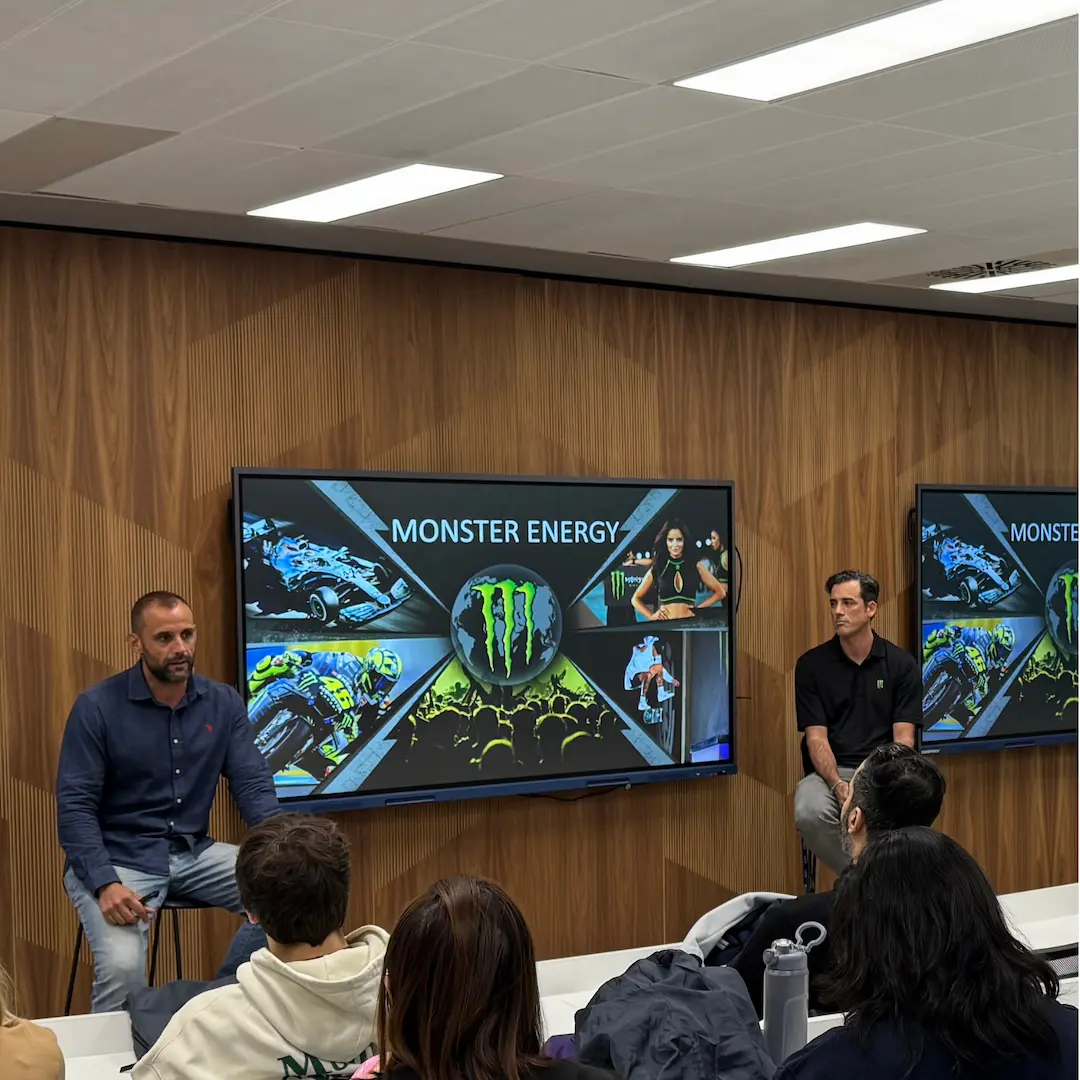 A central idea from the session was that product and brand are not interchangeable.
The product is what a company develops and sells. The brand is the wider identity, associations, experiences, and relationships created around it. In the case of Monster Energy, the speakers explained how marketing contributes to positioning the company as a lifestyle brand rather than focusing exclusively on the functional characteristics of an energy drink.
This approach influences how the company communicates, develops partnerships, reaches different audiences, and establishes its place within highly competitive markets.
Andrés Costa has previously discussed how individual products are connected to specific consumer needs and occasions while maintaining the wider identity of the Monster Energy brand.
For students, this provided a practical example of how marketing strategy can differentiate a company and give consumers reasons to connect with it beyond the product itself.
Evolving with Markets and Generations
The speakers also discussed how the company was created and the difficulties it experienced in its early stages.
Rather than hiding those difficulties, they presented them as part of the company’s development. Initial challenges required Monster Energy to reconsider elements of its strategy, learn from what had not worked, and continue adapting.
This willingness to evolve remains important as markets and generations change. Consumer expectations do not remain static, and a strategy that works at one moment may need to be reconsidered later.
The presentation summarized this approach through four pieces of advice:
- Play to your strengths.
- Keep it simple and build on success.
- Be ready to pivot and iterate.
- Embrace failure and learn from it.
Together, these ideas showed students that adaptability does not necessarily mean abandoning an organization’s identity. It can mean understanding what already works, responding honestly to what does not, and making informed changes from there.
Learning Across Academic Disciplines
Although branding, marketing, and commercial strategy were central to the presentation, the session was relevant to students from across Schiller’s programs.
Students studying business could examine the company’s development, marketing model, and commercial decisions. Sustainability students approached the discussion from the perspective of their own field, while international relations students raised questions connected to global markets and the environments in which international companies operate.
This made the Q&A an important part of the session. Students were able to explore the topics presented by the speakers while also listening to questions shaped by other areas of study.
The exchange demonstrated the value of interdisciplinary learning. Business decisions do not exist separately from social expectations, sustainability concerns, international markets, and changing consumer cultures. Understanding their relationships helps students examine an organization from more than one perspective.
What Does It Take to Work at Monster Energy?
Students also asked about employability and what the company looks for in the people who join its teams.
The speakers emphasized qualities that cannot always be captured by a job title or academic credential:
- Attitude
- No fear of making mistakes
- Commitment
- Readiness to go the extra mile
This advice connected closely with the wider story of the company. If organizations need to experiment, adapt, and learn from failure, they also need people who are willing to take initiative and continue learning when an idea does not produce the intended result.
The speakers encouraged students to understand what they do well rather than trying to imitate someone else:
Know what you’re good at and play with your strengths. If you try to be someone else, you will fail.
Turning Failure into Learning
The session gave students an inside look at how commercial and marketing decisions contribute to the evolution of an international brand. More importantly, it presented success as something built through experimentation, setbacks, learning, and repeated adjustment.
For students preparing to enter different professional fields, the lessons extended well beyond the energy-drink industry. Careers, like companies, rarely follow a perfectly predictable route. Recognizing personal strengths, remaining open to change, and learning from unsuccessful attempts can be just as important as the original plan.
By bringing together questions from business, sustainability, international relations, and other fields, the visit also showed how much students can learn when different academic perspectives enter the same conversation.
The final message was clear: play to your strengths, remain ready to adapt, and do not allow fear of failure to prevent progress.