 Request information

Inside Diplomacy: Schiller Madrid Students Visit the Embassy of Ecuador in Spain
How does diplomacy work beyond the theories, legal frameworks, and international relations cases studied in the classroom?
Students from the Master of Arts in International Relations and Diplomacy at Schiller International University’s Madrid Campus had the opportunity to explore this question firsthand during a visit to the Embassy of Ecuador in Spain.
Accompanied by Professor Verónica Dávalos, the students were welcomed by H.E. Wilma Andrade, Ambassador of Ecuador to Spain, for a private roundtable conversation at the Embassy. The experience allowed students to step inside a diplomatic environment, engage directly with an experienced representative, and connect their academic learning with the realities of international relations.
For Professor Dávalos, who is Ecuadorian, the visit also offered an opportunity to introduce students to Ecuador from a diplomatic perspective while exploring how international relations operate beyond the texts and cases discussed in class.
Key Takeaways
- Experiencing Diplomacy Firsthand: Students participated in a private roundtable with Ambassador Wilma Andrade at the Embassy of Ecuador.
- Connecting Theory and Practice: The visit explored how theories, legal frameworks, and analysis from the classroom translate into diplomatic practice.
- Understanding Bilateral Relations: Students discussed relations between Ecuador and Spain within a broader Latin American context.
- Exploring Gender and Diplomacy: The conversation addressed the connections between gender, political representation, and diplomatic work.
- Learning from Professional Experience: Ambassador Andrade shared insights from her diplomatic and political career and offered practical recommendations to students interested in the field.
Experiencing Diplomacy Beyond the Classroom
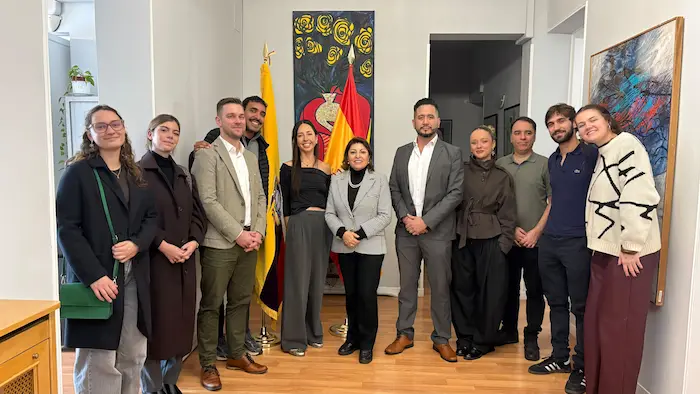 A central objective of the visit was to give students an opportunity to see what diplomacy looks like in practice.
During their studies, students examine international relations through theory, international law, policy, historical cases, and geopolitical analysis. Visiting the Embassy allowed them to consider how these different dimensions interact when diplomats navigate relationships between countries, institutions, and people.
Ambassador Andrade shared insights from her experience in diplomacy and her political career representing Ecuador, including a professional path shaped by public policy and social impact.
Students had prepared questions ahead of the visit, allowing them to actively guide parts of the discussion rather than simply listen to a presentation.
Ecuador, Spain and Modern Diplomacy
The roundtable explored the relationship between Ecuador and Spain, as well as the broader position of Ecuador and Latin America within contemporary international affairs.
For an international cohort studying diplomacy in Madrid, the discussion provided a practical example of how historical, political, social, and international factors can intersect within bilateral relations.
Another important part of the conversation focused on gender and diplomacy, encouraging students to consider questions of representation, public policy, and participation alongside more traditional areas of international relations.
The discussion moved across different dimensions of modern diplomatic work and concluded with practical recommendations from Ambassador Andrade for students considering careers in international affairs.
Learning Directly from Diplomatic Experience
The experience created a direct connection between the concepts students encounter throughout the Master of Arts in International Relations and Diplomacy and the environments where those concepts are ultimately put into practice.
For Professor Dávalos, that was one of the most important objectives of the visit: helping students understand what happens when academic theory, legal frameworks, and analysis meet the complex realities professionals navigate every day.
The visit also gave students an opportunity to develop another important skill for their future careers: asking informed questions and engaging directly with an experienced diplomatic professional.
Schiller International University extends its appreciation to Ambassador Wilma Andrade and the entire team at the Embassy of Ecuador in Spain for opening their doors to our students and providing an enriching environment for conversation and practical learning.
For the students, the visit transformed diplomacy from a subject of study into something they could experience firsthand, reinforcing an essential part of the Schiller approach: connecting academic knowledge with the professional realities students are preparing to enter.