 Request information

What Paris Teaches You About Global Marketing
There is a line from the 1954 movie Sabrina where Audrey Hepburn's character falls deeply in love with Paris while studying there and says, “Paris is always a good idea.” That line was written over 70 years ago, and it still has not changed. The legendary actress, Audrey Hepburn, went on to film five more movies in Paris, including Funny Face, Charade, and How to Steal a Million. In all these classic movies, Paris was not just a backdrop. It was the story. The city sold itself without trying, and that instinct has never left it.
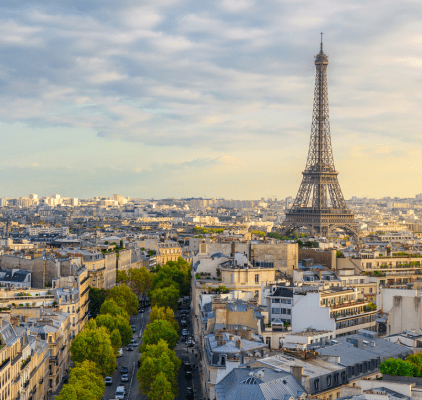
It is what makes Paris one of the most instructive cities in the world for understanding global marketing. It runs on branding at a level most cities cannot come close to, shaping industries from luxury to advertising. From the influence of Paris Fashion Week to the presence of global luxury houses like Louis Vuitton Moët Hennessy (LVMH), Kering, Hermès, and Chanel, the city does not just reflect trends; it sets them. If you are studying global marketing and you are not in Paris, you are reading about this world from the outside. Discover what learning in a city that lives and breathes its brand actually teaches you.
Key Takeaways
- Paris attracts over 100 million visitors a year, making it one of the most concentrated real-world environments for studying global consumer behavior.
- Luxury giants like LVMH generated €80.8 billion in 2025, showing how Paris turns heritage storytelling into global market dominance.
- Cultural events in Paris set the direction for global fashion marketing each season.
- By 2025, luxury made up 28% of Champs-Élysées retail, proving that physical spaces in Paris are designed as brand experiences, not just stores.
- Global brands in Paris adapt to multiple cultures daily without losing identity, making localization a lived strategy, not a theory.
- Paris operates as a long-term marketing campaign, built through film, fashion, and cultural influence over decades.
- Studying in Paris places you inside the environment where global marketing trends are created, not just analyzed afterward.
1. Heritage Storytelling
Paris' luxury sector is built on the heritage strategy: using a brand's history, craftsmanship, and origin story to communicate timeless value. LVMH, headquartered at 22 Avenue Montaigne, operates over 75 prestigious brands and reported revenue of €80.8 billion in 2025. Kering, home to Gucci, Saint Laurent, Balenciaga, McQueen, and Brioni, with its offices at 40 rue de Sèvres in Paris, reported €14.67 billion in revenue for the same year.
Both groups are headquartered in Paris for a reason: Both groups chose Paris for a reason: the city's cultural authority lends credibility that cannot be manufactured elsewhere. Being in Paris teaches you:
- How brands use founder stories, archival imagery, and craft narratives to build emotional loyalty across generations and markets.
- Why Made in France still carries weight with consumers in markets as different as South Korea, the UAE, and Brazil, and how that translates into premium pricing power.
- How luxury brands communicate exclusivity without ever saying the word, and what that restraint looks like across packaging, store design, and advertising.
- The difference between a brand that has a story and a brand that is a story, and why Paris' most enduring houses fall into the second category.
2. Localization is the Global Strategy
Paris welcomed 102 million visitors from across the globe in 2025, with the tourism sector generating over €77.5 billion. Walk through any neighborhood, and you are surrounded by consumers arriving from entirely different cultural contexts, with different price expectations, communication preferences, and ideas of luxury.
The global brands operating in the city have had to become genuinely skilled at speaking to all of them without losing their identity, and watching that happen is one of the most practical educations in international marketing available anywhere. Studying marketing in Paris gives you:
- Direct exposure to multicultural consumer behavior, not through case studies, but through the actual city around you.
- An understanding of how brands adapt tone, imagery, product selection, and store layout across different cultural audiences while staying coherent.
- Practical cross-cultural communication skills that come from navigating a city where French formality and international informality exist side-by-side.
- Insight into how global brands adjust their messaging for different markets without fragmenting their identity is one of the core challenges in international brand management.
3. Elegance as a Marketing Tool
The broader marketing culture has shifted toward the casual. Streetwear is combined with fine jewelry. Sneakers appear at award ceremonies, and yet Paris remains one of the few cities in the world where formality is not a relic. It is a live and current consumer preference, and brands know it.
Paris Fashion Week is the clearest proof. The event is consistently ranked as the most influential of the Big Four fashion weeks, ahead of New York, London, and Milan. It brings together Dior, Saint Laurent, Chanel, Louis Vuitton, Balenciaga, Loewe, and dozens of other houses for nine days that set the direction for global fashion marketing. Buyers, editors, celebrities, and influencers converge on Paris not just to see clothes, but to receive cultural signals that will drive brand communication worldwide for the next season.
For marketing students, this is a rare chance to watch global advertising trends form before they go global. You will learn about fashion marketing and international business in Paris and beyond:
- Why elegance and visual refinement remain effective marketing tools in specific segments, and how brands calibrate the tension between aspiration and accessibility.
- How fashion weeks function as global brand launches, not just industry events, and how social media has extended their reach far beyond the runway.
- The role of creative director transitions in shaping brand identity and public narrative.
- How emerging brands navigate the global challenge of participating in fashion week culture on smaller budgets, and what that reveals about the economics of brand visibility.
4. Stores are Brand Experiences
One of the clearest lessons Paris offers about experiential marketing is that a physical space can do what advertising cannot: it can make someone feel something before they buy anything. Paris's flagship culture is built on this principle. The Louis Vuitton store on the Champs-Élysées spans five levels and is the largest LV boutique in the world, with its top floor stocking exclusive pieces unavailable elsewhere. French leather goods brand Polène opened a 1,000-square-foot free experiential space at its Champs-Élysées flagship in late 2025, building foot traffic and brand affinity without requiring a purchase. By 2025, luxury accounted for 28% of the Champs-Élysées retail offering, up from under 10% in 2017. What experiential learning in Paris looks like for marketing students:
- Seeing firsthand how flagship stores function as brand museums, creating emotional associations that outlast any single campaign.
- Understanding why physical retail investment continues in an era of digital growth, and how Paris brands use store design to reinforce everything their advertising communicates.
- Observing how brands layer access and exclusivity into the in-store experience itself, making the store visit part of the brand's narrative.
- Gaining insight into how hospitality and tourism marketing intersect with retail, particularly relevant as Paris attracts an enormous international visitor base that enters these spaces as both consumers and brand audiences.
5. The City is a Marketing Campaign
Millions of people plan holidays around Paris every summer. Many of them arrive having been sold on the idea of Paris by a film, a fashion campaign, a magazine spread, or a social media post. The city has functioned as a destination brand for over a century, and it remains one of the most effective examples of destination branding in the world.
The Instituto de Estudios Superiores de la Empresa (IESE or Institute of Advanced Business Studies) Cities in Motion Index 2025 placed Paris third, recognizing its strengths in human capital development and global connectivity. The film industry has long been one of its most effective marketing channels, and recent campaigns have only reinforced it. The Devil Wears Prada 2 involved official partnerships with Dior, Valentino, Lancôme, L'Oréal Paris, Grey Goose, Mercedes-Benz, and Tiffany & Co., with brand contributions valued at $250 million. Paris was not in the film. But Paris was all over the campaign: It teaches you:
- How a city builds and sustains a global brand across decades, using culture, events, architecture, and media as its primary marketing tools.
- Why destination branding is one of the most complex forms of international marketing, and why Paris is the clearest case study available.
- How entertainment and luxury marketing intersect to create cultural moments that serve brand objectives without feeling like advertising.
- The role of cultural authority in brand positioning, and why brands outside France still choose Paris as the setting or partner for their most ambitious campaigns.
6. The Events Calendar Is the Curriculum
Studying in Paris means being present at some of the most instructive marketing events on the global calendar.
- Paris Fashion Week is where the global retail direction is set each season. Attending, or simply being in the city during one of these weeks, gives you a direct view of how brand communication operates at its most concentrated.
- Cannes Film Festival (May) has become one of the world's most powerful luxury marketing platforms. In 2026, brands including Louis Vuitton, Chanel, Ami Paris, and Nespresso all mounted activations along the Croisette. Launchmetrics now publishes an annual Cannes report measuring brand performance in monetary terms, a signal of how seriously companies treat it as a marketing investment.
- Cannes Lions (June) is the world's most influential creativity and advertising festival, drawing global brand decision-makers, agency leaders, and platform executives to the French Riviera for a week that shapes the industry's direction.
- VivaTech (Paris, annually) drew 180,000 professionals and 14,000 startups to its 2025 edition, cementing its position as Europe's leading showcase for the intersection of technology, luxury, and innovation.
Paris Is the Classroom. Schiller Puts You There
Most marketing programs teach you how the world works from inside a building. Schiller International University's Paris campus puts you in a city where international business, luxury branding, culture-driven communication, and consumer behavior are all happening at street level, every single day. Studying an MSc in Digital Marketing and E-Commerce at our Paris campus allows you to learn in the world's most concentrated environments for global marketing education.
Studying a master's at an American college in Paris compounds. The fluency you build here, reading different cultural audiences, understanding how heritage and experience drive consumer decisions, seeing what real brand storytelling looks like when it works, travels with you into every market and every role you take on after graduation. Paris does not just teach you global marketing. It gives you the instincts that make you good at it.
FAQs
Q1. Why is Paris considered an important city for global marketing?
It is home to the headquarters of the world's largest luxury conglomerates and hosts events, such as Paris Fashion Week, Cannes, and Cannes Lions, that shape global advertising and brand strategy every year. The city's cultural authority gives brands credibility that influences consumer perception worldwide.
Q2. What can students learn about branding from studying in Paris?
You get direct exposure to how heritage brands build identity, how experiential retail creates loyalty, and how global companies adapt messaging across different cultural audiences, all visible on the streets, stores, and events around you, not just in case studies.
Q3. How does culture influence international marketing strategies?
Culture shapes what consumers value and how they respond to brand communication. In Paris, you see multiple cultural audiences being marketed to simultaneously, which gives you a practical framework for cross-cultural communication that translates to any global market.
Q4. What industries in Paris offer the most marketing insight?
Luxury and fashion are the most prominent, but Paris also gives you exposure to hospitality and tourism marketing, experiential retail, entertainment marketing through Cannes, and digital innovation through VivaTech, each operating on an international scale.
Q5. How does studying abroad in Paris prepare you for a global marketing career?
Cultural fluency, multicultural professional confidence, and proximity to the city's industry network open doors that a degree alone does not. A marketing internship in Paris or direct exposure to the city's business environment accelerates the kind of judgment that takes years to build from a distance.
Discover Our Campuses