 Request information



Are you an international student dreaming of earning a US-accredited degree but struggling with traditional on-campus education? The answer might be closer than you think. Earning an online degree can offer many opportunities.
The global e-learning market is projected to reach nearly $1 trillion by 2028. This represents a CAGR of 14% since 2018, with the US leading the charge with an estimated $87.51 billion in revenue in 2025. Flexible, affordable, and accessible online degree programs are driving this growth.
The global growth of distance learning programs has been remarkable, with the market projected to reach $457.8 billion by 2026 (1). About 70% of students feel online classes are better than traditional learning methods. More and more international students are turning to distance learning for a flexible, accessible, and career-boosting education.
Whether you are a working professional, a student with family commitments, or simply seeking a more personalized learning experience, online degree programs provide an ideal way to balance studies. Read on to explore the benefits of online education.
Distance learning is an educational approach that allows students to learn remotely, using digital platforms and tools. It leverages technology to deliver instruction, making education accessible regardless of geographical barriers. Distance-based learning offers a comfortable learning environment where students can manage their time effectively, balancing studies with other responsibilities.
Distance learning is not a one-size-fits-all approach. It comes in different forms, each with its own unique structure.
Think real-time learning where students interact live with instructors. This involves live online classes, video conferencing, and instant messaging. It offers immediate interaction with instructors and peers, mimicking a traditional classroom.
Self-paced learning allows students to access course materials at their convenience. This includes pre-recorded lectures, online forums, and email communication. This flexibility is suited for students with varying schedules and learning styles.
Distance learning is preferred by working professionals and students who need flexibility in their schedules. It allows them to manage their work-life balance effectively while pursuing higher education.
The highlights are:
Distance learning continues to evolve with diverse approaches.
Video Conferencing: Live interactions between students and instructors via platforms such as Zoom or Teams to conduct online classes.
Hybrid Distance Education: Combines online and in-person learning components to facilitate career advancement.
Online Open-Schedule Courses: Online students can complete coursework at any time with self-paced modules available 24/7 that improve time management skills.
Fixed-Time Virtual Course: Scheduled online class sessions with real-time interaction, beneficial for working professionals.
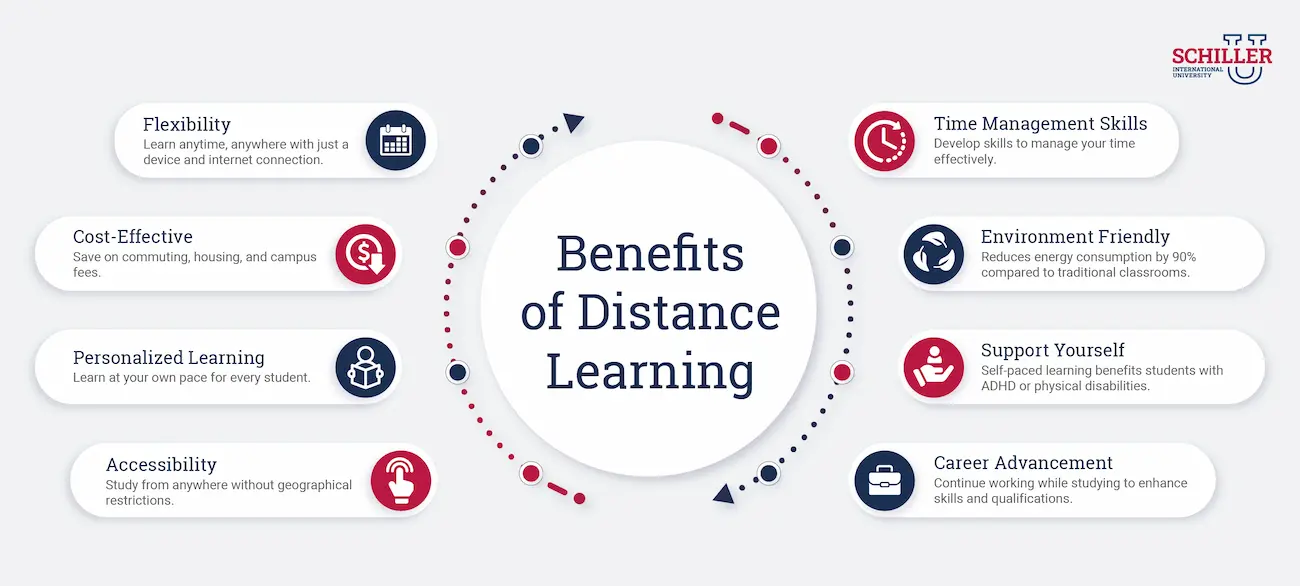
Are there any reasons why so many international students are choosing online degrees? The following are just a few of the benefits of online learning:
The flexibility of online education is one of its most significant advantages. Imagine balancing your studies with work, family, and other commitments without compromising your education. Online learning makes it possible. Unlike traditional on-campus programs, online courses allow you to study at your own pace, fitting coursework around your schedule.
According to Devlin Peck, 63% of students choose to study online because of the flexibility of virtual learning (Devlin Peck, 2025).
Key Benefits:
Online degree programs remove geographical barriers to quality education. It is all about providing a comfortable learning environment that suits your individual needs.
Concerned about tuition, accommodation, and commuting costs? There is good news. Online degree programs can be more affordable than traditional on-campus programs. It is a great way to save money on transportation, textbooks (many courses have digital resources), and campus accommodation. In 2023, 42% of students indicated that affordability was a major factor in their decision to enroll in an online degree programs (Statista).
Below is a comparison of Traditional On-Campus Learning as well as Online Degree Programs costs at Schiller International University:
|
Expense |
Traditional On-Campus (Tampa, USA) |
Online Degree Programs |
|
Tuition Fees (Bachelor’s) |
$ 17,100/ year |
$ 8,550/year |
|
Tuition Fees (Master’s) |
$ 21,600 |
$ 10,800 |
|
Accommodation |
$ 2,657 |
Minimal or none, as students study from home |
|
Transportation |
$900–$1,500/year for commuting |
Minimal or none, as there is no campus commute |
|
Textbooks |
$480/year for physical books |
Lower due to digital resources or inclusive access programs |
|
Other Campus Fees |
$ 3,420 |
Minimal or none for online programs |
Tuition Fees: Online programs generally have lower tuition fees compared to traditional on-campus programs.
Accommodation: On-campus students incur significant housing costs, while online students avoid these expenses entirely.
Transport: On-campus learning involves commuting expenses, which are negligible for online learners.
Textbooks: Online programs often leverage digital or discounted materials, reducing textbook costs compared to traditional programs.
Other Campus Fees: On-campus students pay additional fees for facilities and services not applicable to online students.
Choosing to earn your degree online helps reduce the overall financial burden, making higher education more accessible.
Think online education is easy? Think again. It demands discipline and time management skills. Managing online courses successfully requires setting goals, prioritizing tasks, and staying organized. The soft skills for 60% of online students were reported to have improved (Devlin Peck, 2025).
These time management skills are not just valuable for academic success, but also highly sought after by employers. You are not just earning a degree; you are gaining valuable life skills as well.
A further advantage of online learning is its wide variety of programs and specializations. You can find an online university offering a program tailored to your needs, no matter what your interests or career goals. From bachelor's degree programs to master's degree programs, the options are virtually endless. In 2023, 17% of students pursued online education as it was the only way for them to pursue their chosen field of study (Statista).
Whether you are aiming for a bachelor's degree or a master's degree, the digital world offers education tailored to diverse learning styles.
Earning a US-accredited bachelor's or master's degree no longer requires a physical presence in the United States, thanks to online education’s growing accessibility. Accreditation ensures that the institution meets rigorous academic and operational standards, providing a legitimate and high-quality education. Here’s an expanded overview:
A US-accredited degree is awarded by an institution that has undergone stringent evaluation by independent accrediting bodies recognized by the US Department of Education or the Council for Higher Education Accreditation (CHEA). Accreditation guarantees that the institution adheres to high academic standards, ensuring credibility and recognition globally.
Quality Assurance: Accreditation signifies that the education provided is robust, credible, and meets established academic standards.
Online degree programs offer flexibility and accessibility for students worldwide. These programs are designed to provide students with the same quality of education as an on-campus program while allowing them to complete coursework remotely. The key features include:
Institutions such as Schiller International University offer a wide range of online bachelor's and master's degree programs. These include career-related areas such as:
These programs are affordable, flexible, and designed for working professionals. By leveraging online education from accredited US institutions, students can achieve their academic and professional goals without geographical constraints while ensuring their degrees hold global value. At Schiller, students can choose between a bachelor’s and master’s degree, with a 100% experiential learning program and US accreditation.
Schiller International University is an institute that strongly advocates for this advanced mode of teaching by offering programs that allow students to study from around the world in the comfort of their homes. With a 70/30 asynchronous to synchronous model, students can enjoy flexibility while benefiting from regular virtual classes and personalized support. Schiller's distance learning programs are designed to help students earn a US-accredited degree from anywhere in the world, at their own pace. Browse Schiller's Distance Learning programs to explore these opportunities.
Earning a degree online has a number of benefits, including flexibility, affordability, and accessibility. Schiller International University offers online degree programs that are an excellent option for those interested in pursuing higher education without compromising their current lifestyle.