
 Request information

Is Studying in Europe Worth It for Latin American Students?
A European degree can strengthen a resume. But for a student traveling from Latin America, that alone is not enough to justify the cost of moving to another continent.
The better question is: what will the investment give you in return?
Tuition is only part of the calculation. Accommodation, travel, visas, insurance, and everyday expenses all matter. So do the academic quality of the program, opportunities to develop professional skills, access to international networks, and what you can realistically do after graduation.
The decision to study in Europe makes the most sense when these factors work together for Latin American students considering bachelor's or master's degrees abroad.
Key Takeaways
- Europe attracts a large international student population: EU countries issued 549,400 education-related residence permits in 2024.
- Scholarships can make European study more accessible: Nearly 100 of the 135 Mexican students selected for Erasmus Mundus in 2025 received full scholarships.
- Study in Europe is gaining ground across Latin America: 36 Peruvian students won Erasmus Mundus scholarships in 2025, Peru's highest number in more than a decade.
- The real value lies beyond the degree: Career relevance, professional networks, international exposure, and post-graduation opportunities should shape the decision.
- Total cost matters: Tuition, accommodation, living expenses, visas, insurance, and travel should be assessed together.
What Makes Studying in Europe Worth the Investment?
The strongest reason to study abroad is rarely the location by itself. It is the combination of academic preparation and professional exposure that the environment can provide.
Europe brings together different economies, industries, cultures, and education systems within a relatively connected region. For students interested in international business, technology, sustainability, hospitality, international relations, or other globally oriented fields, that can provide useful context for understanding how organizations operate across borders.
The scale of international education also matters. In 2024, education accounted for 549,400 first residence permits issued by EU countries to non-EU citizens. It was the only major residence-permit category to record an overall increase that year. (Source: Eurostat)
That figure does not mean every European university delivers the same value. It does show that international education is an established part of Europe's higher education landscape.
Students comparing destinations can compare European countries for international study before narrowing the decision to a particular city, institution, or program.
Which Academic Factors Should Latin American Students Prioritize?
The location should come after the academic and career objective.
Start with the program itself.
- Does the curriculum match the field you want to enter?
- Does it develop relevant technical knowledge alongside transferable skills?
- Are internships, projects, career services, or employer connections available?
The language of instruction is another practical consideration. English-taught programs can widen the number of European options available to students who want an international education without studying their entire degree in a new language.
The surrounding academic environment matters, too. Working with classmates from different countries can develop communication and collaboration skills that have direct relevance to international workplaces.
This is one reason international campuses are becoming an important consideration for students comparing study destinations. Students can understand why European campuses are attracting more international students when evaluating what type of academic environment suits their goals.
How Should You Calculate the Cost of Studying In Europe?
There is no single European tuition or living-cost figure that applies to every student. Costs vary by country, city, institution, and program.
A realistic budget should include:
|
Expense |
What to consider |
|
Tuition |
Program fees, deposits, registration costs |
|
Accommodation |
Rent, residence fees, utilities and deposits |
|
Living expenses |
Food, transport, phone and daily spending |
|
Visa and insurance |
Application fees, health insurance and documentation |
|
Travel |
Flights between Latin America and Europe |
|
Academic costs |
Books, software, equipment and course materials |
|
Contingency |
Unexpected expenses and emergency travel |
This is why tuition alone can be a poor measure of affordability. A lower-fee university in a more expensive city may ultimately cost more than a higher-fee program elsewhere.
Students should therefore compare the total cost of attendance against the likely academic and professional return.
For students considering Spain, for example, understanding the cost of studying in Madrid can help put tuition into the context of accommodation and everyday expenses.
Can Scholarships Make Europe More Accessible?
Financial support can materially change the calculation for a Latin American student.
Mexico provides a strong example. In 2025, 135 Mexican students were selected for Erasmus Mundus joint master's programs. Nearly 100 received full scholarships covering tuition, installation and living costs, airfare, and health insurance. More than 1,000 Mexican students have participated in the program since 2004. (Source: European External Action Service)
Peru provides another indication of the reach of European scholarship opportunities. In 2025, 36 Peruvian students received Erasmus Mundus scholarships, the country's highest number of recipients in more than a decade. Peru ranked fourth among Latin American countries that year. (Source: European External Action Service)
These awards are competitive, so students should not build a financial plan around receiving one. They do demonstrate that structured funding routes exist for qualified Latin American applicants.
When comparing European cities where quality and affordability meet, look at the complete funding picture: tuition coverage, accommodation, living support, travel allowances, eligibility requirements, and deadlines.
Can International Exposure Improve Career Readiness?
International exposure becomes valuable when it contributes to professional capability.
Studying with people from different countries can require students to communicate across cultural differences, collaborate with unfamiliar perspectives, and adapt to new ways of working. These experiences can complement the subject knowledge developed through a degree.
Professional networks can also extend beyond the university. Internships, employer events, industry projects, and relationships with international classmates may create connections that remain useful after graduation.
France illustrates the scale of this international environment. In 2024–25, 443,500 foreign students were enrolled in French higher education, up 3% year over year and 17% over five years. Foreign students represented around 15% of the country's higher education population. (Source: Campus France)
Still, international exposure should not be confused with guaranteed employability. An international degree does not automatically secure a job. Employers may also consider work experience, language skills, technical capabilities, and knowledge of the local labor market.
That makes internships, career support, employer engagement, and program relevance important criteria when comparing universities.
What Should Students Know About Visas and Post-Graduation Options?
Visa requirements should be investigated before choosing a destination.
For non-EU students, requirements vary by country and program duration. Depending on the destination, applicants may need proof of admission, financial resources, accommodation, and health insurance.
Post-graduation rules vary as well. Some countries offer options for eligible graduates to stay back temporarily to seek employment, while others have different conditions. Students should check the specific national rules rather than assuming that one European policy applies everywhere.
A useful pre-application checklist is:
- Student visa and residence requirements
- Proof-of-funds requirements
- Permission to work during studies
- Post-study employment or job-search options
- Language expectations in the local labor market
- Recognition of the qualification in the countries where you plan to work
These details can have a direct effect on the overall return on your educational investment.
Could An International University Be the Right Fit?
Once the destination and financial questions are clearer, students can consider which type of institution best supports their goals.
A traditional national university may suit someone looking for a particular academic or research environment. An international university can be relevant for students who prioritize English-taught programs, multicultural learning, and mobility between different locations.
This is where Schiller International University fits naturally into the discussion.
Schiller offers programs at campuses in Madrid, Paris, and Heidelberg, with an intercampus mobility model that allows eligible students to move between locations. The university currently reports a community representing more than 130 nationalities.
For a Latin American student, that model can be relevant if international mobility is part of the intended academic outcome. Moving between campuses can place students in different cultural and professional settings during their education, while keeping them within the same university network.
Students can learn about Schiller's bachelor's and master's programs according to their academic field and longer-term career objectives.
The university's four-campus model also means international exposure is not limited to a single exchange period. Students who meet the relevant academic, legal-status, program, and space requirements can explore Schiller's international campuses as part of their academic planning.
How Can You Decide If Europe Is Right for You?
The decision becomes clearer when you work backward from your intended career.
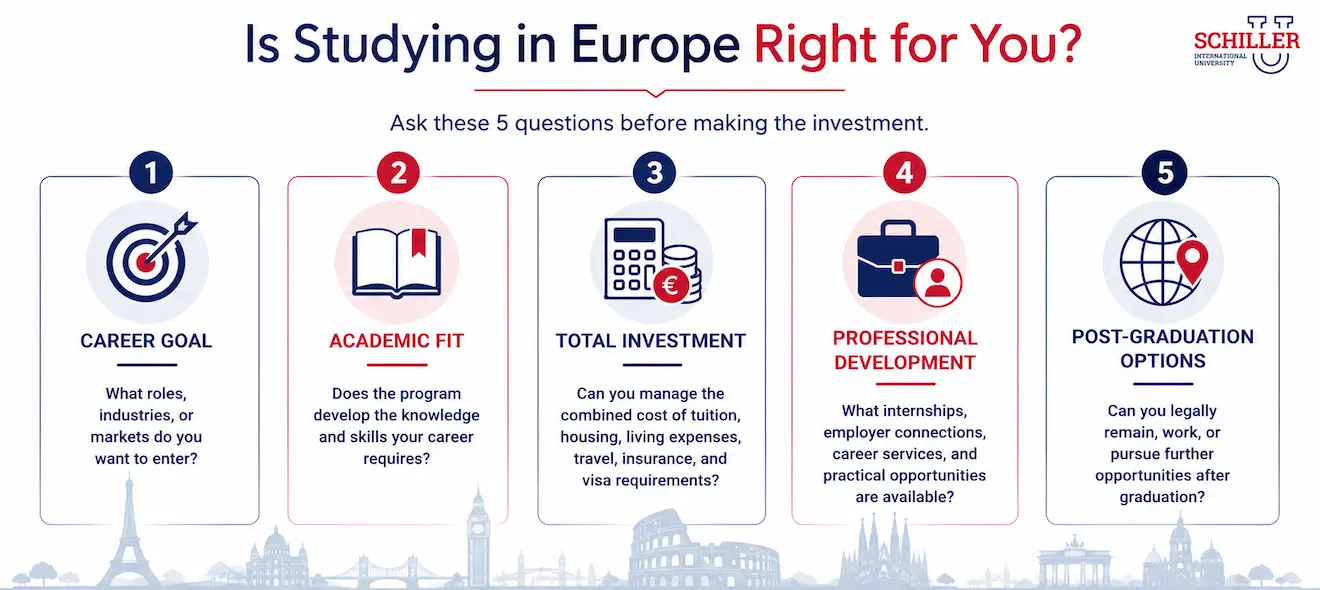
If the answers align, studying in Europe can represent a meaningful investment in international education rather than simply an overseas qualification.
Choosing Europe with a Clear Purpose
For Latin American students, the case for studying in Europe is strongest when the destination is connected to a specific academic and professional objective.
The right degree should provide relevant knowledge. The right environment should help develop professional capabilities. The right destination should make financial and practical investment manageable. And the right post-graduation pathway should support what you intend to do afterward.
That makes the decision less about choosing Europe for its reputation and more about choosing an educational model that fits your ambitions.
Ready to take your education from Latin America to Europe? Find the right Schiller programs in Europe for your academic and career goals and study in an English-taught, international environment.
FAQs
Q1: Is studying in Europe worth it for Latin American students?
It can be, if the program, total cost, career opportunities, and post-graduation options align with your goals.
Q2: What are the benefits of studying in Europe compared to Latin America?
Key benefits can include multicultural learning, international networks, English-taught programs, exposure to European industries, and opportunities to develop transferable skills.
Q3: Which European countries are most popular among Latin American students?
Spain, France, Germany, Italy, and the Netherlands are popular choices. However, cost, program fit, visa requirements, and career prospects should matter more than popularity.
Q4: Can Latin American students study in Europe in English?
Yes. Many European universities offer English-taught bachelor's and master's programs, although availability varies by country, institution, and field.
Q5: How can Latin American students apply to universities in Europe?
Requirements vary, but commonly include academic records, identification, proof of language proficiency where required, and program-specific documents. Non-EU students must also complete the relevant visa or residence process.
Discover Our Campuses