 Request information

International Literacy Day 2026: 7 Types of Literacy Skills You Need Today
On 8 September, International Literacy Day 2026 marks a milestone. UNESCO’s 60th anniversary observance uses the theme “Literacy for people, the planet and prosperity,” with the global celebration and UNESCO International Literacy Prizes ceremony taking place in Chiapas, Mexico.
The occasion begins with an urgent reality. UNESCO reports that at least 739 million young people and adults lacked basic literacy skills in 2024. Four in 10 children do not reach minimum proficiency in reading, while 272 million children and adolescents were out of school in 2023.
For an adult, those figures can mean being unable to check a medicine dosage, complete a benefits form, or understand a rental contract without help. Foundational literacy determines whether someone can act independently in systems shaping health, income, housing, and civic life.
Key Takeaways
- 739 million young people and adults lacked basic literacy skills in 2024, while 4 in 10 children did not reach minimum reading proficiency.
- 7 types of literacy shape participation in today's world, from foundational and digital literacy to AI, business, intercultural and global employability skills.
- 39% of workers' existing skill sets are expected to be transformed or become outdated between 2025 and 2030.
- 170 million new roles are projected to be created by 2030, compared with 92 million roles displaced as technology and other global shifts reshape work.
- 3 Schiller programs featured in the literacy ladder connect learning with data and AI, business and financial, and communication and intercultural literacy.
Literacy Is a Continuum, Not a Completed Task
Literacy is the ability to read the code a system runs on. That may mean reading words and numbers, interpreting a dashboard, questioning an AI-generated answer, reading a balance sheet, or recognizing how a workplace makes decisions.
Literacy forms a continuum. Foundational literacy creates the basis for participation. Digital, data, AI, business, communication, and workplace literacies build toward professional fluency.
Every era adds another system to read. Someone may be highly educated and still struggle to evaluate an algorithm or interpret a labor market. No rung stays finished forever.
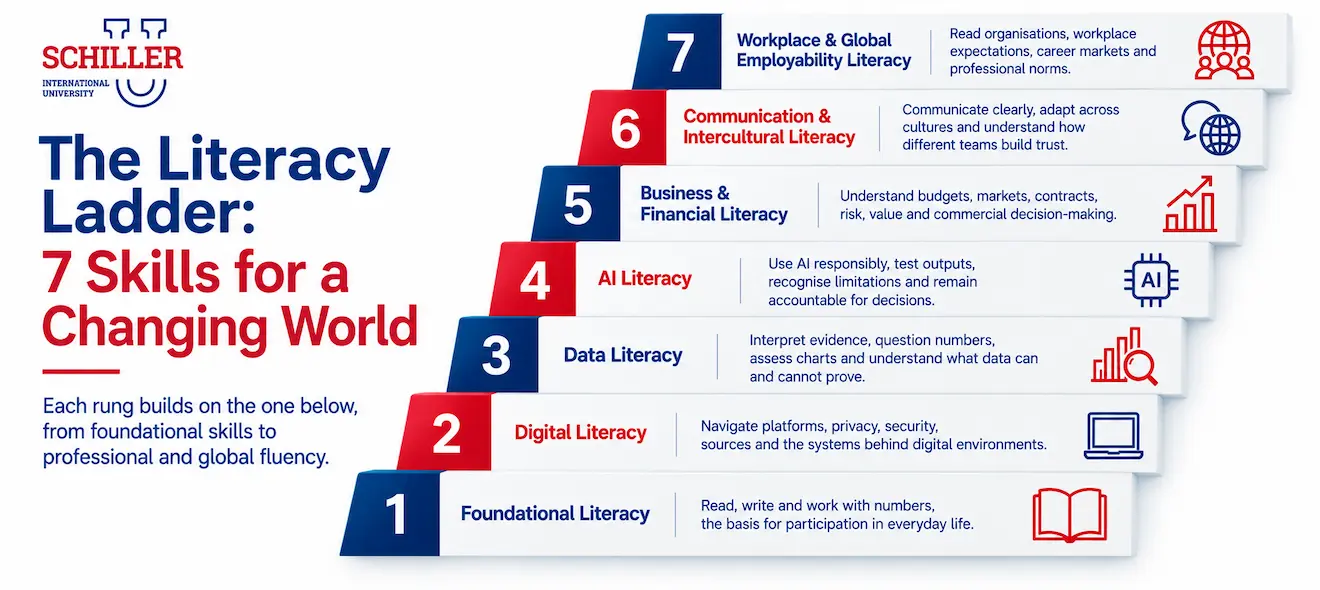
The 7 Types of Literacy Skills
1. Foundational Literacy
Foundational literacy covers reading, writing, and numeracy. It enables you to follow instructions, compare prices, complete documents, and understand public information. These abilities are the floor of civic and economic participation.
The consequences of being excluded at this level are profound. An unread dashboard may weaken a business decision; an unread dosage label may threaten a person’s health. The examples belong on the same literacy continuum, but their stakes are not equivalent. Foundational illiteracy is an injustice. AI illiteracy is a disadvantage.
2. Digital Literacy
Digital literacy skills extend beyond operating a phone or opening an app. They include understanding platform business models, ranked search results, application permissions, file storage, identity, and privacy.
Age does not guarantee competence. People under 25 may use digital services fluently while knowing little about ranking systems, security, source credibility, or digital citizenship. Digital literacy requires users to question the environments that software creates.
3. Data Literacy Skills
Data literacy means reading evidence without being overawed by numbers. You need to notice what a chart leaves out, who a sample excludes, and whether two variables merely move together.
Consider a sales dashboard showing a 20% increase. The result looks different if the reporting period excludes low-performing regions or counts returning customers differently. The decisive skill is disciplined skepticism: asking where the number came from, what it measures, and which decision it can support.
4. AI Literacy
AI literacy skills are becoming central to professional judgment. They include knowing what to delegate, how to write a useful brief, how to test the output, and who remains accountable.
An AI system can produce a polished answer containing invented sources, hidden assumptions, or inappropriate recommendations. Professional fluency therefore requires sound judgment. You must verify important claims, protect confidential information, recognize bias, document significant decisions, and know when a specialist must take over.
Tool-specific training has a short skill half-life because products change quickly. Judgment travels further. A marketer must assess whether generated copy fits its audience and evidence. A data analyst must test whether a model is valid for the population affected. A manager must decide whether automation improves a process or makes an error faster. AI literacy means making those decisions responsibly, regardless of which tool is popular this quarter.
5. Business and Financial Literacy
Business and financial literacy means reading the systems that turn work into value, including profit and loss statements, contracts, market forecasts, supply chains, budgets, and currency exposure.
Technical expertise may identify a solution. Business literacy helps you explain its cost, risk, timing, and likely effect. That combination allows you to argue for a decision and take responsibility for resources.
6. Communication and Intercultural Literacy
Communication literacy makes knowledge usable for another person. It includes writing so a nonspecialist can act, listening, negotiating, and adapting detail to the decision at hand.
Intercultural communication skills add another layer: reading how trust, disagreement, hierarchy, silence, and deadlines are expressed across cultures. Direct feedback may be expected in one team and damaging in another. A proposal that persuades colleagues in Madrid may need different context in Tampa. This literacy makes every other rung portable across borders.
7. Workplace and Global Employability Literacy
Workplace literacy means reading an organization as a system. You need to know who decides, when to escalate a problem, how feedback is given, and what performance review measures. Many graduates meet these unwritten rules only after being evaluated against them.
Global employability skills address the labor market around that workplace. In Frankfurt, official German guidance describes a tabular CV with education, grades, and language levels; a photo is often expected, although practices vary by industry. US guidance emphasizes concise, results-focused language and excludes photos from federal resumes. Credential recognition, work authorization, hiring cycles, and sector demand also influence when and where to apply.
A graduate can understand discipline yet be professionally illiterate in the environment where it is practiced. That gap affects how someone presents experience, asks for feedback, and judges an opportunity. Career readiness for international students develops through repeated practice in organizations and multicultural teams.
Why Literacy Is Now a Workforce Issue
The ladder matters because the shelf life of occupational knowledge is shortening. The World Economic Forum’s Future of Jobs Report 2025 found that employers expect 39% of workers’ existing skill sets to be transformed or become outdated between 2025 and 2030. The report projects 170 million roles will be created and 92 million displaced as technology, demographic change, economic pressures, and the green transition restructure the global workforce.
Restructuring differs from the disappearance of work. Tasks move between people and technologies, new roles emerge, and existing positions demand different capabilities. AI and big data lead the report’s fastest-growing skills, but analytical thinking remains the core skill most employers seek, identified as essential by seven in 10 companies.
Employers identify skills gaps as their leading barrier to business transformation. The report does not call these gaps “workplace literacy.” Through the literacy ladder, however, framing problems, evaluating evidence, communicating recommendations, and adapting to organizational constraints are capabilities that shape labor market readiness.
Higher Education Turns General Literacy into Professional Fluency
Schooling establishes broad knowledge and foundational skills. Higher education develops disciplinary literacy: the vocabulary, methods, evidence standards, and ethics through which a profession decides what counts as sound work.
A diplomat distinguishes a formal position from negotiating space and writes for policy audiences. A hotel general manager reads occupancy, staffing, and guest expectations as one operating system. A data analyst questions models and uncertainty. A supply chain leads inventory, supplier risk, transport constraints, and currency movements together.
Students develop these professional languages by applying concepts, receiving feedback, defending decisions, and seeing how standards change across situations. International higher education adds another form of practice: explaining disciplinary judgments among people whose assumptions and professional norms differ.
Purposeful experience supports study abroad employability. Crossing a border does not automatically produce career readiness. Applied projects, internships, reflection, and feedback turn exposure into capability.
How Schiller Builds Literacy Across Programs and Countries
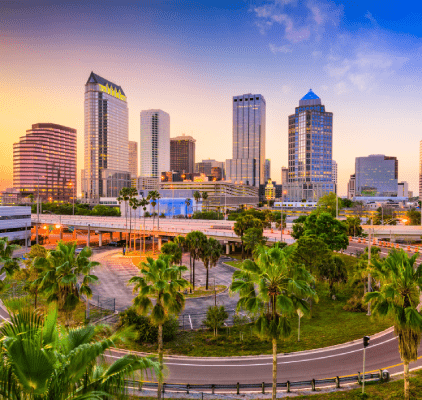
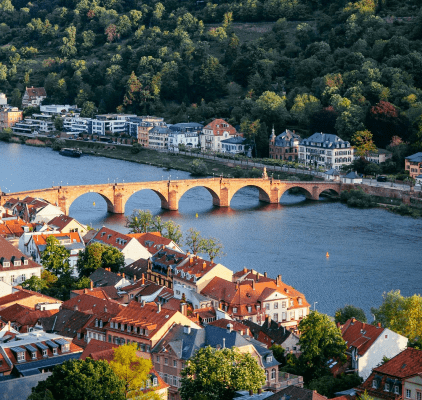
At Schiller International University, international learning spans campuses in Heidelberg, Madrid, Paris, and Tampa. Eligible bachelor’s students can apply to move after their first year, while eligible master’s students may move after their fourth month. This can place one degree path in different cultural and labor-market settings. Students may also pursue internship opportunities across locations, subject to program requirements, local rules, and availability.
Specific degrees develop different parts of the ladder. The MS in Data Science develops data and AI literacy through advanced analytics, machine learning, data visualization, and the interpretation of complex datasets. The Master of Business Administration builds business and financial literacy through finance, strategy, operations, and decision-making. The MA in International Relations and Diplomacy develops communication and intercultural literacy through diplomacy, international affairs, negotiation, and engagement across political and cultural contexts. The MS in Sustainability Management brings several of these literacies together, requiring students to interpret environmental and business challenges, evaluate evidence, and make decisions within complex global systems. Campus availability may vary by program and intake.
At Schiller, global employability literacy is developed through experiences that require students to apply what they know across different academic, cultural, and professional settings:
- Intercampus mobility: Schiller's Intercampus Mobility opportunities allow eligible students to continue their studies at different Schiller campuses, experiencing new classroom norms, cultures, and professional environments as part of their degree journey.
- International learning environments: Multinational cohorts give students regular opportunities to explain ideas across perspectives, adapt how they communicate, and work with people whose assumptions and professional norms may differ from their own.
- Internship opportunities: Internships can provide practical exposure to local working environments, helping students understand how professional expectations and workplace practices vary between markets, subject to program requirements, local rules, and availability.
- Career support: Schiller's career services provide workshops and individual guidance covering CVs, cover letters, LinkedIn profiles, career planning, networking, and preparation for different employment markets.
Keep Climbing the Literacy Ladder
The literacy ladder never ends. Someone who stops climbing is not uneducated; they are literate in a world that moved on. New tools, markets, and professional standards will keep changing what informed participation requires. Durable literacy therefore combines a strong foundation with the willingness to question, adapt, and become fluent again.
Build the skills for a changing world! Explore programs at Schiller International University and find the right path for your future.
Discover Our Campuses