
 Request information

Cyber Diplomacy: How it is reshaping International Relations
A cyberattack does not need to cross a border physically to become an international problem.
It can disrupt a government institution, compromise critical infrastructure, expose sensitive information, or trigger accusations between states, all from a digital environment that rarely respects geography. That reality is changing what governments discuss, what diplomats negotiate, and what students preparing for careers in international affairs may need to understand.
Cyber diplomacy sits at the intersection of technology, security, foreign policy, and international cooperation. It reflects a growing recognition that cybersecurity is no longer only a technical concern for IT departments. It has become part of the broader conversation around national security, state behavior, international law, and conflict prevention.
This raises an important question for students interested in international relations: How does diplomacy work when some of the most consequential disputes and threats exist in cyberspace?
The answer is still developing. But one thing is clear: the agenda of international relations is expanding.
Key Takeaways
- ENISA analyzed 4,875 cybersecurity incidents between July 2024 and June 2025, illustrating the scale of the threat environment governments must respond to.
- 38.5% of the incidents recorded in ENISA’s 2025 dataset targeted public administration, showing why cyber threats can directly affect governments and public institutions.
- The UN’s Open-Ended Working Group on ICT security ran from 2021 to 2025, bringing states together to discuss responsible behavior, international law, confidence-building, and cooperation.
- In December 2025, the UN General Assembly adopted Resolution 80/16, continuing international work on security in the use of information and communications technologies.
- The World Economic Forum identifies networks and cybersecurity among the fastest-growing skills in importance through 2030, while analytical thinking remains a core skill for 69% of employers.
What Is Cyber Diplomacy?
Cyber diplomacy refers to diplomatic efforts addressing issues that arise in cyberspace, including cyber threats, responsible state behavior, digital governance, and international cooperation.
As cyber incidents can cross borders and affect governments, infrastructure, and relationships between states, they have become an international relations concern. Cyber diplomacy helps countries address these challenges through dialogue, cooperation, and policy.
For future diplomats and international policy professionals, the focus is not on becoming cybersecurity engineers but on understanding how technology can shape national security, international law, and relations between states.
Why Cyber Threats Have Become an International Relations Issue
International relations have always involved questions of power, security, cooperation, and conflict. Cyber threats have introduced a new environment in which those questions can play out.
A major cyberattack can affect public services, financial systems, communications networks, or critical infrastructure. It can also create diplomatic tension when governments attribute malicious activity to another state or seek international support in responding to it.
The scale of this challenge is significant. ENISA analyzed 4,875 cybersecurity incidents between July 2024 and June 2025. Its 2025 dataset also found that public administration was the most targeted sector, accounting for 38.5% of recorded incidents. These figures help explain why cybersecurity and diplomacy are becoming increasingly connected: attacks on digital systems can have direct implications for governments and public institutions. (Source: ENISA)
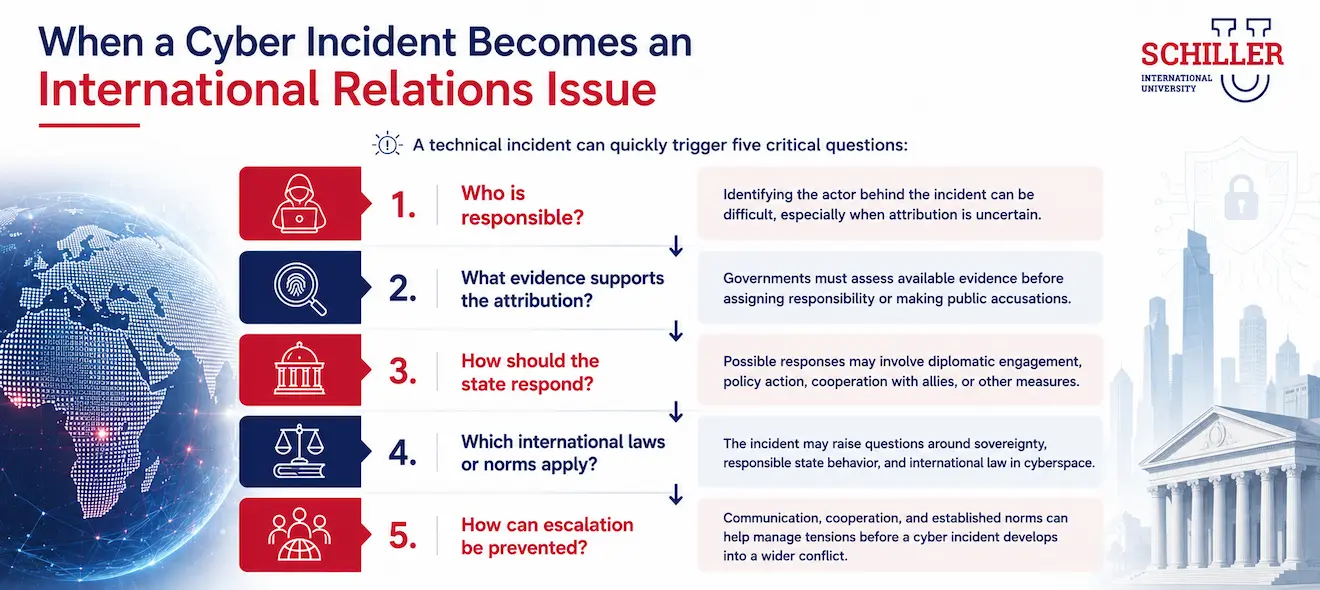
Those are not questions technology alone can answer.
Cyber Conflict Is Different from Traditional Conflict - But Still Political
Cyber conflict does not always follow the patterns associated with conventional warfare.
An attack may remain undisclosed. Attribution can take time. The consequences may emerge gradually rather than immediately. Private companies may own or operate systems that are strategically important to national security.
This creates a need for communication and restraint, particularly when governments face uncertainty. Cyber conflict prevention can therefore involve establishing channels for dialogue, developing shared expectations, and creating confidence-building measures that reduce the risk of misunderstanding.
Traditional diplomacy has long dealt with the challenge of managing competing interests before they escalate into conflict. The same logic now applies in the digital domain, although the technical and legal context is often more complicated.
The Role of Cyber Diplomacy in International Relations
The role of cyber diplomacy is not limited to responding after an attack. Much of its value lies in building frameworks before a crisis occurs.
Governments are increasingly discussing what responsible state behavior should look like in cyberspace. These conversations can cover the protection of critical infrastructure, the applicability of international law, information sharing, capacity-building, and mechanisms for cooperation.
The United Nations provides one of the clearest examples of this work. Its Open-Ended Working Group on security in the use of information and communications technologies completed a five-year process running from 2021 to 2025. The discussions addressed issues including state behavior, international law, confidence-building measures, capacity-building, and cooperative measures. (Source: United Nations)
This is what global cyber governance looks like in practice. It is not a single treaty that resolves every digital security challenge. It is an ongoing effort to create common understanding among countries with different political systems, strategic interests, and levels of technological capability.
The work has also continued beyond that process. In December 2025, the UN General Assembly adopted Resolution 80/16, establishing further institutional work on security in the use of ICTs. The continued development of these mechanisms suggests that cyber policy is becoming a sustained part of multilateral diplomacy rather than a temporary response to a particular technological trend. (Source: United Nations)
Why International Cooperation Matters in Cyberspace
No country manages cyberspace in isolation.
Digital networks connect economies, institutions, and populations across national boundaries. A vulnerability in one part of that system can have consequences elsewhere. At the same time, countries have very different levels of cybersecurity capacity.
The ITU’s Global Cybersecurity Index 2024 assessed 194 economies, reflecting the breadth of international attention given to national cybersecurity readiness and capacity. (Source: International Telecommunication Union)
This creates a practical challenge for international cybersecurity cooperation. Stronger defenses in one country do not automatically solve weaknesses elsewhere. Cyber capacity-building, information exchange, technical assistance, and diplomatic dialogue can therefore become part of broader international security discussions.
Cooperation does not mean that states will agree on every aspect of cyber policy and international relations. Strategic interests still matter. Questions surrounding sovereignty, surveillance, data governance, and state responsibility can produce substantial disagreement.
Diplomacy becomes valuable precisely because agreement cannot be assumed.
Digital Diplomacy Is Expanding What Diplomats Need to Understand
The growth of digital diplomacy does not replace traditional diplomatic skills. Negotiation, political analysis, cross-cultural communication, and knowledge of international institutions remain central to the profession.
What is changing is the context in which those skills are applied.
A foreign affairs professional may increasingly encounter discussions involving artificial intelligence, data security and privacy laws, digital infrastructure, cyber warfare, or technology regulation. Understanding the technical details at an expert level may not always be necessary. Understanding their policy implications can be.
Consider the difference between two questions:
How does a particular cybersecurity system work?
and
How could a vulnerability in that system affect national security, international cooperation, or relations between states?
The second question sits much closer to the work of international relations professionals.
This is also why the relationship between technology and global affairs deserves attention from students before they enter the workforce. The World Economic Forum’s Future of Jobs Report 2025 identifies networks and cybersecurity among the fastest-growing skills in importance through 2030. Analytical thinking remains a core skill for 69% of employers, while 39% of workers’ existing skill sets are expected to be transformed or become outdated between 2025 and 2030. (Source: World Economic Forum)
For future diplomats and policy professionals, the lesson is not that everyone must specialize in cybersecurity. It is that the ability to analyze complex issues across disciplines is becoming more relevant.
What Skills Could Support a Career in Cyber Diplomacy?
Cyber diplomacy brings together international relations, policy, and technology. Professionals do not need to be cybersecurity engineers, but they do need to understand how digital developments can influence governments, security, and relationships between states.
International Relations and Geopolitical Analysis
Cyber incidents do not occur in a political vacuum. Understanding alliances, geopolitical tensions, trade relationships, and security interests can help professionals assess how governments interpret and respond to digital threats.
Policy and Legal Awareness
Cyber policy raises questions around international law, sovereignty, regulation, privacy, and responsible state behavior. Professionals need to understand how these frameworks shape government’s responses to digital activity.
Negotiation and Communication
Cyber diplomacy often requires translating complex technical issues into clear policy discussions. Strong communication and negotiation skills can help professionals work across governments, institutions, and competing national interests.
Cybersecurity Awareness
Technical expertise is not always required, but a basic understanding of cybersecurity can help professionals engage with emerging policy debates. Schiller has also examined studying cybersecurity and data ethics in a country focused on privacy, highlighting how digital issues can extend into wider ethical and policy discussions.
Analytical Thinking
Cyber incidents can involve incomplete information and competing interpretations. Analytical thinking helps professionals assess evidence, question assumptions, and consider the potential consequences of different policy responses.
Where Does Cyber Diplomacy Create Career Relevance?
Cyber diplomacy is unlikely to appear as a single, narrowly defined career track in every organization. Instead, knowledge of cybersecurity and digital governance can become relevant across a range of international careers.
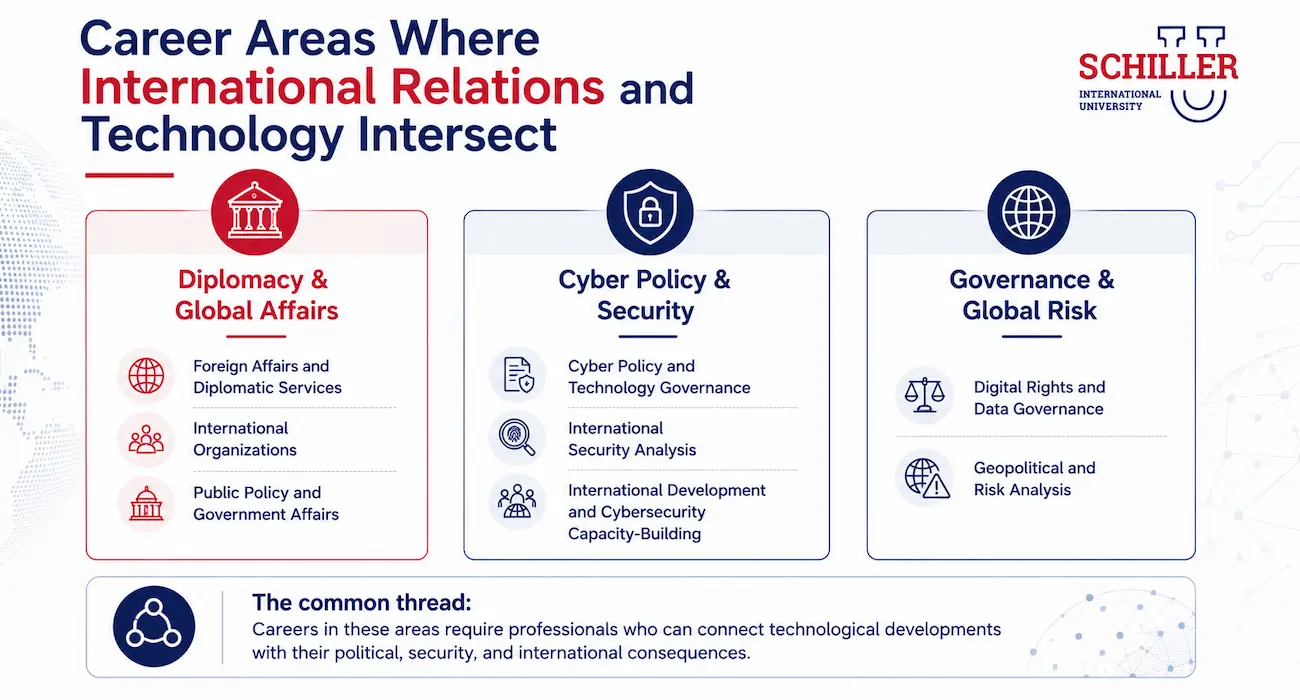
The common thread is the ability to connect technology with international consequences.
This reflects a broader shift in how careers in international affairs are developing. The field is no longer concerned only with conventional political negotiations or geographic conflicts. Digital systems, online activism, information environments, and cyber security concerns can all shape how states interact. The growing influence of digital activity on global affairs is also visible in areas such as online activism and international relations.
Preparing for an International Relations Career in a Digital Environment
Students interested in this area do not need to choose between becoming a diplomat and becoming a technology specialist.
A stronger approach may be to develop depth in international relations while building enough awareness of emerging technologies to understand where they intersect with global policy.
An International Relations and Diplomacy education can provide a foundation in areas such as geopolitics, international organizations, negotiation, conflict, and global governance. Technology-related developments can then be understood as part of the changing environment in which those disciplines operate.
Schiller’s Bachelor's in International Relations and Diplomacy and MA in International Relations and Diplomacy provide academic pathways for students who want to examine global affairs through an international perspective.
The relevance of this preparation becomes clearer when viewed through the changing nature of diplomatic work. Future professionals may be asked to discuss traditional security concerns in one meeting and questions around AI governance, cyber policy, or data security in another.
The underlying ability remains consistent: understanding complex issues, recognizing different national interests, and finding ways to communicate and cooperate across borders.
Diplomacy Will Continue to Follow the World’s Hardest Problems
Diplomacy has always changed in response to the problems governments need to solve.
Climate negotiations expanded the environmental agenda. Global health crises strengthened international coordination around public health. Digital technologies are now bringing cybersecurity, data governance, and cyber conflict into the same diplomatic conversation.
The students best prepared for this environment may be those who can move comfortably between disciplines: connecting political developments with technological change, understanding security without reducing it to military power, and recognizing that cooperation increasingly depends on systems that cross national borders.
As cyber diplomacy continues to shape international relations, the challenge for future professionals is not to predict every technology that will emerge. It is to develop the analytical and international perspective needed to understand what those technologies mean once they begin affecting governments, societies, and relationships between states.
Students considering where an International Relations and Diplomacy degree could lead can consider Schiller’s BA in International Relations and Diplomacy and Master's in International Relations and Diplomacy programs. They provide a clearer view of the academic foundations relevant to a field whose agenda continues to expand.
FAQs
Q1: What is cyber diplomacy?
Cyber diplomacy refers to diplomatic efforts focused on issues arising from cyberspace, including cybersecurity, responsible state behavior, international law, digital governance, and cooperation between countries on cyber-related challenges.
Q2: Why is cyber diplomacy important in international relations?
Cyber threats can affect national security, public institutions, economies, and relationships between states. Cyber diplomacy provides channels for countries to discuss norms, reduce misunderstandings, cooperate on security, and address the international consequences of cyber incidents.
Q3: How do cyber threats impact global diplomacy?
Cyber incidents can create political tension, particularly when governments believe another state or state-linked actor is responsible. They can also raise questions around attribution, international law, proportional response, and conflict prevention.
Q4: What skills are needed for a career in cyber diplomacy?
Useful skills can include international relations knowledge, geopolitical analysis, policy awareness, negotiation, communication, analytical thinking, and a working understanding of cybersecurity and digital technologies.
Q5: How can students pursue a career in cyber diplomacy?
Students can begin by developing a strong foundation in international relations, diplomacy, global governance, and international security. Adding knowledge of cyber policy, technology governance, data issues, and cybersecurity can help them understand how digital developments intersect with international affairs.
Discover Our Campuses