
 Request information

Best Countries in Europe for Latin American Students (2026): France vs Spain vs Germany
Three countries. Three different pathways to your future.
For Latin American students, France, Spain, and Germany are the leading choices when considering higher education in Europe. Each offers internationally recognized qualifications, access to the European job market, and a high standard of education. However, the experience extends far beyond university rankings or tuition fees.
The right destination depends on what matters most to you. Some students prioritize affordability, while others focus on career opportunities, language, or the type of academic environment that best supports their ambitions.
We will compare France, Spain, and Germany across the factors that influence long-term value, including tuition fees, living costs, employability, language, and student life. By the end, you will have a clearer understanding of which destination best aligns with your academic and career goals.
Key Takeaways
- Germany offers the lowest tuition costs at many public universities, although students should still budget €850–€1,100 per month for living expenses.
- France combines internationally respected higher education with annual public tuition of around €2,895 for bachelor's degrees and €3,941 for master's degrees.
- Spain balances affordability with cultural and linguistic familiarity, making it an attractive option for many Latin American students.
- Monthly living costs are broadly similar across all three destinations, meaning long-term career prospects and educational fit often matter more than tuition alone.
- Choosing the right destination starts with understanding your priorities, not simply comparing rankings.
Why France, Spain, and Germany Stand Out
Europe offers a wide range of study destinations, but France, Spain, and Germany consistently remain among the most popular choices for students from Latin America. Each combines recognized qualifications with strong employment markets, international learning environments, and opportunities to build a global career.
Although these countries are often compared together, they appeal to students for different reasons.
France attracts students interested in internationally recognized programs in business, finance, hospitality, luxury management, political science, and international relations. Its close links with multinational organizations make it particularly appealing for students with global career ambitions.
Spain is a natural choice for many Latin American students because of its shared language and cultural familiarity. Studying in a Spanish-speaking environment can make the transition to university life easier while providing access to European education and international career opportunities.
Germany is widely recognized for engineering, technology, manufacturing, and applied sciences. Combined with low tuition costs at many public universities and strong connections between universities and industry, it continues to attract students seeking career-focused education.
Rather than asking which country is "best," a more useful question is which one best supports your academic interests, career aspirations, and preferred learning environment.
If you are still exploring your options, you may also find Schiller's guide on why more students in France, Spain, and Germany are choosing international universities helpful for understanding the broader trends influencing study choices across Europe.
Cost of Studying in France vs Spain vs Germany
Cost is often the first factor students compare, but tuition fees tell only part of the story. Accommodation, food, transport, insurance, and everyday expenses all contribute to the overall cost of studying abroad.
The table below provides a practical comparison of tuition fees and average monthly living costs across the three destinations.
|
Comparison |
France |
Spain |
Germany |
|
Estimated Annual Tuition Costs |
€6,000–€18,000+ (varies by institution and program) |
€5,000–€20,000+ (varies by institution and program) |
€5,000–€20,000+ (varies by institution and program) |
|
Estimated Monthly Living Costs |
€800–€1,200 |
€800–€1,200 |
€850–€1,100 |
|
Overall Budget Profile |
Moderate |
Moderate |
Lowest tuition overall |
While Germany generally offers the lowest tuition, the overall cost difference is smaller once accommodation and living expenses are included. France offers excellent value through internationally recognized education, while Spain combines relatively affordable tuition with a familiar cultural environment for many Latin American students.
Career Opportunities After Graduation: Which Country Fits Your Goals?
For many Latin American students, studying in Europe is an investment in their future career. While all three destinations offer access to the European job market, each has strengths that align with different industries and professional ambitions.
Rather than asking which country offers the "best" opportunities, consider where your chosen field is most likely to thrive.
France: A Hub for Global Business
France appeals to students looking further domestic careers. Its economy is closely connected to international business, finance, diplomacy, luxury brands, hospitality, and creative industries, giving students opportunities to build networks while they study.
Whether your goal is to work for a multinational company, an international organization, or a globally recognized brand, France offers an environment that combines academic excellence with international exposure.
Spain: Familiarity with International Opportunity
Spain offers a unique balance between cultural familiarity and European career prospects. For many Latin American students, studying in a Spanish-speaking environment makes the transition to university life more comfortable while providing access to industries such as international business, tourism, logistics, entrepreneurship, and digital marketing.
For students who want to gain international experience without adapting to a completely new language from day one, Spain can be an appealing choice.
Ultimately, the strongest destination is the one that supports your long-term career goals rather than simply offering the lowest tuition or the highest ranking.
Germany: A Strong Choice for STEM Careers
Germany is known for its close links between universities and industry, making it particularly attractive for students pursuing technical and research-driven careers. Fields such as engineering, computer science, artificial intelligence, renewable energy, and advanced manufacturing continue to benefit from strong employer demand and practical learning opportunities.
Students interested in innovation or postgraduate research often choose Germany because academic study is closely connected to real-world applications.
Can Latin American Students Study in Europe in English?
Many students assume they need to be fluent in French, German, or Spanish before applying to university. Today, that is no longer the case.
Universities across France, Spain, and Germany continue to expand their English-taught bachelor's and master's programs, allowing international students to earn a European degree while gradually developing local language skills outside the classroom.
Learning the local language still has clear advantages. It can make everyday life easier, broaden internship opportunities, and strengthen long-term employability. However, it should not prevent you from considering a destination that aligns with your academic and career ambitions.
If you are planning an international career, studying in English while learning a second language alongside your degree can offer the flexibility to work across different markets after graduation.
Students interested in multilingual learning environments can also explore Schiller's guide to studying in Madrid, Paris, or Germany through international campuses to understand how different academic settings support global careers.
Scholarships and Financial Support
Studying in Europe can be more affordable than many students expect, particularly when scholarships and financial aid are taken into account.
Across France, Spain, and Germany, universities, governments, and external organizations offer funding for international students based on academic achievement, financial need, research interests, or program eligibility.
Before choosing a destination, compare:
- University scholarships
- Government-funded financial aid
- Merit-based awards
- Research scholarships
- Country-specific funding opportunities
Starting your scholarship search early gives you access to more funding options and helps you build a realistic budget before submitting applications.
Student Life: Which Destination Feels Right?
Your university experience is shaped by more than lectures and assessments. The city you live in, the people you meet, and the opportunities you have outside the classroom all contribute to your personal and professional growth.
Each destination offers a distinct student experience.
- France combines academic tradition with a vibrant international environment, making it well suited to students interested in business, culture, politics, and global affairs.
- Spain offers a familiar linguistic and cultural setting for many Latin American students, making it easier to adapt while enjoying a dynamic student lifestyle.
- Germany appeals to students who value structured learning, innovation, and a strong research culture supported by modern infrastructure.
Rather than asking which country offers the "best" student life, think about where you will feel most motivated to learn, grow, and build lasting connections.
If you would like to learn more about studying across Europe, explore Schiller's stories on campus life and international student experiences.
Which European Destination Matches Your Goals?
Every student's priorities are different. Some focus on affordability, others on career opportunities or language, while many are looking for the right balance between all three.
The comparison below offers a simple starting point.
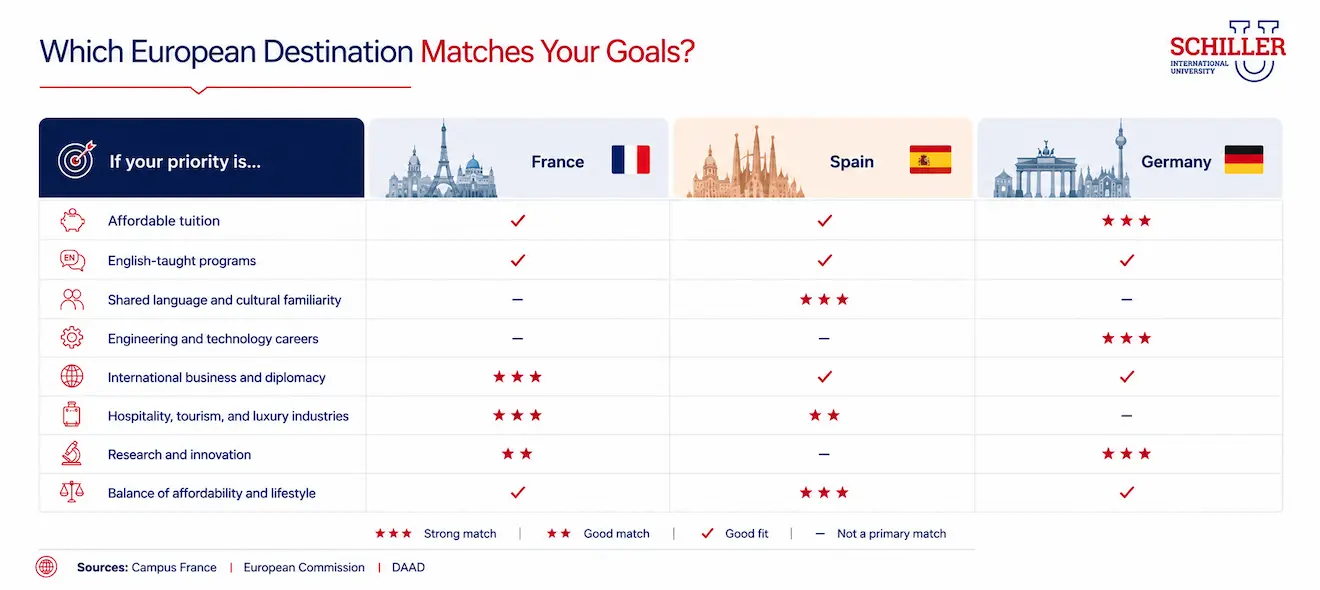
Use this comparison as a guide rather than a ranking. The best destination is the one that supports your academic interests, career ambitions, and preferred way of living and learning.
Studying Across Europe with One University: Schiller International University
Choosing between France, Spain, and Germany is not always straightforward. Some students are drawn to Spain's cultural familiarity, others to France's international business environment, while many value Germany's reputation for innovation and research.
Schiller International University offers a different perspective.
With campuses in Madrid, Paris, and Heidelberg, students experience an American-style education while studying in internationally connected European cities. This multi-campus approach allows students to experience different academic and cultural environments without limiting their education to a single destination.
Schiller's programs combine practical learning with international exposure, helping students develop transferable skills, intercultural awareness, and global outlook that employers increasingly value.
If you're comparing study options, you can also explore Schiller's bachelor's and master's programs to discover which academic pathway best supports your long-term goals.
Choosing the Right Destination
France, Spain, and Germany each offer compelling reasons to study in Europe, but they suit different ambitions.
Germany stands out for engineering, technology, and research. France is a strong choice for international business, diplomacy, hospitality, and luxury industries. Spain combines academic quality with cultural familiarity, making it particularly attractive for many Latin American students.
The right decision is not about choosing the highest-ranked country; it is about finding an environment where you can thrive academically, personally, and professionally. Explore Schiller's campuses to learn how studying across multiple international locations can broaden your academic and cultural experience.
FAQs
Which European country is best for Latin American students in 2026?
There is no single best destination. Germany is well suited to STEM and research, France to international business and diplomacy, and Spain to students seeking a familiar language and culture alongside a European education. The right choice depends on your academic goals, budget, and career plans.
Is France, Spain, or Germany more affordable for international students?
Germany generally offers the lowest tuition at many public universities, while Spain and France combine moderate tuition with similar monthly living costs. Comparing total expenses, not tuition alone, provides a clearer picture of overall affordability.
Can Latin American students study in Europe in English?
Yes. Universities across France, Spain, and Germany continue to expand their English-taught bachelor's and master's programs. Learning the local language remains beneficial, but many students successfully complete their degrees in English.
Which country offers the strongest career opportunities?
Each destination has different strengths. Germany leads in engineering and technology, France excels in business, finance, diplomacy, and luxury industries, while Spain offers growing opportunities in tourism, entrepreneurship, logistics, and international business.
What should I compare before choosing a destination?
Before choosing where to study, look further then university rankings and consider the factors that will shape your overall experience. Evaluate career opportunities in your chosen field, tuition fees and living costs, the language of instruction, available scholarships, student lifestyle, and opportunities for internships and professional networking. Considering these elements together will help you select a destination that supports both your academic ambitions and long-term career goals.
Discover Our Campuses