 Request information

American Style Education: European Perspective
At many European universities, learning has long followed a clear, academically structured path. Classes often rely on lecture-based instruction with assessments concentrated at the end of the year to measure student progress. While this tradition remains respected, more institutions are adapting to new expectations for professional skills and employability. The influence of American-style education is a key part of that shift, introducing a flexible, experiential approach that encourages students to engage in discussions, challenge existing ideas, and work on practical projects along with their regular studies.
It shifts changes how students learn in European cities as part of an American education system, moving away from theoretical knowledge to real-world application. Learning also happens outside the classroom, as daily life and interactions reflect what you study. When flexible academics meet an international setting, students get a practical education that prepares them for the global world.
Key Takeaways
- The American model prioritizes exploration before specialization, allowing you to study multiple subjects before choosing your path.
- Experiential learning moves education beyond theory, integrating internships, live projects, and real-world problem solving into your degree.
- The gap between American and European education is narrowing as both systems move toward flexibility, collaboration, and applied learning.
- Studying an American curriculum in Europe combines structured academic tradition with practical, discussion-led learning.
- International classrooms with up to 130 nationalities turn cultural diversity into a core part of how you learn, not just where you study.
- Employers now rank internationality among the top three hiring factors, valuing cross-cultural experience over purely academic performance.
- This hybrid model prepares you for a global workforce where adaptability, collaboration, and real-world experience matter more than memorization.
Understanding the American Education Model
The moment you step into an American-style classroom, the dynamic shifts. The American education model differs from Europe and emphasizes how students should explore different subjects before choosing a specialty. Instead of narrowing your focus from the start, you are encouraged to experiment with a wide range of topics, build creativity, and strengthen your critical thinking before picking a path. This approach reflects the American philosophy of liberal arts education, which values both depth and breadth of knowledge. Key features of the American education model:
- Academic Flexibility: You choose your major, minor, and elective courses, which allow you to pursue a degree that reflects your actual interests and career direction, adjusting as you progress.
- Experiential Learning: Case studies, internships, live client projects, and community-based assignments replace passive listening. The priority is applying knowledge in real-world contexts, not simply memorizing it for a test.
- Continuous Assessment: Your grade is built across the entire semester through participation, presentations, assignments, and projects. A single bad day does not define your academic performance.
- Emphasis on Personal Growth: Academic excellence and personal development are treated as connected, not separate. You are encouraged to develop confidence, communication skills, and a point of view, all while mastering your subject area.
- Cross-Disciplinary Thinking: Liberal arts education is designed to future-proof students by helping them learn to solve problems and think critically, preparing them for jobs yet to be envisioned.
The Evolution of European Higher Education
European universities have spent centuries building some of the world's most respected academic institutions. Their traditional model, focused on lectures and a single final exam, created strong specialists. This approach still has real strengths, but it is now evolving.
The Bologna Process made it much easier for students to move between European countries by standardizing degrees in 48 countries. Now, qualifications are comparable, and credits can be transferred across borders. This was not a small administrative shift. It has reshaped how European institutions think about educational value. Before the Bologna Process, it was difficult to imagine that all European countries would adopt a common three-cycle degree framework for higher education: bachelor's, master's, and doctoral studies.
Today, that framework is the baseline. Beyond structure, the pedagogical shift is just as visible. As the digital global economy values adaptability more than memorization, European universities are also shifting how they teach:
- Collaborative learning environments where students work in cross-functional teams on real problems.
- Flexible learning pathways that support interdisciplinary study.
- Hands-on learning models that integrate internships, simulations, and fieldwork.
The gap between American and European approaches to learning is narrowing. But at universities specifically designed to deliver an American curriculum in Europe, that integration is already complete.
Benefits of American Education in Europe
When you choose to study an American curriculum in Europe, you are not picking one system over the other. You get the best of both systems. This combination offers benefits that go far beyond what you see in a brochure.
1. English-Taught Degrees in Europe
You study in English, which means you access a globally usable academic credential without being fluent in the local language. For international students, this removes a significant barrier to studying in countries like France, Germany, or Spain.
2. Dual Degrees
Many institutions offer dual degrees, allowing you to graduate with two separate degrees, one American and one European, through a single academic pathway. Instead of choosing between American or European recognition, you gain both, strengthening your credentials for international careers, postgraduate study, and global mobility.
3. Globally Recognized Degrees
Employers in New York and employers in Berlin both understand what an American-accredited European degree means. U.S.-based institutions accredited by globally recognized bodies, such as the Accrediting Commission of Career Schools and Colleges (ACCSC), ensure that their degrees are valued across borders, giving graduates a credential that holds weight on both sides of the Atlantic.
4. Continuous Access to Career Resources
European campus life is not just academic. At American universities in Europe, students have access to career advisory services, one-on-one mentoring, and internship networks that connect them with companies operating regionally and globally.
5. The Best of Both Worlds
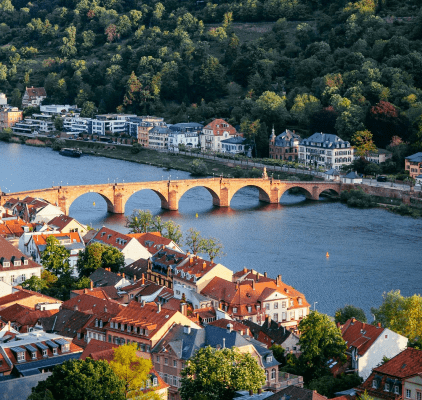
You get to live in Europe and experience the culture, history, and work life of cities like Paris, Madrid, and Heidelberg. At the same time, you earn a degree that offers the flexibility, assessment methods, and broad learning of the American system.
International Classrooms and Cross-Cultural Collaboration
You can study international business from a textbook anywhere in the world. You can read about intercultural communication theory in a quiet library. But you cannot truly experience it until you work with someone whose background is completely different from yours and solve a problem together in class. Studying at an American higher education institution gives you the opportunity to do just that. This diversity is not just a bonus. It is a key part of your education. It helps you build skills that a single-nationality campus cannot offer:
- Intercultural Communication Skills: You change the way you think and learn to read a room that is genuinely diverse. Negotiating, presenting, and collaborating across cultural backgrounds becomes natural, not theoretical.
- Global Mindset Development: Exposure to multiple nationalities in daily academic life shifts how you see markets, problems, and people. Biases and assumptions get tested regularly and quietly.
- Worldwide Networking Opportunities: The classmates you build relationships with over two or three years will be spread across every continent when you graduate. That network is built before your first job interview.
- Real-World Problem Solving: Present real-world challenges to students, who form cross-campus, multidisciplinary teams to devise solutions through a structured mentoring process.
- Confidence in Ambiguity: When your daily academic environment involves navigating different communication styles, expectations, and worldviews, you develop the kind of adaptability that employers are actively seeking in 2026.
Career Readiness and Global Employability
The degree is the starting point. What you do with it depends on what you build around it. In a market where employers have changed their hiring criteria, this distinction matters more than it did even five years ago.
The 2026 Global Employability University Ranking and Survey (GEURS26) found that employers are increasingly prioritizing adaptability and work experience when evaluating candidates over static credentials, specifically seeking learning agility, the capacity to quickly learn, unlearn, and relearn in response to new technologies and evolving industry trends.
Furthermore, internationality has moved to the third position among employability drivers, surpassing academic performance for the first time. For recruiters, this no longer means simple mobility; it signifies institutional openness and an ability to collaborate across borders, languages, and cultures. Organizations are actively scouting for talent that demonstrates these traits to build resilient, globally ready teams.
The Schiller International University Experience
For over 60 years, Schiller has operated at the intersection of the American academic structure and genuine European immersion. It is not a US university that happens to have European locations. It is an institution specifically built to deliver both at the same time.
With our intercampus mobility program, students can move between our four campuses in Madrid, Tampa, Paris, and Heidelberg during their studies, experiencing European life across multiple cities and cultural contexts while staying within the same academic program.
Global citizenship education at Schiller is not a concept written into a mission statement. It is what happens every day, in classrooms where 130 nationalities share the same problem set.
Ready to experience an American-style education on a European campus? Explore Schiller's programs in Madrid, Paris, Heidelberg, and Tampa.
FAQs
Q1. What is meant by an American-style education in Europe?
It means studying under the American academic model on a European campus. You follow a flexible curriculum built around participation, continuous assessment, and interdisciplinary exploration, while physically living and studying in a European city.
Q2. How do European universities benefit international students?
European universities give you access to rich academic traditions, diverse student communities, and professional ecosystems in some of the world's most influential cities. For international students, studying in Europe often means lower tuition, English-taught programs in non-English-speaking countries, and degrees that are recognized across EU member states.
Q3. What are the advantages of global learning experiences?
Global learning means more than crossing a border. When your daily academic environment includes people from 50 or 100 nationalities, you develop communication skills, cultural intelligence, and professional flexibility that stay with you.
Q4. How does studying abroad help develop an international perspective?
Studying abroad puts you in situations where your default assumptions stop working. The way you approach a group project, write a business proposal, or read a negotiation shifts when the other people in the room have entirely different professional and cultural contexts. Over time, this builds a practical international perspective. You do not just know that cultural differences exist; you have navigated them daily for years.
Q5. Why are international employers attracted to globally educated graduates?
Because the job itself is global, most industries operate across borders, serve diverse customer bases, and require people who can function in multicultural environments without needing a training program first. A graduate who has studied at a multi-campus international university, earned a dual-accredited degree, and worked alongside classmates from 130 countries arrives already equipped for that reality.
Discover Our Campuses