 Request information

Entrepreneur Emán Vara Brings Real-World Business Insight to Schiller Madrid
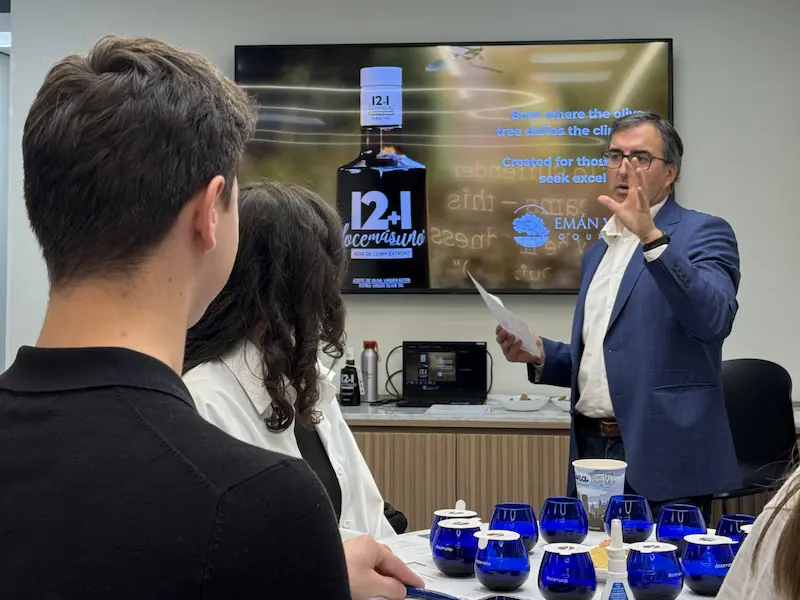
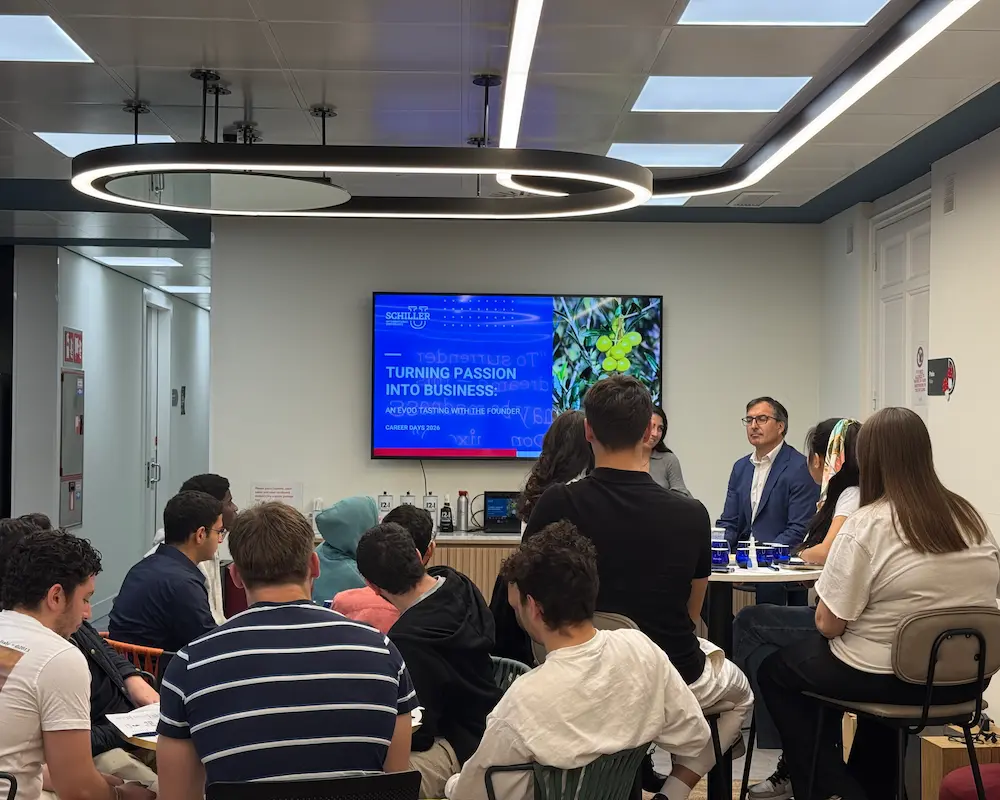
Students at the Madrid campus of Schiller International University recently experienced entrepreneurship first-hand during a special Career Days session led by Spanish entrepreneur Emán Vara, founder of Emán Vara Gourmet.
Titled “Turning Passion into Business: An EVOO Tasting with the Founder,” the session combined storytelling, product experience, and business strategy—offering students a practical perspective on how a business is built, positioned and brought to market.
Building a Business Against the Odds
 Emán Vara’s journey stands out for its unconventional approach. Following the death of his father, he chose not to continue along a traditional path, instead he built something entirely new. His company, Emán Vara Gourmet, produces premium extra virgin olive oil (EVOO) under extreme climate conditions in Valladolid—an area not typically associated with olive oil production. What might seem like a limitation became his differentiator.
Working in an extreme continental climate—marked by harsh winters and intense summers—he developed a product defined by precision, resilience, and identity. Rather than competing on volume, his focus has always been clear: create a premium, limited-production extra virgin olive oil that stands out in quality, health properties, and storytelling. The result is product that has gained international recognition.
Experiential Learning Through Entrepreneurship
Rather than a traditional lecture, the session was designed as an immersive experience.
Throughout the session, Emán Vara shared insights from over 13 years of entrepreneurial experience, addressing the challenges of starting and scaling a business, the importance of resilience and long-term thinking, and how to create value through innovation and differentiation. He also emphasized a key entrepreneurial mindset: focusing on building something meaningful rather than planning for failure—encouraging students to approach business with commitment, adaptability, and persistence.
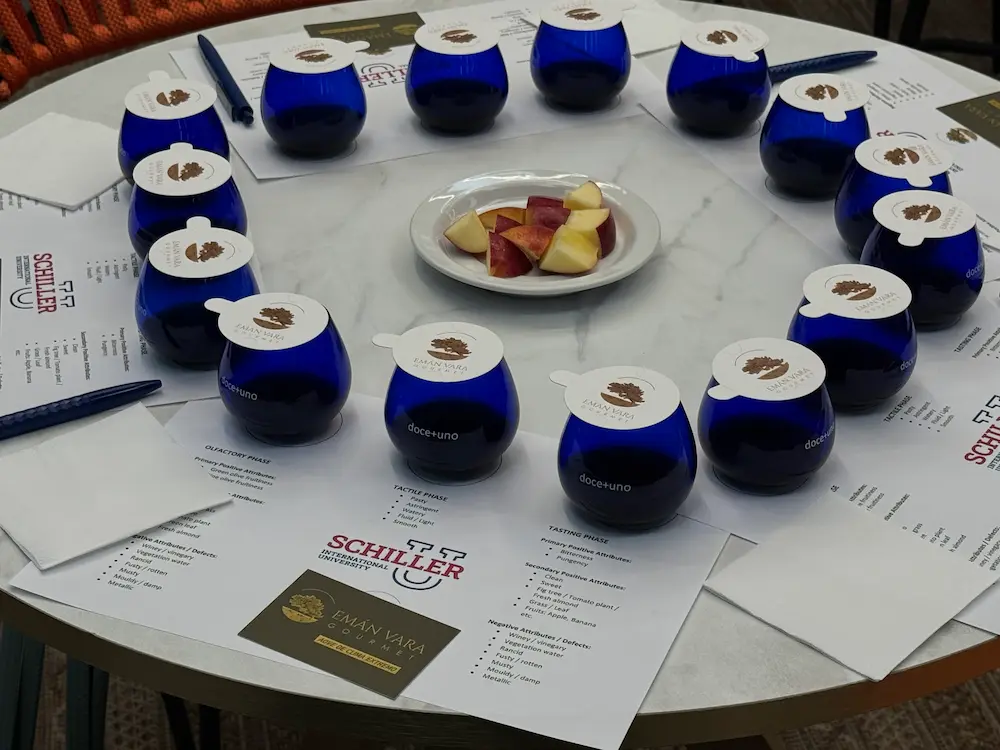
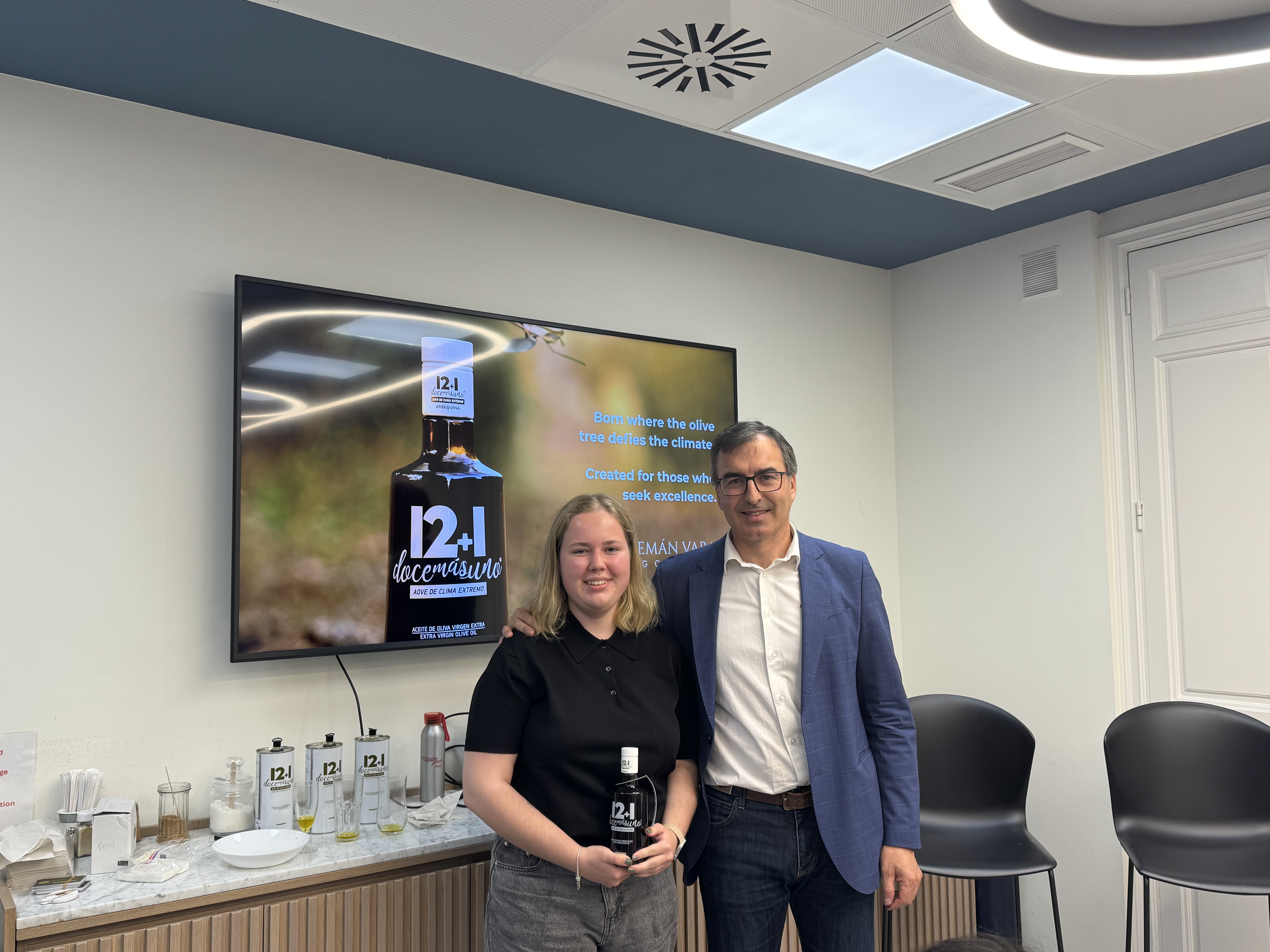 The session culminated in a simple but powerful exercise: students were challenged to identify the harvest date of the olives used in the oil they had just tasted—an activity that required attention, analysis, and critical thinking. It transformed the tasting into a moment of applied learning, where observation met decision-making. The winning student walked away with a bottle of the oil, but more importantly, everyone left with a deeper understanding of how detail, precision, and storytelling intersect in business.
This approach reflects Schiller’s commitment on experiential learning, where students engage directly with real-world business challenges and opportunities understanding not just what a business is, but how it feels to build one.
Connecting Entrepreneurship to Schiller Programs
Sessions like this play a key role in supporting programs such as International Business and other career-focused degrees at Schiller International University. By engaging directly with entrepreneurs, students gaininsight into building a business from scratch, exposure to real-world decision-making, and a deeper understanding of market positioning and strategy—while also finding inspiration to pursue their own entrepreneurial pathways.
This approach reflects Schiller’s broader educational model, which combines academic knowledge with practical experience to prepare students for careers in business, innovation, and global markets.
Beyond the Session: A Conversation with the Entrepreneur
 Following the session, Schiller spoke with Emán Vara to explore the thinking behind his journey: from choosing a non-traditional location like Valladolid to building Emán Vara Gourmet, a premium brand in one of the world’s most competitive industries.
What motivated you to build your business in a rural area like Valladolid, a non-traditional region for olive oil, and what opportunities do you see in rural entrepreneurship in Spain?
I’m originally from Ataquines, Valladolid, so this project is deeply personal. It wasn’t about choosing a location—it was about returning to a place I knew well and seeing it from a different perspective. I understood the land, the climate, and its limitations, but also it´s hidden potential.
What others might see as a disadvantage, I saw as an opportunity. Valladolid is not a traditional olive oil region, and that allowed me to approach it without preconceived ideas. The extreme continental climate—very cold winters and very hot summers—creates unique conditions that directly impact the olive and, ultimately, the oil.
I believe rural entrepreneurship in Spain has enormous potential. It’s about reinterpreting territory, creating value from what already exists, and building projects that are not only sustainable but also capable of competing globally.
What makes your approach to EVOO (Extra Virgin Olive Oil) production unique, especially in such extreme climate conditions?
Our approach is based on understanding and respecting the conditions we work with. The extreme climate is not something we try to avoid—it’s something we embrace.
These conditions stress the olive trees, and that stress translates into oils with higher concentrations of polyphenols and more complex sensory profiles. This requires precision at every stage: from cultivation to harvesting at the exact moment, and extraction under strict control.
We are not focused on volume—we are focused on excellence. It’s a limited production, but with a very clear identity.
In a highly competitive Spanish olive oil industry, how important is product differentiation, and how did you position your oil as a premium gourmet product?
Differentiation is essential. Spain produces a large amount of olive oil, but much of it is treated as a commodity. Competing in that space is very difficult unless you change the rules of the game. From the beginning, I was clear that we had to build something different. Our positioning is based on three pillars: a unique origin, measurable health attributes, and a strong brand narrative.
We produce in an extreme climate, which already sets us apart. We focus on oils with high polyphenol content, which adds a functional value. And we communicate all of this through design, storytelling, and international recognition. We don’t compete on price—we compete on value.
Your participation in Career Days at Schiller Madrid Campus brought together storytelling and a hands-on tasting experience. How did you find engaging with students in this setting, and what role do you think experiential learning plays in shaping future entrepreneurs?
It was a very enriching experience. When you combine storytelling with a tasting, the message becomes much more powerful. People don’t just understand the product—they experience it. For students, this is especially important. Entrepreneurship is not only about theory; it’s about making decisions, taking risks, and understanding how ideas translate into real products. Experiential learning bridges that gap. It allows them to connect concepts with reality, and that’s where real understanding happens.
You spoke about the importance of committing fully to your vision instead of having a “plan B.” How has this mindset influenced your entrepreneurial journey, and why do you think it matters today?
Not having a “plan B” forces you to commit completely. It aligns your decisions and eliminates hesitation. In my case, it has been key. When you are doing something unconventional, there will always be doubts—both external and internal. Full commitment gives you the consistency needed to move forward. Today, there are many distractions and alternative paths. Staying focused on a clear vision is, in itself, a competitive advantage.
What are the biggest challenges and opportunities in building a sustainable entrepreneurship model within the agricultural sector?
The main challenge is uncertainty. Agriculture depends on factors you cannot fully control—climate, market conditions, costs. At the same time, there is a growing opportunity. Consumers are increasingly interested in quality, traceability, and sustainability. They want to know where the product comes from and how it is made. This creates space for projects like ours, where sustainability is not just a concept, but part of the business model. It’s about doing things properly and communicating it clearly.
Many students are interested in building something from scratch. What advice would you give on how to build a business from scratch in a non-traditional location?
The first thing is to understand your context and use it as an advantage. Don’t try to replicate what others are doing in different environments. Second, build a strong narrative. A good product is essential, but it needs a story that connects with people. And third, think globally from the beginning. Being in a non-traditional location is not a limitation—it can be a differentiator if you position is correctly.
Looking ahead, how do you plan to continue innovating within both the extra virgin olive oil business and the broader gourmet sector?
Innovation will come from both the product and the experience around it. On the product side, we will continue refining quality and exploring new formats. On the experience side, we are working on how to connect more directly with the consumer—through digital tools, storytelling, and new ways of presenting the product. We also see the opportunity to expand into the gourmet sector in a broader sense, where olive oil becomes part of a more complete culinary experience.
If you could summarize your journey in one lesson for future entrepreneurs, what would it be?
Build something that cannot be easily replicated. If what you do is truly unique—in product, in origin, and in how you communicate it—you stop competing in the traditional sense and start building your own space.