Request information
Paris Students Take a Trip to Strasbourg
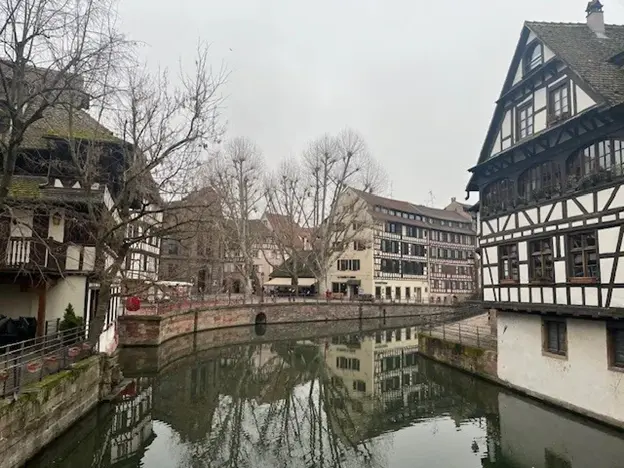
In January, our Paris students in the IR456 course, The European Union, took a trip to Strasbourg. Through this experiential learning opportunity, students gained a better understanding of the realities of a city at the heart of the European project.
Following the visit, students reflected on how this real-world experience deepened their understanding of European integration, and how delicate and complex it can be.
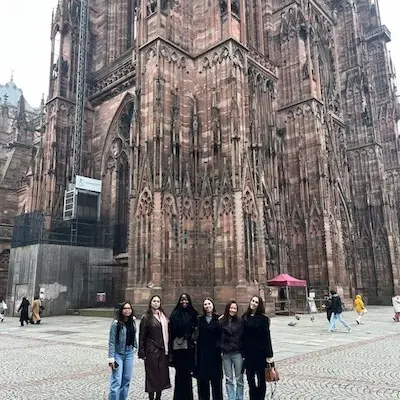 "During our field trip to Strasbourg, we not only engaged with the European institutions but also experienced firsthand the region’s rich Alsatian culture, which reflects a unique blend of French and German influences. Strasbourg’s gastronomy is a vivid expression of this heritage: traditional dishes such as choucroute garnie, tarte flambée (flammekueche), and baeckeoffe.
This Franco-German fusion is also deeply present in the city’s language and architecture. Many buildings in the historic centre feature characteristic timber-framed façades and Gothic structures that echo German architectural styles, while traces of the local Alemannic German dialect and place names remind visitors of the area’s past as both French and German territory.
A highlight of the trip was when four of us took the tram across the Rhine to Kehl (Germany). What struck us most was not the short journey itself, but the contrast in border experience: on the French side, there were no formal checks, whereas on the German side, we saw a visible presence of border police performing identity controls. This experience mirrored broader political developments in Europe. In recent years, Germany has temporarily reintroduced border controls at many of its internal frontiers, including those with France, Belgium, the Netherlands and other neighbours, officially to address irregular migration, security concerns, and cross-border crime. These measures, initially introduced in September 2024 and extended repeatedly, involve mobile and stationary checks and have remained in place well beyond their original timeframe, even as part of broader efforts to manage migrant flows and respond to domestic political pressures.
Although Schengen’s core principle is the free movement of people and goods without internal border controls, the German experience shows how member states are increasingly using the legal provisions in the Schengen Borders Code to temporarily reinstate checks in response to perceived threats to public order or security. All these dynamics became tangible during our trip, as we observed firsthand the gap between the EU’s ideal of borderless mobility and the political and security practices currently shaping member states’ behaviour."
- Andrea Ginevra Quai
"As we walked around the city, the scenery was breathtaking. I learned many new things about Strasbourg’s culture and way of life. For example, I learned that many restaurants are only open between noon and 2 p.m. and then close until later in the afternoon. I also tried new foods and met interesting people during the trip. The city reminded me a lot of Germany, which makes sense because Strasbourg is close to the German border and has a history influenced by both French and German cultures. This mix of cultures is a good example of European diversity. Overall, this trip helped me better understand Europe, not only through its institutions like the European Parliament, but also through its culture, history, and everyday life. Even though we could not visit the Parliament, the experience in Strasbourg helped me see how Europe is connected politically, culturally, and historically. It was a very educational and memorable trip"
- Lovasoa Nantenaina Rakotoharimanana



Discover Our Campuses
Our BA in International Relations and Diplomacy is available online and at the following campuses: