Request information
How Would You Change The World? Public Speaking in Action
How Would You Change the World?
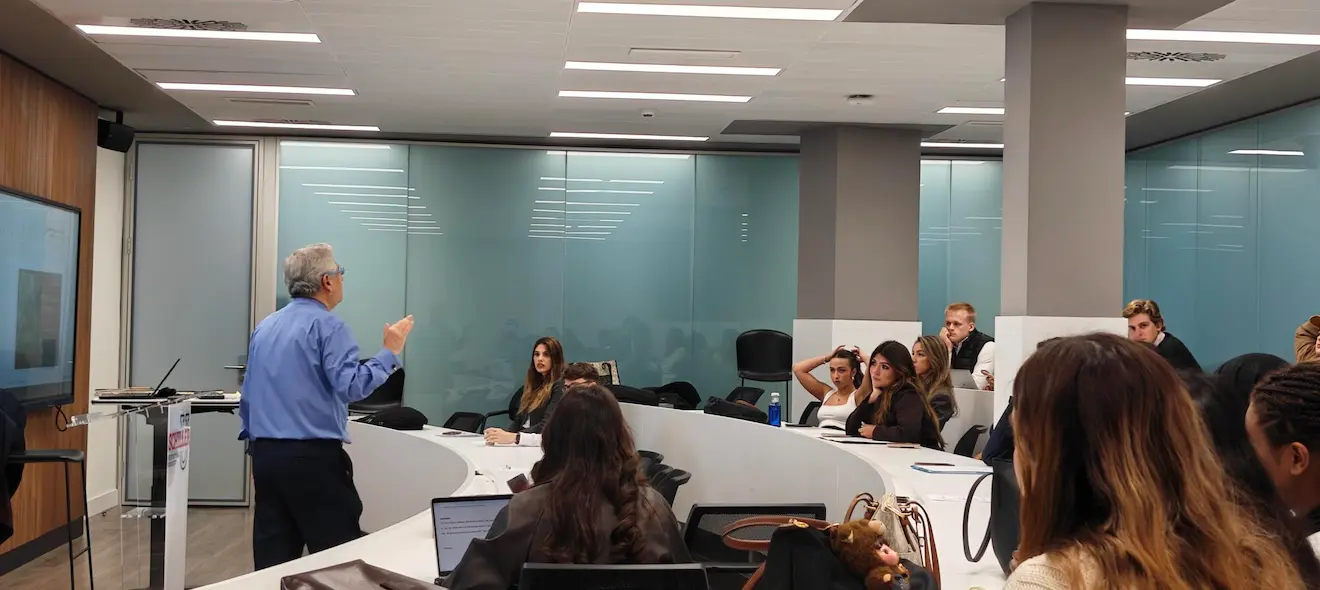
Every year, the public speaking course taught by Professor José Pinto at Schiller culminates in a final public speaking assignment that is as simple in its wording as it is powerful in its impact: “How would you change the world?” What follows is never just an academic exercise. It is a moment where ideas meet courage, where personal stories become public through storytelling in public speaking, and where students step fully into their voices, strengthening their communication skills for students and their ability to practice effective public speaking.
This year’s student public speaking presentations were delivered in front of a live audience of Schiller students, peers, faculty, and staff. The room quickly transformed into a space for reflection, challenge, and connection, reminding everyone present of the importance of public speaking in university education. Here, public speaking is not just a skill, but is a tool for social change, a platform for using your voice for change in meaningful ways.
Speeches with Purpose and Impact
The speeches reflected a wide range of perspectives, some deeply introspective, others more political, but all were united by a common desire to make the world more humane, more just, and more conscious. Each speech with impact demonstrated growing persuasive speaking skills and a clear understanding of persuasive communication.
Students explored how change can begin in very different ways, showing how public speaking for change can take many forms. Some focused on leadership, honesty, and freedom of speech, questioning what it truly means to lead by example and highlighting the connection between leadership and communication skills. Others turned inward, reflecting on how changing the world often starts with changing ourselves: choosing empathy over fear, being present, and learning to listen without judgment—powerful examples of empathy and leadership in action.
Across all approaches, one message remained clear: there is no single way to change the world, but there is always a responsibility to try. These were truly student speeches that inspire action, showing how public speaking helps students change the world through courage and clarity.
One Act of Compassion at a Time
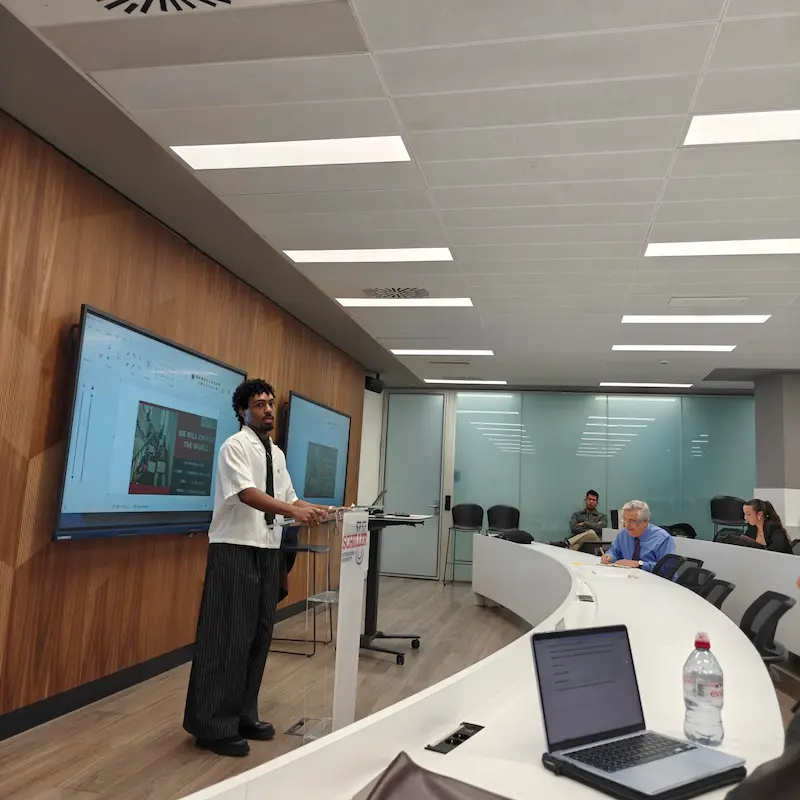 At the end of the session, Professor José Pinto at Schiller selected the speech that moved him most deeply.
The winning speech of 2026 was awarded to our second-year BS International Business student, Anas Mohamed, who focused on doing something profoundly human. His presentation stood out as a powerful example of changing the world through compassion. The student shared the story of Marko, a homeless man who “was not hungry for food, but for conversation.” In a society shaped by the unspoken rule of “walk and don’t look,” the speech challenged the audience to slow down, notice, listen, and care.
The message was both simple and powerful: changing the world does not always require grand gestures. Sometimes, it begins with a single act of compassion. Anas offered one of the most meaningful compassion-driven leadership examples, reminding us that change happens one act of compassion at a time. His ability to connect emotionally with the audience reflected true growth in public speaking skills development in speaking with confidence about issues that matter.
Read Anas Mohamed' speech here.
A Message to Carry Forward
This final assignment is a powerful example of how Schiller prepares students for real-life challenges. The public speaking course goes far beyond theory, encouraging students to practice public speaking beyond the classroom. Public speaking is not treated as a performance, but as a responsibility: a way to inspire action, awaken empathy, and spark meaningful conversations.
At the close of the session, Professor José Pinto at Schiller left students with a simple yet powerful message that captures the spirit of the course: “Be free and dream.” A message not only about public speaking, but about life beyond the classroom and the lasting value of effective public speaking and persuasive communication in shaping society.
Students left the room not just as better speakers, but as individuals who had strengthened their leadership and communication skills, embraced public speaking for change, and learned the power of using your voice for change. They carried with them a shared reflection—an invitation to dream boldly, to act with intention, and to have the courage to shape the world around them.
We are very proud of all the students who took part in this experience and congratulate them for their dedication, courage, and growth throughout the course.
Student Speech (Full Text)
How would I change the World
Changing the world is a hard thing to do, but it’s easier once it’s one act of compassion at a time.
Let me tell you a story, the story of Marko.
It was a winter evening in Madrid near Atocha Station, people were rushing past with scarves pulled tight, coffee cups warming their palms, focused on trains to catch and places to be. Even though the temperature was around zero, most of us had somewhere to go, somewhere warm to return to. Not everyone did.
That’s when I saw him there sitting against the wall near the station’s entrance. Marko was wrapped in layers that looked donated rather than chosen. His jacket was too thin for the cold, and his shoes had clearly walked many streets for many years. I hesitated at first, like most people do. There’s an unspoken rule we follow: look forward, keep moving, don’t make eye contact, and we call that normal. I felt that familiar hesitation, the moment where you decide whether to keep moving or not. I chose not to, and bought him a sandwich and hot coffee.
When I handed them to him, he smiled, but what surprised me was that he didn’t immediately start eating. He didn’t reach for the food nor the coffee at all. Marko wasn't hungry for food, he was hungry for a conversation and for company. Then he said: "Thank you for stopping. People usually don’t"
He wasn’t always homeless. He came from Croatia with his wife to Madrid. To work at a carpet's factory. However, after many fights and arguments, Marko and his wife got a divorce. Depression followed and focusing on the job was too hard. Unfortunately, without enough support or a person to turn to, it led him to where he is now.
As he spoke, he didn’t sound angry. He sounded tired. He told me that the cold is difficult, especially at night when the temperature drops below zero. But the cold isn’t the hardest part. The hardest part is when people walk past him like he's not there, like he's invisible.
We talked for a while and when I eventually stood up to leave, he thanked me again. Not for the food. Not for the coffee. But for sitting down. For listening. For treating him like a human being. And that’s when I realized something: I hadn’t solved his problems. I hadn’t changed his circumstances. But I had changed his world, even if only for a few minutes. And sometimes, those few minutes are enough to remind someone that they still belong in this world.
Not by doing something extraordinary, but by doing something human. By refusing to let people become invisible. By choosing to notice the people we’re taught to ignore. I will change the world by offering presence: by listening, by acknowledging, by caring in a world that moves too fast to stop for even a moment.
I can’t control how busy the world is or how cold the streets get in winter. But I can control how I respond to the people around me. I can choose empathy. I can choose to see people instead of walking past them. What changed that day wasn’t just Marko’s experience, it was also mine. I realized how easy it is to walk past people and tell ourselves we don’t have time, when what they need the most costs us almost nothing. From that day on, I chose to slow down, to notice, and to engage.
Marko is still there. The winter hasn’t ended, and his story didn’t magically change when I walked away. But for a brief moment, he wasn’t invisible. And if changing the world requires changing one person’s experience of it even if temporarily, then that day, outside Atocha station, I did exactly that. I changed the world. And I will keep doing it, one act of compassion at a time.
Anas Mohamed
January 15, 2026
Discover Our Campuses
Our BA in International Relations and Diplomacy is available online and at the following campuses: