Request information

Why is College in Europe Cheaper than College in America?
Studying abroad is a big decision, especially when you are balancing money, long-term value, and the hope that the degree you earn will genuinely open doors. If you have ever looked at American university tuition and felt your stomach drop, you are not alone. Many students start comparing the cost of studying in Europe versus the US, not out of curiosity, but out of a real need to make education feel possible and affordable. Europe offers something different. Europe does not treat higher education as a luxury; it treats it as a right. Tuition is more transparent, living costs are often more manageable, and the entire system is built to be accessible rather than overwhelming.
And when you pair that affordability with the opportunity to earn a US-accredited degree at universities such as Schiller International University, with campuses in Madrid, Paris, and Heidelberg, the value becomes both global and personal. You can build a successful career with less debt, more mobility, and a learning experience that places your aspirations, not your financial burden, at the center.
The Real Price Divide: College in Europe versus America
When students start comparing the cost of college in Europe versus America, it usually comes from a place of practicality, not preference. You want to know where your money goes, how far it stretches, and what kind of future it buys you. Understanding this price divide is the first step in seeing why Europe feels more attainable, and why many international students view it as a realistic path rather than an aspirational one.
Why Cost Gap is so Wide
In the US, tuition often climbs into numbers that do not feel remotely within reach unless you are prepared for loans. Many private colleges charge $20,000 to $60,000 per year, sometimes even higher, and that does not include the cost of living and accommodation.
Across Europe, the picture shifts entirely. Countries like France, Germany, and Spain keep tuition intentionally low to ensure accessibility. Many private universities charge between €10,000 and €18,000 per year for international students. This is not a minor cost difference. It is a completely different philosophy of education.
Program Length also Matters
Aside from tuition, the cost of education in Europe is influenced by something students rarely consider at first: their time. European programs, especially postgraduate degrees, are intentionally shorter. Compared to the US, master's degrees in Europe take one year, not two. That means:
- One full year of less tuition.
- One full year of fewer living expenses.
- One year gained to start earning or pursuing further higher education.
A shorter path does not mean a lighter education. It simply reflects Europe’s streamlined, mobility-focused higher education structure.
Why Is College Cheaper in Europe?
Understanding the why behind Europe’s affordability helps you see the decision better. Europe is not cheap by accident. Their education system is designed differently for a reason.
1. Education as Public Good, not Private Product
In many European countries, higher education is state-supported as it is viewed as a societal investment. Lower fees are not a discount, but a deliberate choice to make education more accessible to a wider range of people. This creates a completely different student culture. Less financial pressure, more academic freedom, and fewer students graduating with heavy debt.
2. Transparent and predictable tuition
In Europe, tuition is usually set by government policy or uniform private institutional structures. Costs rarely jump unexpectedly, and hidden fees are less common. For students used to US pricing, this transparency often feels like a breath of fresh air.
3. Shorter and Structured Degree Pathways
Thanks to the Bologna Process, degree structures across Europe follow consistent formats. This harmonized approach saves time, simplifies mobility, and lowers overall cost, without compromising academic quality.
4. Lower Living Expenses in many Major Cities
While cities like Paris can be expensive, many European cities, especially student-friendly ones like Madrid or Heidelberg, offer lower rents, more affordable transport, and lifestyle costs that do not drain your budget every month. With careful planning, international students often find Europe easier to sustain financially than the US.
Living Costs in Europe versus the US
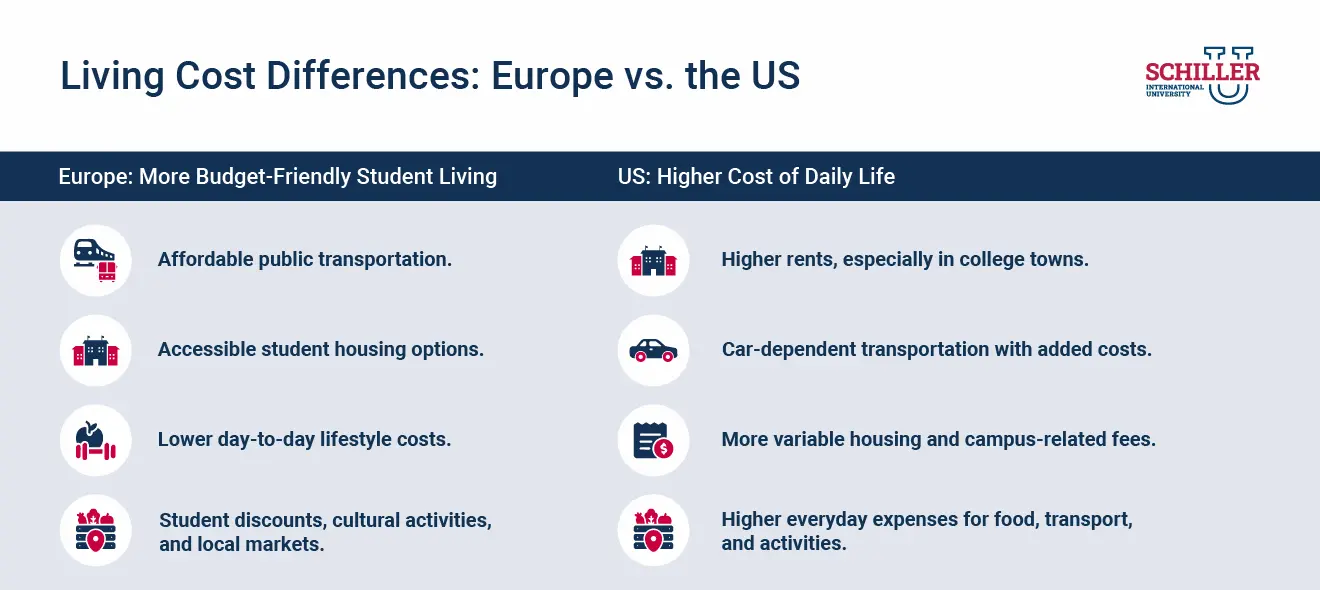
When students compare living expenses in Europe vs the US, it is often the small, everyday realities that shape the final decision, not just spreadsheets of national averages. Affordability becomes real when you calculate what your rent looks like, how often you can afford to go out, and whether you can live comfortably without stretching your finances thin.
- Europe often gives you more control over your lifestyle budget: In Europe, public transport is more affordable, student housing is more accessible, and the cost of simply 'living' does not escalate as quickly as it often does in US college towns.
- Student life supports affordability: European cities are built with students in mind. Discounts, student passes, local markets, and low-cost cultural activities mean you can experience more without constantly worrying about money.
How Schiller International University Blends Affordability with Global Value
Schiller combines the benefits of studying in Europe with the recognition of an American degree. Our comprehensive bachelor's and master's degree programs offer you a truly global path that does not involve a lifetime of debt.
1. An American degree delivered across Europe
Schiller is accredited in the US, which means you earn a US-recognized undergraduate or postgraduate degree in Europe, but you can experience it through the diverse, multicultural environments of Madrid, Paris, and Heidelberg. You will study in Europe, live in Europe, and graduate with a US degree.
2. Mobility that builds career confidence
One of Schiller’s most unique advantages is the ability to rotate across campuses. This means you can begin in Madrid, spend a semester in Paris, and complete your program in Heidelberg, all while staying within one university system. Having this kind of mobility will help you develop cultural fluency, independence, and international awareness.
3. Lower costs, higher return on investment
As Schiller’s European campuses operate within the European cost environment, students benefit from:
- Lower living expenses (depending on the city).
- Shorter programme durations.
- Transparent fees.
- Reduced overall study costs compared to studying in the US for the same degree credential.
In a world where financial stress is a major barrier to education, this model makes global learning more achievable.
Choosing where to study is ultimately a matter of values, including financial, academic and personal factors. For many students balancing ambition with affordability, Europe offers a pathway that makes global education accessible without sacrificing quality, mobility, or career potential.
With Schiller International University, you do not have to make a choice between affordability and recognition. You earn an American degree while living, studying, and growing in Europe’s most dynamic student cities. The result is:
- A global education that feels achievable.
- A future that feels open.
- And a journey that feels yours.
Explore Schiller’s campuses in Paris, Madrid, and Heidelberg to start your higher education journey.
FAQs
Q1. How does Schiller International University offer an American degree while studying in Europe?
Answer: Schiller is accredited in the United States, so all programs follow US academic standards. You study on European campuses, but graduate with a US-recognized degree.
Q2. Is studying at Schiller’s European campuses more affordable than studying in the US?
Answer: Yes. European living costs are often lower, the programs are shorter, and the tuition structures are more accessible. Consequently, the cost is significantly lower overall.
Q3. Can I study in English at Schiller’s campuses in Spain, France, or Germany?
Answer: Absolutely. All Schiller offers programs that are fully taught in English, so you can study in Europe without needing multiple local languages.
Q4. What are the main cost differences between studying in Europe and the US for international students?
Answer: Europe offers lower tuition, shorter degrees, more predictable fees, and often more manageable living costs. The US system typically comes with higher tuition and hidden costs.
Q5. Does a Schiller degree earned in Europe have the same value as one earned in the US?
Answer: Yes, it is the same accredited American degree, recognized globally, whether you earn it in Madrid, Paris, Heidelberg, or Tampa.
Discover Our Campuses