Request information

Is a Master's in International Affairs Worth it?
The world is moving through one of the most complex geopolitical moments in recent history. Global institutions are under pressure, alliances are shifting, conflicts are becoming increasingly difficult to resolve, and governments depend heavily on professionals who can interpret, negotiate, and influence international policy. At the same time, multinational organizations, humanitarian agencies, and development bodies are actively seeking people who can guide strategy across borders.
A master’s degree with a focus on international affairs, such as international relations and diplomacy, sits at the center of this world. It is a career investment and can help you carve a path to global influence where your work directly shapes policies, negotiations, and decisions that affect governments, communities, and industries worldwide.
What Does a Master’s in International Affairs Prepare You For?
A comprehensive international affairs degree prepares you for tasks far beyond political theory. It helps you build key skills needed for a career in international relations and diplomacy, such as an acute mindset, analytical ability, and practical skills needed to operate in high-stakes global environments.
1. A Training Ground for Real Global Problem-Solvers
This master's degree is multidisciplinary by design. You will learn to interpret geopolitical risk, build negotiation strategies, manage diplomatic communication, and make evidence-based recommendations in fast-shifting environments. You will also explore how security, economics, development, climate, and technology intersect, because in real diplomacy, nothing exists in isolation. You graduate with the ability to:
- Analyze policy and draft strategic recommendations.
- Interpret global political movements.
- Navigate cross-cultural environments.
- Understand global economics and trade dynamics.
- Manage negotiations and diplomatic dialogue.
- Assess political risks for governments or corporations.
2. Understanding Power, Policy, and Global Institutions
A master’s degree in international affairs gives you a structured understanding of how power works in the world. You learn how countries negotiate interests, how multilateral bodies (such as the UN or WTO) function, and how international law influences state behavior.
This foundation will also help you understand why countries rely on policy professionals to maintain stability and cooperation, as well as apply for roles where you can solve similar problems for nations and united institutions.
3. Applying Global Economic and Development Frameworks to Real Policy Challenges
International affairs graduates understand more than economic concepts. They explore challenges and opportunities for global development institutions. This includes analyzing foreign aid models, understanding the economic pressures behind conflict or cooperation, and evaluating how trade agreements affect political stability. You gain the ability to:
- Interpret development indicators and economic data.
- Assess how global markets influence diplomatic outcomes.
- Evaluate the impact of policy decisions on vulnerable populations.
- Design evidence-based policy proposals for governments or global institutions.
4. Strengthening Cross-Cultural Leadership and Strategic Communication
A major part of international affairs work happens in rooms where cultures, expectations, and histories collide. This degree trains you to lead in those environments, with cultural sensitivity, strategic communication, and influence grounded in diplomacy rather than authority. You build expertise in:
- Cross-cultural communication.
- Conflict-sensitive leadership.
- Public diplomacy and strategic messaging.
- Stakeholder management across countries.
- Presenting policy recommendations to diverse audiences.
Careers, Salaries, and Long-Term Growth
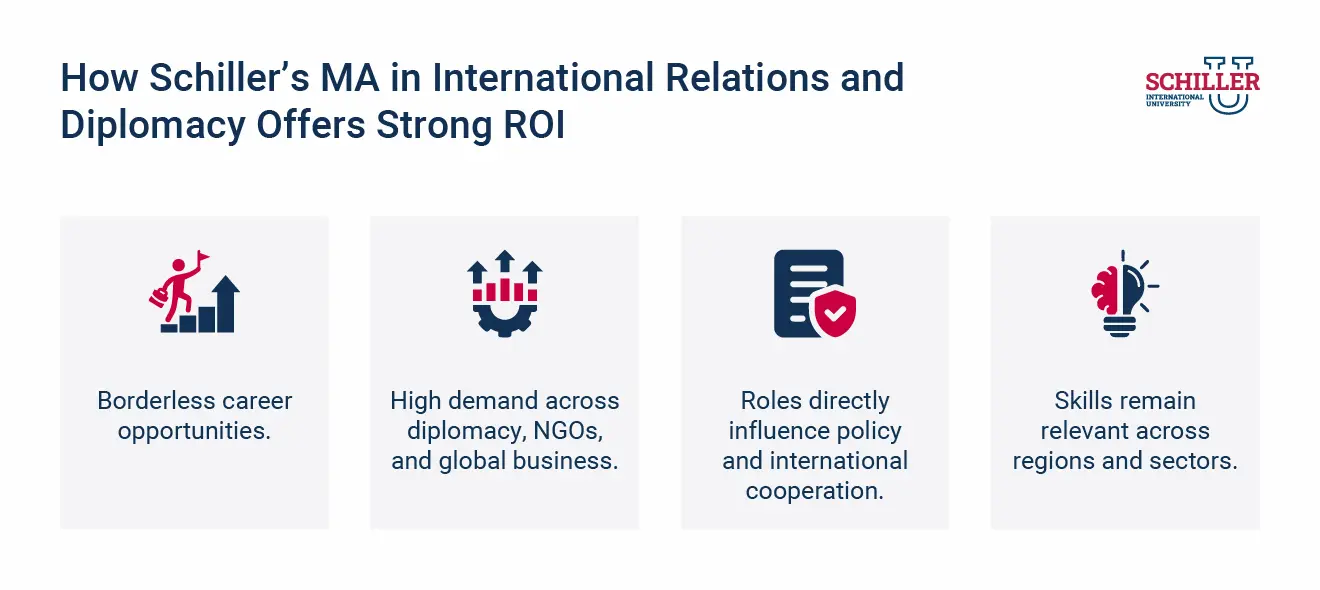
A master’s in international affairs directly connects you to roles where decisions influence governments, international organizations, humanitarian systems, and global businesses.
International Affairs Career Pathways
A career in international relations and diplomacy leads to tangible, structured career routes across policy, humanitarian work, and multinational strategy.
1. Foreign Policy and Diplomatic Careers
If you want to represent a nation, influence policy, or shape international negotiations, you will find opportunities in:
- Ministries of Foreign Affairs
- Embassies and consulates
- Legislative and government advisory units
- Policy research and analysis teams
- National security and strategic affairs offices
Graduates in these roles support treaty negotiations, manage bilateral relationships, and advise governments on geopolitical risk.
2. United Nations and Multilateral Institutions
For those who want to work on global development, humanitarian response, or international governance, typical employers include:
- United Nations Development Programme (UNDP), United Nations High Commissioner for Refugees (UNHCR), United Nations Children's Fund (UNICEF), United Nations Educational, Scientific and Cultural Organization (UNESCO).
- World Bank, International Monetary Fund (IMF), and Organization for Economic Cooperation and Development.
- Peacebuilding and conflict prevention units.
- Climate and development-focused global programs.
Professionals here work on issues ranging from displacement and human rights to economic development and global health.
3. NGO and Global Governance Roles
If your interest leans toward humanitarian or development work, international affairs prepare you for roles in:
- Human rights advocacy groups.
- International development agencies.
- Climate adaptation and sustainability projects.
- Humanitarian relief and emergency coordination.
These roles place you at the frontline of global challenges, where policy and community needs intersect.
4. Political Risk and Global Business Careers
Governments are not the only ones navigating geopolitical uncertainty. Corporations increasingly hire international affairs graduates to forecast risk, shape global strategy, and ensure compliance. Employers include:
- Political risk consulting firms.
- Global energy and infrastructure companies.
- Multinational technology firms.
- International trade and compliance teams.
- Insurance, finance, and risk analysis units.
This pathway offers some of the fastest salary growth and job opportunities after a master’s in international relations and diplomacy.
Salary After a Master’s in International Affairs
Earning potential varies according to the sector, region, and your level of experience. But overall, global data shows a strong return on investment for graduates who move into international policy and diplomatic careers. An international affairs professional makes an average salary of $106,182 a year. International mobility increases earning potential, which is why many graduates shift between regions, moving into higher-paying markets after gaining experience.
Long-Term Career Growth
One of the strongest advantages of an international affairs degree is career mobility. Unlike many fields where roles remain tied to one country’s job market, this field allows you to accelerate your career by moving between regions, institutions, and global organizations. Graduates often begin in a home-country policy role, transition to a UN or multilateral posting, move into higher-paying regions (Europe, the Middle East, and North America), and ultimately step into senior leadership across diplomacy, development, or global strategy.
This is why this degree is considered a strategic long-term investment. Your experience compounds every time you work in a new region or institution.
How Schiller International University Makes This Investment Stronger
A degree in international affairs is valuable. But an MA in International Relations and Diplomacy at Schiller International University elevates that value through a model built around global exposure and experiential learning.
1. A Global Learning Environment That Mirrors Real Diplomacy
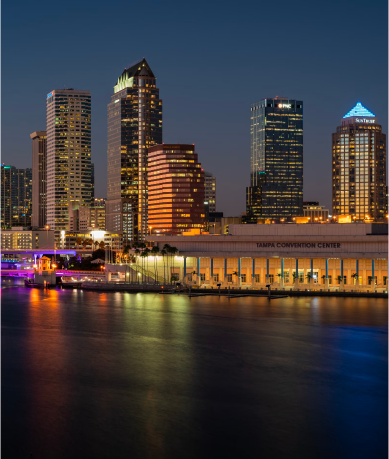
Schiller’s inter-campus mobility program gives you access to diverse political cultures, global institutions, and cross-border learning environments. You can study seamlessly across our campuses in Tampa, Paris, Madrid, and Heidelberg after one year.
2. Experiential Learning Through Real International Organizations
You will work on real-world policy and diplomacy simulations, collaborate with NGOs, explore UN-adjacent learning environments, and engage with faculty with diplomatic experience. This is training in real, global contexts.
3. Career-Designed, Globally Connected, and Highly Practical
Schiller’s MA is designed to be both practical and globally connected. It emphasizes hands-on diplomatic negotiation projects. With faculty who have extensive backgrounds in policy and international affairs, you receive personalized support across all four campuses. Strong connections with employers in governmental and international organizations enhance the learning experience.
A master’s degree in international affairs is a strategic investment in a career where your work can influence governments, shape policy, and impact communities worldwide. In a world that urgently needs skilled negotiators, policy thinkers, and global problem-solvers, this degree opens doors to careers that matter.
Explore Schiller's MA in International Relations and Diplomacy to succeed in some of the most influential roles in global affairs.
FAQs
Q1. What can I do with a master’s in international affairs?
Answer: You can work in diplomacy, foreign policy, international organizations (such as the UN and World Bank), NGOs, political risk consulting, development agencies, and global business roles.
Q2. How much can I earn with a degree in international relations or international affairs?
Answer: Earnings vary by role and experience. They can range from as high as $163,000 to as low as $31,000 per year. The average annual salary is approximately $106,182.
Q3. What’s the difference between international affairs and international relations?
Answer: International affairs focuses more on applied policy, diplomacy, and global governance. International relations is often more theoretical. Many universities integrate both areas.
Q4. Is a master’s in international affairs a good fit for a career in diplomacy or global business?
Answer: Yes. The degree develops negotiation skills, geopolitical understanding, policy analysis, and cross-cultural communication, which are essential for diplomacy and international business strategy.
Q5. Why choose Schiller International University for an international affairs degree?
Answer: Schiller offers a globally immersive model, experiential learning, four international campuses, and a curriculum aligned with diplomatic, policy, and global business careers.
Discover Our Campuses