Request information

Is a Computer Science Degree Worth It in 2026?
In 2026, the conversation around computer science has shifted. Artificial intelligence (AI), automation, and remote collaboration are redefining every industry, from healthcare and finance to entertainment and sustainability. So, it is easy to wonder if a computer science degree is still worth it. If you have ever asked yourself that question, you are not alone. Today, many students are weighing the value of traditional degrees against the growing popularity of short, fast-track technology courses.
According to the US Bureau of Labor Statistics, computer and information technology occupations are projected to grow 22% from 2023 to 2033, far faster than the average across all fields. The average salary for computer scientists in 2025 is approximately $140,000 per year, with sustained demand for skilled graduates who can bridge technology and human problem-solving.
This shows how computer science remains one of the most stable and future-focused degrees worldwide. It is no longer just about learning to code but about understanding how technology, data, and global connectivity are reshaping the world of work.
How Automation and Data are Reshaping Job Roles
In the past, computer science graduates often entered careers as software developers or network engineers. Today, they are just as likely to become AI specialists, data scientists, or automation architects.
AI tools now handle many routine programming tasks, but they have also created a new need for professionals who can design, train, and manage those systems. For students and professionals alike, this shift means an opportunity to move from simply using tools to designing systems that shape tomorrow’s technology.
The World Economic Forum’s Future of Jobs 2025 report identifies AI and big data roles as the fastest-growing career categories worldwide, while traditional programming roles are evolving toward system design and data-driven decision-making.
Automation has not replaced computer scientists. It simply changed what they do. Computer science degrees that integrate AI, data science, and ethical computing provide a pathway to build skills for leading roles in technology innovation.
Impact of AI Disruption and Remote Work
The rise of remote work has made the technology workforce truly global. Companies no longer hire only within their borders. They recruit based on skills, not postcodes. It is true that the way people work has changed over time, but the need for skilled problem-solvers has not. What has evolved is where and how those skills are applied.
- By 2026, sustainable and flexible remote or hybrid work practices will rise further, opening up international opportunities for graduates who can work across time zones and cultures.
- Employers now look for adaptability, people who can communicate across diverse teams, manage projects virtually, and solve problems collaboratively.
- A global bachelor's degree in computer science that includes exposure to multiple countries, such as Schiller’s international campus network, builds exactly that capacity.
Career Progression Degrees Vs. Fast-track Courses
It is true that coding bootcamps and online certifications can teach technical skills quickly. But a Bachelor of Science in Computer Science offers something deeper. You will build a foundation in systems thinking, logic, mathematics, and data. These skills do not expire with the next software update.
If you aim to move into leadership, innovation, or global project management, the degree provides not only technical ability but credibility and a strategic perspective.
If you are looking to build something lasting, a career that grows with technology, not one that risks being replaced by it, a computer science degree still offers one of the most resilient foundations you can choose.
A bachelor’s degree in computer science is one of the few qualifications that open doors across borders, sectors, and evolving technologies.
What You Will Study in a Bachelor of Science in Computer Science
When you study computer science today, you are not just learning to code. You are learning to think like an innovator. A modern computer science degree focuses on understanding the logic that drives technology and applying that knowledge to solve real-world problems.
At Schiller International University, the BSc in Computer Science program combines future-focused theory with practical learning across four global campuses: Madrid, Paris, Heidelberg, and Tampa.
1. Building basic foundations
You will develop the ability to design systems, work with large datasets, and approach problems through a lens of efficiency and innovation.
2. Core modules and skills
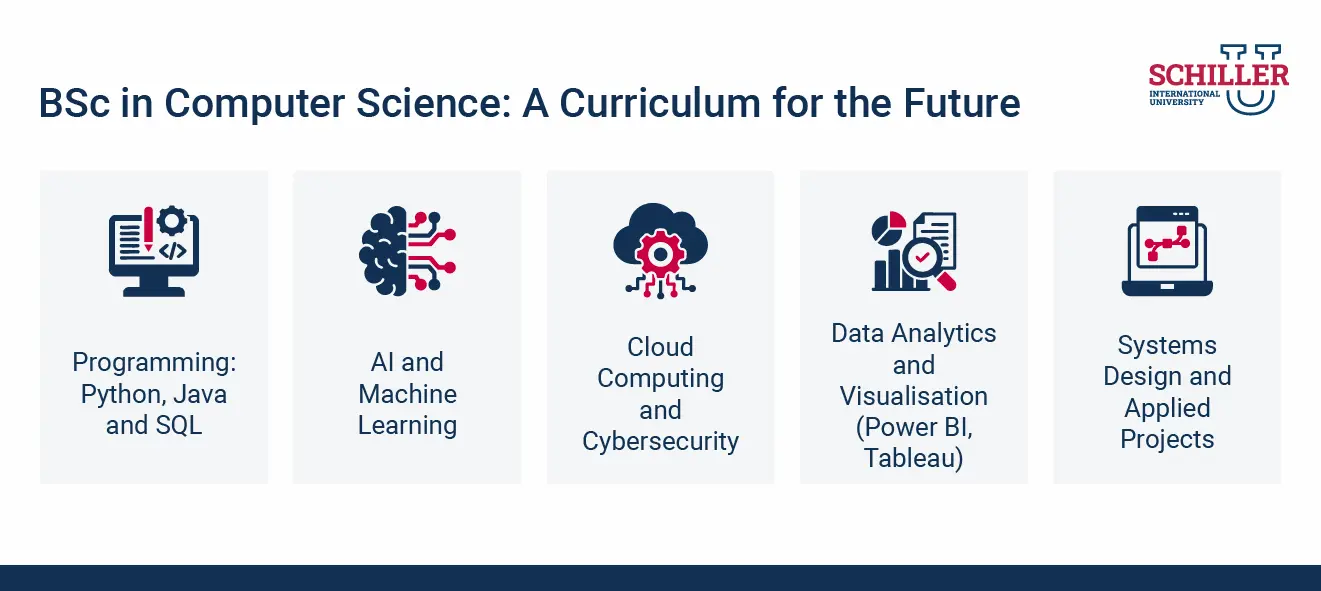
From coding and algorithms to cybersecurity, cloud, and machine learning, your key areas of study will include:
- Programming in Python, Java, and SQL.
- Understanding algorithms and data structures.
- Working with cybersecurity and cloud systems.
- Applying machine learning and artificial intelligence to real-world contexts.
- Using modern tools such as GitHub, Anaconda, Power BI, and Apache Spark
3. Applied learning and projects
From building mobile apps to analyzing real datasets, applied learning sits at the core of Schiller’s approach. You will collaborate on hands-on projects, mirror the structure of real technology teams, and develop problem-solving agility.
4. Computer Science vs. IT
While IT focuses on maintaining existing systems, computer science focuses on creating them. It is the difference between using technology and inventing it. If you want to learn how to build products, design systems, or drive innovation, a computer science degree is the more future-oriented path.
Skills that Define the Future Computer Science Graduate
As the digital economy grows, so does the demand for professionals who can pair technical mastery with strategic and human understanding.
- Technology Foundations: Employers consistently rank coding proficiency, algorithmic thinking, and data analytics as top requirements. These are the universal languages of modern problem-solving, and the foundation for any career in AI or software.
- Human Skills: In 2026, technical ability alone is not enough. The most valuable professionals can adapt quickly, communicate effectively, and collaborate across virtual or global teams. These are skills students at Schiller build naturally through cross-campus study and multicultural learning environments.
- AI Literacy and Ethical Computing: With great technological power comes great responsibility. Courses that address the ethical and social implications of AI are increasingly vital. Future-ready graduates need to understand not only how to train models, but when and why to use them responsibly.
- Employers’ top demands in 2026: Data from the US BLS shows that software developers, data scientists, and information security analysts are among the fastest-growing roles. Employers also value cross-disciplinary awareness and graduates who understand both business needs and technical possibilities.
What Jobs Await Computer Science Graduates in 2026
Technology has become the foundation of every modern industry. Whether you want to build AI systems, analyze big data, or create secure digital infrastructures, a computer science degree continues to open versatile career paths.
The world needs thinkers who can translate ideas into systems and data into solutions. Whether your dream is to build sustainable technology, drive innovation in healthcare, or create tools that make everyday life easier, computer science jobs give you the foundation to do it.
1. Promising Roles
By 2026, AI and machine learning specialists will top the global job-growth charts. Data scientists, cloud architects, and cybersecurity professionals follow closely behind. Every sector, from banking to healthcare, is looking for talent that can translate data into decisions.
2. Emerging Fields
Automation and robotics engineers are expected to see strong demand as industries digitize. Meanwhile, the early field of quantum computing is creating roles for graduates with advanced theoretical understanding, which is a clear benefit of a research-grounded degree.
3. Sector Opportunities
- Finance and Fintech: Algorithmic trading and blockchain development.
- Healthcare: Medical data analytics and healthcare technology (healthtech) innovation.
- Sustainability: Smart infrastructure and environmental monitoring.
- Education and Media: AI-assisted learning tools and digital platforms.
4. Salary Outlook (2026)
- United States: Average salary is $120,000-$140,000 per year (BLS, 2025).
- Germany: Average salary is €64,000-€69,000 per year for mid-level developers (Glassdoor).
- France: Average salary is €51,583-€91,412 for an AI Intelligence Engineer (Salary Expert).
- Spain: Average salary is €47,173-€83,597 for an Engineer Artificial Intelligence (Salary Expert).
5. Remote Work and Global Mobility
With sustainable remote and hybrid roles on the rise, graduates who can operate globally will have a clear edge. Schiller’s international degree recognition in both the US and EU provides a pathway to cross-border employability and long-term career flexibility.
Behind every algorithm and every breakthrough is someone who once decided to learn how things work, and how to make them better.
Why Schiller? A Global Path to Career-Ready Learning
At Schiller International University, the BSc in Computer Science is designed for students who want more than a classroom education. It is for those who wish to experience global learning, applied projects, and seamless campus mobility that translate directly into employability.
With campuses in Madrid, Paris, Heidelberg, and Tampa, students can study in different tech ecosystems while earning an accredited degree recognized across both continents. The university’s dual-degree structure and Optional Practical Training (OPT) opportunities in the US allow graduates to gain international experience in real-world roles.
At Schiller, you will apply your learning to real-world projects, explore the ethical dimensions of technology, and graduate with the confidence to work anywhere innovation happens.
In an unpredictable job market, computer science remains one of the few fields that guarantees adaptability. It is the foundation for navigating a technology-driven world. The ability to design, analyze, and apply technology ensures relevance across industries for decades to come. In 2026, students who are able to bridge innovation and humanity, as well as code and collaborate, will thrive.
Explore Schiller’s globally accredited BSc in Computer Science program and start shaping the technologies of tomorrow.
FAQs
Q1. What is the job outlook for computer science graduates in 2026?
Answer: Employment in computer and IT roles is projected to grow 22% (2023–2033), adding hundreds of thousands of new positions worldwide.
Q2. How much can a computer science graduate earn in Europe or the US?
Computer science graduates usually earn between €47,000 and €92,000 in Europe and between $120,000 and $140,000 in the US, depending on their role and location.
Q3. Are online coding courses better than a computer science degree?
Answer: Online coding courses serve different goals than full-time degrees. Courses teach skills; a degree builds systems-level thinking, research ability, and leadership potential.
Q4. How does studying computer science abroad benefit international students?
Studying computer science abroad offers students global exposure, diverse collaborations, and recognized qualifications that increase employability across multiple regions.
Q5. What are the key skills employers look for in computer science graduates today?
Answer: Employers want to hire professionals who possess programming proficiency, data analysis skills, experience with cloud systems, teamwork abilities, and an ethical understanding of AI.
Discover Our Campuses