 Request information

A Comprehensive Guide to the H1B Visa: Your Path to a US Career
The H-1B visa is a key pathway for many international students seeking employment in the United States after completing their studies. Navigating the complexities of the H-1B application process can be challenging, so clear information about eligibility requirements, documentation, and processing timelines is essential. Whether a student is pursuing a bachelor’s degree or a master’s degree, understanding the structure and expectations of the H-1B program plays an important role in long-term career planning.
Recent policy updates, including new requirements introduced in 2025, make it even more important to stay informed.
A solid grasp of the visa nuances, along with clarification of common myths, can significantly enhance an applicant’s overall strategy and likelihood of success. With accurate knowledge and reliable resources, prospective applicants are better positioned to move confidently through the steps required to obtain an H-1B visa.
For students weighing where to begin that journey, many choose to study at our American campus in Florida, building US-based credentials, a domestic professional network, and OPT eligibility that all strengthen a future H-1B petition.
What is the H-1B Visa?
The H-1B is a non-immigrant work visa that helps qualified international graduates and other skilled professionals work in the US for a limited period. It is for 'specialty occupations,' jobs that normally require a bachelor’s degree or equivalent in a specific field, for example, IT, engineering, mathematics, medicine, and similar technical roles. It also covers certain fashion models of distinguished merit and ability.
Employers use the H-1B to hire people with skills they cannot easily find in the local labor market. To protect both US workers and H-1B employees, the law requires employers to pay at least the prevailing wage or the employer’s comparable wage for similar staff, whichever is higher. Employers must certify this to the Department of Labor during the application process.
For students, the H-1B can be an important step from study to a career in the US. It is temporary by design, typically granted for an initial three years and renewable up to six years, and it is commonly used as a pathway toward employer-sponsored permanent residency where available. Planning ahead, knowing the timelines, and getting good employer and legal support will make your application stronger.
Key news
On 19 September 2025, the White House issued a Proclamation titled ‘Restriction on Entry of Certain Nonimmigrant Workers.’ New H-1B petitions filed on or after 21 September 2025 must be accompanied or supplemented by a payment of $100,000, unless excluded by the Proclamation. The restriction does not apply to previously issued H-1B visas or petitions submitted before 21 September 2025.
USCIS and DHS have moved to implement and clarify the Proclamation. USCIS issued procedural guidance, and DHS has proposed a weighted selection process for H-1B registrations that would favor higher-skilled, higher-paid beneficiaries while still preserving opportunities at other wage levels. These are active policy changes. If you are planning to apply, follow USCIS and DHS notices closely because processes, fees, and selection rules are evolving.
Practical takeaway for students and employers
The new payment requirement applies only to new petitions filed after 21 September 2025. It does not change renewal fees, nor does it stop current H-1B holders from travelling on their existing visas. But the combined effect of the proclamation and the proposed weighted selection could make it harder and more expensive for some applicants to secure a new H-1B. Plan for alternatives, for example, employer transfers, cap-exempt opportunities such as research or higher education employers, or other visa routes, and talk to an immigration specialist.
Key Points about the H-1B Visa:
|
Key Point |
Description |
|
Visa Type |
Nonimmigrant work visa. |
|
Validity |
Initially valid for three years; can be extended up to six years. |
|
Sponsorship |
Requires sponsorship from a U.S. employer. |
|
Specialty Occupations |
Roles must require specialized knowledge and normally at least a bachelor's degree or its equivalent. |
|
Numerical Limitations |
Subject to a yearly cap, meaning only a limited number of visas are available each year. This often leads to a lottery system. |
|
Multi-Stage Process |
The process involves several steps, including filing a Labor Condition Application (LCA) with the Department of Labor and submitting a petition with United States Citizenship and Immigration Services (USCIS). |
Benefits of the H-1B Visa
The H-1B visa offers several advantages for both employers and employees.
Benefits for Employers:
Employers benefit from hiring foreign workers through the H-1B program by gaining access to a broader talent pool with specialized skills that may not be readily available in the U.S. labor market. This can enhance innovation and productivity within their organizations:
|
Employer Benefits |
Description |
|
Access to Global Talent |
Ability to hire skilled professionals from around the world |
|
Increased Innovation |
Diverse perspectives contribute to creative solutions |
|
Competitive Advantage |
Ability to fill specialized roles that are hard to staff domestically |
|
Fill Skill Gaps |
The visa helps businesses address specific skill shortages within their workforce |
Benefits for Employees:
For employees, obtaining an H-1B visa opens numerous opportunities:
|
Employee Benefits |
Description |
|
Work in the USA |
The opportunity to live and work in the United States in a skilled profession |
|
Pathway to Green Card |
Potential pathways to permanent residency |
|
Career Advancement |
This can lead to career growth and higher earning potential |
|
Professional Development |
Exposure to new environments and opportunities for professional development |
|
Higher Salaries |
Competitive salaries often higher than domestic counterparts |
H1B Visa Cap and the Lottery System (2025–26 Update)
Each fiscal year, USCIS issues a limited number of new H-1B visas. Congress currently sets the annual regular cap at 65,000, with an additional 20,000 visas for applicants who hold a US master’s degree or higher. Demand almost always exceeds supply, so the selection process is carried out through a lottery based on electronic registrations.
Under the law, up to 6,800 visas from the 65,000 regular cap are set aside each year for the H-1B1 program (US–Chile and US-Singapore Free Trade Agreements). Unused H-1B1 numbers return to the next year’s regular cap.
Some employers and roles are cap-exempt, including:
- Higher education institutions.
- Nonprofit research organizations.
- Governmental research organizations.
- Certain workers in Guam and the Commonwealth of the Northern Mariana Islands (CNMI) whose petitions are filed before 31 December 2029.
USCIS now uses an electronic registration system to determine which petitions are cap-subject and to run the selection process. Employers must register each beneficiary and provide the required registration fee and a valid passport or travel document for that beneficiary. Only employers with a selected registration may file a cap-subject petition.
Because the cap and selection rules change periodically, it is important to monitor USCIS updates.
Annual Cap Breakdown:
|
Category |
Cap Limit |
|
Regular Cap |
65,000 (minus up to 6,800 reserved for H-1B1) |
|
Master’s Degree Exemption |
20,000 |
|
Total Potential Visas |
85,000 |
For further information about the numerical cap, check the USCIS H-1B Cap Season page.
The H-1B Lottery Process and Electronic Registration Process
USCIS uses an initial electronic registration to identify unique beneficiaries and allocate cap numbers. The registration window runs for a minimum of 14 calendar days (dates vary by year). USCIS performs selections after the window closes. If a beneficiary is selected, USCIS issues a selection notice, and the petitioner may file the H-1B petition.
Selection Process:
Steps involved in the lottery selection process:
|
Step |
Action Taken |
|
Register First |
Employers (or authorized representatives) must submit an electronic registration for each unique beneficiary and pay the registration fee. A valid passport or travel document must be supplied for each beneficiary. |
|
Selection |
USCIS conducts a beneficiary-centric selection. If selected, the registrant receives a selection notice. Only then may the petitioner file a cap-subject petition for that beneficiary. |
|
Fraud Prevention |
Each registrant must attest under penalty of perjury that the registration is truthful, represents a legitimate job offer, and was not coordinated to unfairly boost selection chances. USCIS actively enforces these rules and may deny, revoke, or refer cases for prosecution. |
How Long Does an H-1B Visa Take?
Regular processing can take several months. Premium processing is available for many I-129 petitions and is processed in 15 business days. Processing times depend on the service center workload, the completeness of the petition, and whether USCIS issues an RFE.
Timeline Summary:
- Electronic Registration Window: March (minimum 14 days; exact dates announced by USCIS each year)
- Selection: After registration closes (USCIS issues selection notices)
- Petition filing for selected beneficiaries: File from 1 April, or no more than six months before the requested employment start date (only if registration was selected)
- USCIS Processing: Varies, see processing times below.
Who Files the Petition?
The US employer files a petition (Form I-129) with USCIS on behalf of the employee (beneficiary). This is a critical step in the H1B visa application process. The employer is responsible for demonstrating that they meet all requirements, and that the employee is qualified for the position. For cap-subject roles, the employer may only file Form I-129 after receiving a valid USCIS selection notice from the electronic registration system. Employers may file no more than six months before the requested employment start date.
Responsibilities of Employers:
|
Responsibility |
Description |
|
Job Offer |
Must provide a valid job offer for a specialty occupation |
|
LCA Filing |
Must file a Labor Condition Application (LCA) with DOL |
|
Petition Submission |
Submit Form I-129 along with required documentation. For cap-subject petitions, this step can only occur after the registration has been selected. |
|
Certified LCA Included with Petition |
Employers must submit the certified ETA-9035/9035E LCA with Form I-129 as part of the petition package. |
New Policies and Considerations for Certain Applicant Groups
Recent policy changes have aimed to streamline the H-1B process for specific applicant groups, including US graduates and DACA recipients. These changes aim to retain talented individuals who have already established their lives in the United States. In addition to these measures, significant updates introduced in late 2025 affect how some new H-1B petitions are filed and selected.
Key Changes:
|
Change |
Description |
|
Expanded Eligibility |
More flexible criteria for graduates from U.S. universities |
|
DACA Inclusion |
DACA recipients can now apply under certain conditions |
(Note: It is crucial to check the latest USCIS updates for the most current information on these policies.)
Labor Condition Application (LCA)
Employers must file an LCA with DOL before submitting Form I–129. The LCA (Form ETA-9035/9035E) is a required part of every H-1B petition and must be certified by DOL before filing with USCIS. It confirms that the role meets wage and workplace standards for H-1B employment.
LCA Requirements:
Requirements include demonstrating compliance with wage and labor protections:
|
Requirement |
Description |
|
Wage Compliance |
Must pay prevailing wage determined by DOL |
This form is submitted by employers seeking approval from USCIS.
H-1B Visa Requirements: Employer and Employee Responsibilities
The H1B visa requirements are stringent, falling under two main categories: employer and employee.
For the Employer:
Employers must meet specific criteria before filing an H-1B petition:
|
Requirement |
Description |
|
Specialty Occupation Demonstration |
The offered role must normally require a bachelor’s degree (or equivalent) in a directly related specialty and involve the theoretical and practical application of specialized knowledge. Employers must document this in the petition and supporting materials. |
|
Certified LCA (ETA-9035/9035E) |
Employers must file an LCA via the FLAG system (or in limited circumstances by mail) and obtain DOL certification before filing Form I-129. The certified ETA-9035/9035E must be included with the I-129 petition. |
|
Wage Obligations |
The employer must pay at least the higher of the employer’s actual wage for similar workers or the prevailing wage for the occupation in the place of employment. The LCA requires the employer to identify the prevailing-wage source (NPWC PWD, OES level, or another legitimate source). |
|
Notice/Posting |
Employers must notify affected workers of the LCA filing either by conspicuous hard-copy posting or an effective electronic notice (or to a bargaining rep). Notice must be given within 30 days before filing or on the day of filing and remain posted for 10 days. |
|
Retention and Public Access File |
Employers must retain LCA documentation and payroll/supporting records (retention periods and public access requirements are set out in 20 CFR 655). The certified LCA and supporting documentation must be available for public inspection as required. |
For the Employee:
To qualify for an H-1B visa, employees must meet certain educational and professional criteria:
|
Requirement |
Description |
|
Degree or Equivalent |
The beneficiary must hold a US bachelor’s (or higher) in a directly related field or a foreign degree equivalent to a US bachelor’s in the relevant specialty; alternatively, recognized combinations of education, specialized training, and progressive experience that together equal a US bachelor’s may be acceptable (documentary proof is required). |
|
Specialized Knowledge |
The applicant’s education and/or experience must match the specialized duties of the role as described in the petition. Employers must show that the role requires degree-level skills. |
|
Documentation |
Employers must supply documentation (degree, transcripts, or institutional letter) to support a master’s degree exemption or to support educational equivalence. All foreign documents require complete English translations. |
|
Intent to Return Home |
Must prove their intent to return to their home country after the visa term concludes. This requires careful documentation and demonstration of ties to their home country. |
Additional Considerations:
Employers must also comply with Labor Condition Applications (LCA), which outline working conditions and wages offered to foreign workers.
How to Apply for an H-1B Visa?
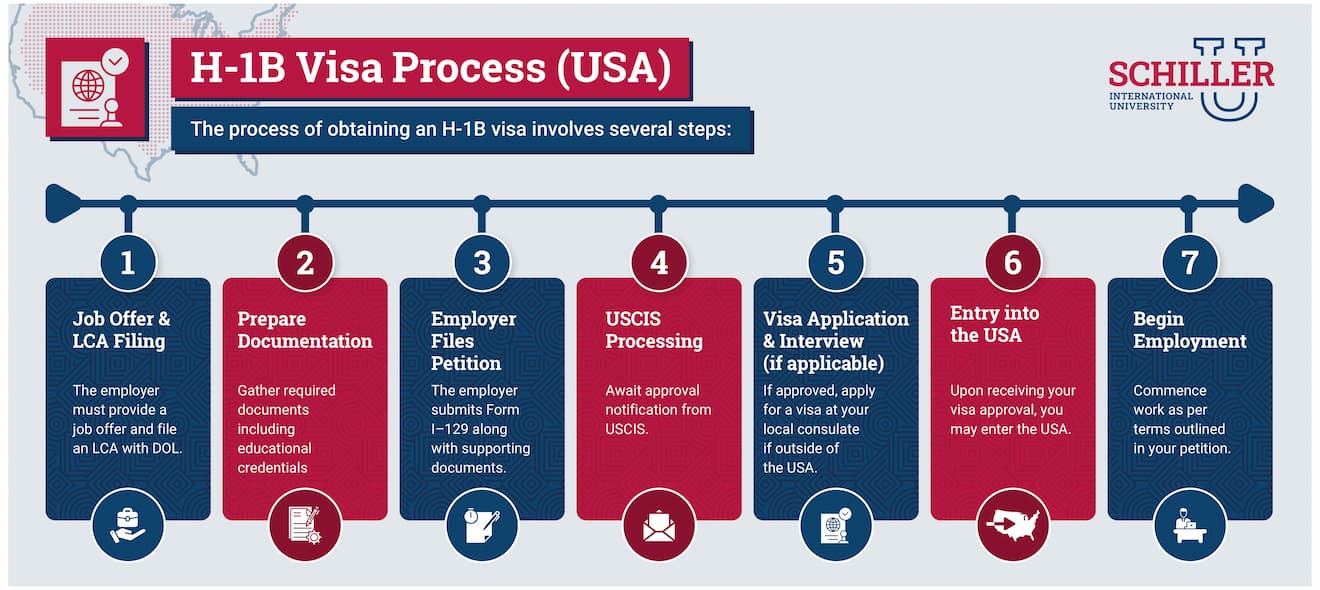
Applying for an H-1B visa is a multi-step process that requires meticulous planning and thorough documentation. For cap-subject cases, the electronic registration step comes first; only selected registrations may proceed to full petition filing.
Step 0: Complete USCIS Electronic Registration (cap-subject cases only)
- The prospective petitioner (employer or authorized representative) must create a USCIS organizational account and submit an H-1B electronic registration for each beneficiary. Individual/petitioner accounts cannot be used to register.
- Each registration requires a non-refundable fee (for the FY2026 season, the registration fee was $215). Fees and payment rules may change; check USCIS before filing.
- Registrants must provide valid passport or travel-document information for every beneficiary at the time of registration. The passport must be the one the beneficiary intends to use to enter the US if a visa is issued. If the passport changes after registration, petitioners should include both passports and an explanation when filing the petition.
- Avoid duplicate registrations. A single prospective petitioner may submit only one registration per beneficiary per fiscal year. USCIS provides duplicate-checking tools, but the registrant bears responsibility for avoiding duplicates. Duplicate or invalid payments can invalidate registrations, and the fee is not refunded.
- The registration window varies year to year. USCIS notifies selected registrants via their online account. Always confirm current-year dates on USCIS.
Step 1: Secure a Job Offer:
Find a sponsoring U.S. employer willing to file the H-1B petition on your behalf. For cap-subject roles, ensure they will register you during the registration window.
Step 2: Employer obtains prevailing wage and prepares LCA
Employer determines the correct wage (actual or prevailing wage, whichever is higher) and files the LCA (Form ETA-9035/9035E) with DOL via FLAG. LCAs cannot be filed more than six months before the employment start date.
Step 3: If selected, file Form I-129 (petition) within the filing window
Only employers with a valid 'Selected' registration may file a cap-subject Form I-129. USCIS opens filing for selected registrations. The selected registration notice will include a designated filing window (typically 90 days).
The petition must include the certified LCA and supporting evidence (degrees, transcripts, job description, employer documents, passport copy, etc.). If the beneficiary was selected under the master’s cap, they must hold the qualifying degree by the time of filing.
Step 4: Filing details and where to file
USCIS accepts online filing for many cap petitions; petitioners may still choose to paper-file Form I-129 per the filing notice instructions. Paper filings cannot be linked to online accounts. Follow the Direct Filing Addresses or the instructions in your selection notice.
Step 5: USCIS adjudication
USCIS reviews the petition. They may issue a Request for Evidence (RFE) asking for more documentation. If denied, the petitioner will receive a written decision. Petition processing times depend on the service center workload and the filing completeness.
Step 6: Lottery/selection
If registrations exceed the cap, USCIS uses the electronic registration to select beneficiaries. If you received a 'Selected' status, you may file; if 'Not selected,' your registration remains as submitted for possible subsequent selections, but you will not be able to file a cap petition unless selected.
Step 7: Approval or denial:
USCIS issues an approval notice (Form I-797) or a denial. Approval permits the employer to proceed with consular processing (if the beneficiary is outside the US) or to change the beneficiary’s status (if inside the US).
Step 8: Consular visa application (if required)
If the beneficiary is outside the US, they must apply for the H-1B visa at a US consulate. Required documents generally include the Form I-797, passport, visa application (DS-160), and supporting materials.
Step 9: Visa interview (If required):
Attend the visa interview if required by the consulate. Provide truthful, consistent documentation.
Step 10: Entry into the US:
After the visa is issued, the beneficiary may travel to the US and seek admission at the port of entry.
Step 11: Commencement of employment
The beneficiary may begin work on or after the start date indicated in the petition (often 1 October for cap cases), subject to visa and admission conditions.
H-1B Specialty Occupations: Defining the Eligible Roles
The H-1B visa applies to "specialty occupations," requiring theoretical and practical application of a body of specialized knowledge and the attainment of a bachelor’s or higher degree in a directly related specific specialty (or its equivalent) as a minimum entry requirement in the US.
|
Classification |
General Requirements (among others) |
Labor Condition Application Required? |
|
H-1B Specialty Occupations |
To qualify for an H-1B visa, the job must require:
The position must also meet one of the following four criteria:
The employee must meet one of the following:
|
Yes. The employer must include a certified Form ETA-9035/9035E Labor Condition Application (LCA) with Form I-129. For more information, see the Information for Employers and Employees page. |
Examples of specialty occupations:
|
Specialty Occupation Category |
Examples |
Required Education/Experience |
|
Engineering |
Software Engineer, Civil Engineer, etc. |
Bachelor’s degree in engineering |
|
Computer Science |
Software Developer, Data Scientist, etc. |
Bachelor’s degree in computer science |
|
Medicine |
Physician, Surgeon, etc. |
Medical degree, residency |
|
Accounting |
Certified Public Accountant (CPA), etc. |
Bachelor’s degree in accounting |
|
Architecture |
Architect, Urban Planner, etc. |
Bachelor’s degree in architecture |
|
Science |
Research Scientist, Biologist, etc. |
Bachelor's degree in a relevant scientific field |
H1B Visa Documents: A Comprehensive Checklist
The documents required for an H-1B petition depend on the employer, the beneficiary, and whether the case is cap-subject. Below is a practical checklist aligned with current USCIS and DOL requirements.
Employer and Petition Documents
|
Document Type |
Description |
|
Form I-129 |
Petition for a Nonimmigrant Worker (must match the information provided in the selected registration). |
|
Certified LCA (ETA-9035/9035E) |
Labor Condition Application certified by the Department of Labor; must be included with Form I-129. |
|
Job Offer Letter |
Formal job offer confirming job title, duties, wage and start date. |
|
Support Letter/Employer Statement |
Detailed support letter explaining the company, job duties, specialty-occupation justification, and beneficiary qualifications (standard in H-1B filings). |
|
Employer’s Business Information |
Company organizational documents, proof of business operations, tax ID, and supporting financial materials if needed. |
|
Documentation of Work Location(s) |
Required when the employee will work at third-party sites; must match LCA worksite details. |
|
Copy of Selected Registration Notice (cap-subject) |
Proof that USCIS selected the beneficiary in the H-1B lottery; required for filing. |
Employee (Beneficiary) Documents
|
Document Type |
Description |
|
Degree Certificates |
Bachelor’s degree or higher required for the specialty occupation. |
|
Transcripts |
Academic records showing course completion. |
|
Educational Evaluations (if foreign degree) |
Required when proving foreign degree equivalency to a US bachelor's degree. |
|
Resume / CV |
Detailed CV showing relevant experience and skills. |
|
Professional Licenses (if applicable) |
For occupations requiring state licensure (e.g., healthcare, engineering). |
|
Passport |
Valid passport with sufficient validity for visa issuance. |
|
Second Passport Documentation (if passport changed since registration) |
USCIS requires both the passport used for registration and the new passport, with an explanation. |
|
Passport Photos |
Passport-sized photographs meeting US Department of State specifications (for consular processing). |
Additional Required Documents
|
Document |
Description |
Responsibility |
|
Evidence of Experience (if using experience toward degree equivalency) |
Experience letters, project descriptions, employment verification. |
Employee |
|
Previous Immigration Documents |
Copies of prior I-20s, DS-2019s, I-797s, visas, I-94 records (to demonstrate proper status). |
Employee |
|
Master’s Cap Proof (if applicable) |
Degree/official transcripts proving the beneficiary earned a US advanced degree before filing the petition. |
Employee |
|
Translation Certificates |
Required for all foreign-language documents. |
Employee |
H1B Visa Fees: Understanding the Costs Involved
The fees associated with filing an H-1B petition can vary based on several factors including employer size and whether premium processing is requested.
|
Fee Type |
Amount (USD) |
Responsible |
|
Registration Fee |
$215 (per beneficiary) |
Employer |
|
Premium Processing (optional) |
$2,805 |
Employer or Employee |
|
Public Law 114-113 Fee |
$4,500 (if 50+ employees) |
Employer |
|
Basic Filing Fee |
$780 $460 for small employers and nonprofits) |
Employer |
|
Fraud Prevention and Detection Fee |
$500 |
Employer |
|
ACWIA Education and Training Fee |
$750 (less than 25 employees) $1,500 (more than 25 employees) |
Employer |
|
Attorney Fee |
Variable |
Employer |
(Note: Fee amounts are subject to change. Always check the official USCIS website for the most up-to-date information.)
Fee breakdown:
- Registration fee: $215 for 2025 season.
- Standard Fee: The standard H-1B filing fee is $780 for the I-129 petition and $460 for small employers and nonprofits.
- American Competitiveness and Workforce Improvement Act (ACWIA) Training Fee: For employers who have 1-25 full-time workers, the fee is $750. For employers with 26 or more full-time employees, the fee is $1,500. Some organizations are exempt, including non-profits with affiliations to educational institutions and governmental research organizations.
- Fraud Prevention and Detection Fee: This $500 fee applies to new H-1B petitioners or those changing employers. USCIS requires the sponsoring employer to pay this fee.
- Public Law 114-113 Fee: This H-1B fee applies to companies with upwards of 50 employees, with over half on H-1B or L-1 status. The additional fee for these companies is $4,000. However, USCIS may exempt this fee.
- Premium Processing: This service is available to those who want to expedite the H-1B visa process in a 15 business days for $2,805. To use this feature, you must complete Form I-907. Another optional expense is if family members apply to be H-4 dependents of the applicant by filling out Form DS-160.
- Attorney Fees (vary): H-1B attorney fees differ depending on the firm. Since the stages are now tiered, only certain companies will eventually file the complete petitions.
- Asylum Program Fee: This is a new fee that will be assessed on all Form I-129 and I-140 petitions to help cover the costs of asylum adjudications. This fee should also help free up SCOPS and FOD resources that have been diverted from EB adjudications to asylum adjudications.
- $600 for employers with 26 or more Full-Time Employees (FTEs)
- $300 for small employers (25 FTEs or less)
- $0 for nonprofit organizations
H1B Visa Processing Time: What to Expect
The processing time for an H-1B petition varies based on USCIS service center workload, completeness of the filing, and whether premium processing is used. H-1B cap-subject cases may also be affected by the volume of petitions filed during the designated filing window. Factors affecting processing time:
- Time of year: Processing is slower during peak H-1B filing periods (typically April–June).
- USCIS workload: High volumes of applications can lead to processing delays.
- Completeness of petition: Missing evidence or inconsistencies may trigger delays.
- Request for Evidence (RFE): USCIS may ask for more documentation before issuing a decision.
Typical Processing Times Table:
|
Processing Method |
Estimated Timeframe |
|
Regular Processing |
Varies by service center; generally, several months. |
|
Premium Processing |
15 business days |
H-1B Visa to Green Card Pathway
The H-1B visa often serves as a stepping stone toward obtaining a Green Card (permanent residency). This process typically involves additional steps and considerable time. Consult with an immigration lawyer to understand the specifics of your situation.
Green Card Pathways:
Common pathways include employer sponsorship through employment-based categories:
|
Pathway Type |
Description |
|
EB–2 |
For professionals holding advanced degrees |
|
EB–3 |
For skilled workers with at least two years’ experience |
H1B Visa Exceptions and Special Considerations
Certain exceptions and special considerations may apply to the H-1B visa process, depending on your specific circumstances or special rules:
- Cap-exempt employers: Universities, non-profit research organizations, and some government research entities are exempt from the annual H-1B cap.
- Third-party worksites: Employer must ensure the LCA worksite matches the actual placement location.
- Successive filings: Rules on duplicate petitions or petitions filed by related entities (8 CFR 214.2(h)(2)(i)(G)) continue to apply.
Always consult the most up-to-date USCIS guidelines.
Amending an H-1B Visa
An amendment is required if there are material changes to the terms of employment, including:
- Job location change not covered by the existing LCA.
- Significant change in job duties.
- Promotion altering required skills or wage level.
Amendment Process Steps:
Steps involved in amending an existing petition:
|
Step |
Action Required |
|
Notify USCIS |
File amended Form I–129 |
|
Update Documentation |
Include a new certified LCA and updated job description if applicable. |
Recapturing Time
H-1B beneficiaries may recapture time spent outside the US to extend the allowable period of H-1B stay beyond the standard six-year limit.
Recapture Guidelines:
Conditions under which time may be recaptured:
|
Condition |
Description |
|
Time Outside US |
Days and periods spent abroad do not count toward the six-year maximum and may be added back with documentation (flight records, passport stamps, I-94s). |
Tips for H-1B Visa Applicants
Actionable tips for prospective applicants:
|
Tip |
Description |
|
Start Early |
Begin preparing your application well before deadlines. |
|
Thorough Preparation |
Meticulous planning and preparation are crucial for a smooth H-1B visa application process. |
|
Accurate Documentation |
Ensure all documents, degrees, passports, and LCA are accurate, complete, and match petition details. |
|
Professional Legal Advice |
Consider consulting with an experienced immigration attorney for assistance. |
Common H-1B Myths Debunked
Addressing common misconceptions can alleviate anxiety and help you navigate the process effectively. Seek out reliable sources of information and avoid misinformation. There are many misconceptions surrounding the H-1B visa process. One of the most common myths:
|
Myth |
Fact |
|
Only tech companies hire through H–1Bs |
Many fields, including healthcare, education, finance, biotech, engineering, and architecture, use the program. |
Summary
The H-1B visa offers a valuable pathway for international graduates and skilled professionals seeking long-term career opportunities in the US. Although the process is detailed and often time-sensitive, understanding each stage, from registration and petition filing to potential green-card progression, helps applicants prepare confidently.
Students who study at Schiller's Florida campus gain firsthand exposure to the US job market and employer networks well before they ever file a petition, giving them a practical head start on this pathway.
This guide supports you in navigating the H-1B process under current USCIS and Department of State guidance.
Glossary of H-1B Visa Terms
Understanding terminology associated with immigration processes facilitates smoother navigation through applications:
Glossary Table:
|
Term |
Definition |
|
Form I–797 |
Notice Action issued by USCIS confirming receipt/approval |
|
Labor Condition Application |
DOL certification confirming wage and working-condition compliance for H-1B roles. |
|
Prevailing Wage |
Wage expected for a specific occupation in a specific geographic area. |
|
Adjustment Status |
Process allowing individuals currently residing within US borders change their immigration status. |
Planning to work in the US after graduation? Start by studying at Schiller's Tampa campus and applying through OPT.
FAQs:
Q1: What is an H-1B visa?
Answer: The H-1B visa allows US employers to temporarily employ foreign workers in specialty occupations, which require highly specialized knowledge and at least a bachelor’s degree in a directly related field (or its equivalent). It is one of the primary work pathways for international graduates in the US.
Q2: How long does it take to get an H-1B?
Answer: Processing times vary based on USCIS workload and whether premium processing is used.
- Regular processing: Several months, depending on the service center.
- Premium processing: USCIS adjudicates in 15 business days.
If USCIS issues a Request for Evidence (RFE), a new 15-business-day premium-processing window begins once the response is submitted.
Q3: Can I apply for permanent residency while on an H-1B?
Answer: Yes! Many individuals transition from H-1B status into permanent residency adjustment processes facilitated by their employers.
Q4: Is there any cap on how many H-1B visas can be issued?
Answer: Yes. Each fiscal year, USCIS allocates:
- 65,000 visas under the regular cap.
- 20,000 additional visas for individuals who hold a US master’s degree or higher (advanced degree cap).
Some employers, such as universities and certain non-profit research organizations, are cap-exempt and may file H-1B petitions at any time.
Q5: What happens if my H-1B petition gets denied?
Answer: If USCIS denies a petition, employers and beneficiaries may have several options depending on the reason:
- Refilling (if eligible).
- Submitting a motion to reopen or reconsider.
- Appealing to the Administrative Appeals Office (AAO).
- Exploring alternative visa classifications.
Your employer or attorney can help determine the best next step based on the denial notice.
Discover Our Campuses